Asia “consolidating as the leading destination region” for international students




- New research shows that international students are increasingly searching for Asian destinations
- A combination of highly regarded universities, branch campuses, English-taught programme expansion, and relatively affordable tuition fees are contributing to the trend
- While Asia is without doubt a regional hub for study abroad, the same cannot be said for Latin America, which has lost many branch campuses and which offers only a small selection of English-taught programmes
- The Middle East is becoming more competitive, but demand is mostly concentrated in Türkiye, UAE, and Saudi Arabia
A new report from the British Council and Studyportals shows that international students are increasingly choosing to study in Asian destinations. Students are drawn by the greater affordability, expanding number of English-taught programmes (ETPs), and strong graduate outcomes associated with studying in this region.
The study findings show demand as measured by pageviews on Studyportals websites through July 2023–July 25 and represent the searches of 51 million prospective students. This methodology captures prospective students' interest about 6–24 months before enrolment and so provides insights about demand that can materialise into enrolments 1–2 years in the future.
The research report also measured demand for the Middle East and Latin America, which we will summarise as well.
Interest growing for most Asian destinations
The research found that Asia’s many English-taught programmes (more than 20,000) and highly ranked universities are contributing to students gravitating to this region. Asia now has more universities in the 2026 QS World Universities Rankings than any other region, with 565 universities making their way onto the list.
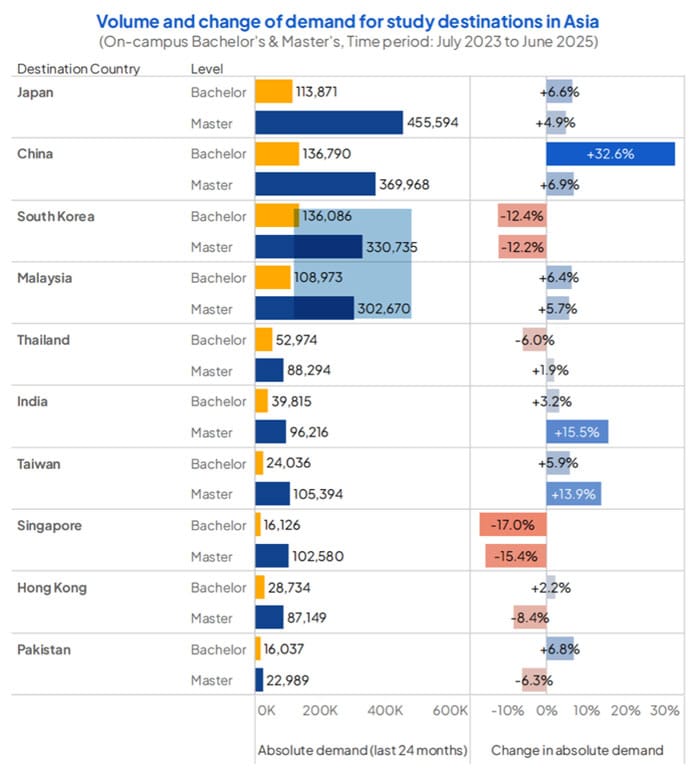
Of Asian destinations, Japan and China command the most interest from international students (based on searches over the 24 months leading up to June 2025). South Korea and Malaysia are also competitive, but from July 2024 to June 2025, interest in South Korea declined. This may be linked to the fact that 70% of South Korean universities raised their tuition fees this year.
Japan leads in demand for master’s-level programmes, followed by China, then Taiwan and Singapore (though Singapore lost ground in the 12 months leading to June 2025). Greater numbers of students are also travelling to India for master’s degrees.
China is the most popular for bachelor’s degrees (and becoming ever more so, as shown in the following chart). Malaysia is gaining share of interest at this level, in contrast to South Korea and Thailand.
Smaller Asian destinations are also picking up steam, especially at the bachelor’s level. Demand rose 101% for Vietnam and 38% for Indonesia between July 2024 and June 2025.
Of the 10 countries displaying the most interest in Asian bachelor’s programmes, seven are in Asia, with the US, UAE, and Nigeria rounding out the list. For the master’s level, six of the top 10 origin countries are in Asia, while the remaining four are the United States, Nigeria, the UK, and Türkiye.
Branch campuses in Asia add to the region’s attractiveness
There are more Western universities than ever setting up branch campuses in Asia, a key consideration for students who want degrees from Western universities but who also appreciate the greater affordability of destinations outside of the Big Four. Of the world’s more than 300 branch campuses, Asia hosts about 60% of them. In China, there are about 50 branch campuses, more than in any other country.
India expanding English-taught programmes to gain an edge
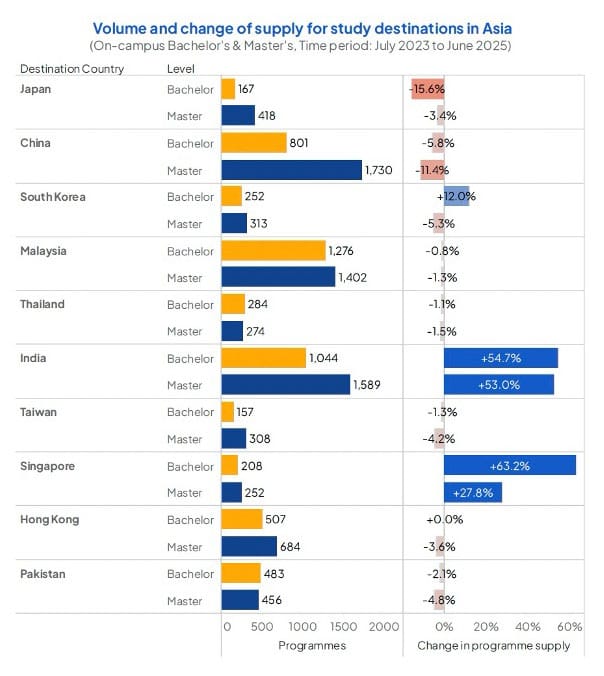
India now offers almost as many English-taught programmes (ETPs) as China and Malaysia. In addition, it is rapidly expanding provision of these programmes (+55% for bachelor’s and +54% for master’s in 2025 versus 2023) while China and Malaysia are either reducing or maintaining their supply.
Interestingly, among the top origin countries for students searching for bachelor’s programmes in Asian destinations – Bangladesh, India, and Pakistan – only India shows a reduction in demand between 2023 and 2025, which suggests that Indian students may be taking advantage of greater supply of ETPs in their own country.
Asia’s rise coincides with slightly less interest in the Big Four
When looking at the volume of Asian students searching for bachelor’s programmes in the Big Four, demand for Australia, Canada, and the US has fallen by -0.5%, -1.9%, and -1.2%, respectively, since July 2023. The UK is the outlier, but barely, with a +0.3% increase in pageviews. At the master’s level, Australia had -1.2% fewer pageviews, Canada declined by a more notable -4.8%, and the US lost -1.3% of interest. Again, the UK remained fairly stable with a 0.7% rise in demand from Asia.
Latin America is currently not a major education hub
While many Asian destinations are now attracting or on their way to attracting as many international students as they send out, this trend is not happening in Latin America. Brazil is the only country in the regional sample to have contributed an increase in pageviews since 2023 (+34.4%).
Brazil is also the outlier in terms of Latin American students searching for study abroad programmes. For bachelor’s programmes, demand from Brazil grew by 20.6% since 2023, and for master’s programmes, it rose by 12.8%. Otherwise in the region, Mexican student searches for both bachelor’s and master’s programmes abroad remained stable, while Colombian, Peruvian, and Ecuadorian students were less likely to be searching for programmes offered in other countries.
In general, Latin America’s draw for international students is weakening due to its having lost more than half its foreign campuses and its small supply of English-taught programmes.
Top Middle Eastern destinations are Türkiye, UAE, and Saudi Arabia
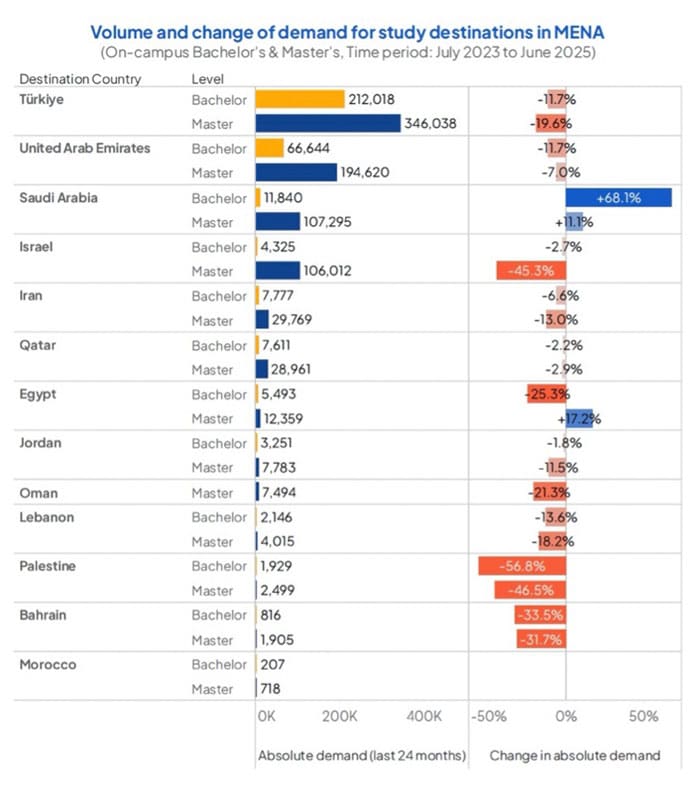
Türkiye and UAE dominate share of interest in the Middle East at both the bachelor’s and master’s levels, but Saudi Arabia is rapidly closing the gap, as shown in the chart below.
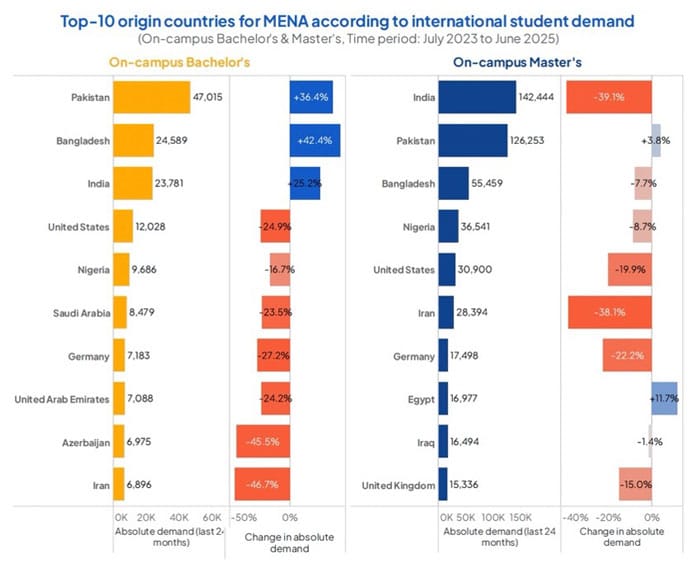
The Middle East is the most interesting of the three regions studied in terms of an important measure of internationalisation: diversity of source countries. As the following chart shows, students from around the world are searching for Middle Eastern countries, though demand has fallen for the most part since 2023. Pageviews only increased from Pakistan, Bangladesh, and India – and only at the bachelor’s level.
Asia and the Middle East are now competing strongly for the world’s international students
The conclusion of the Studyportals/British Council report observes:
“Beyond traditional study destinations like Australia, Canada, the UK, the US, as well as increasingly popular destination located in Europe, those in Asia, Latin America, and the MENA region are not simply peripheral to the global education system, but they are actively shaping it. The dominance of Anglophone destinations remains, but it is no longer uncontested as these regional hubs are developing in ways that reflect their distinct economies, higher education structures, and international ambitions.
The Middle East is also becoming a hub for branch campus activity, and more universities in the region are earning spots on major global university ranking systems.”
“The global centre of gravity in higher education is clearly shifting,” said Edwin van Rest, CEO and co-founder at Studyportals."Asian and MENA universities used to send students abroad. Now they're keeping them home and attracting students from other regions. Universities need to understand this shift if they want to stay competitive.”
For additional background, please see:
- "The four key trends that will shape international student mobility for the next decade"
- "ICEF Podcast: Redrawing the map of global student flows from the ‘Big Four’ to the ‘Big Fourteen’"
- "Asian destinations show their strength in latest ranking of student cities"
- "Search data highlights surge in student interest in Asian and Middle Eastern destinations at mid-year"
Most Recent
-
One cohort of international graduates will contribute US$1.7 trillion to host country economies throughout their careers Read More

-
UK: Study visa application withdrawals surge amidst new BCA compliance requirements Read More
-
What is happening with international student numbers in Canada so far this year? Read More