UK’s ELT sector reports declining enrolments through first quarter of 2026




- Student weeks and student numbers were down in 2025, and they are trending down in the first months of 2026
- Türkiye and Argentina posted important growth, but demand is down from Asia
- Peak body English UK is calling on government to “move further and faster to create a more supportive operating environment”
The UK’s English-language teaching sector (ELT) experienced a challenging year in 2025, though the decline in students and student weeks was more moderate than was the fall-off for Canada’s and Australia’s ELT sectors.
New data from English UK, the peak body for 85% of all accredited English-language teaching (ELT) centres in the country, shows that state and private member centres hosted 311,815 full-time students face-to-face last year and delivered 998,045 student weeks.
Most ELT students (98%) study with private institutions, and of English UK’s 287 members, 264 are in the private sector. We will focus on that sector in this article.
Private sector trends
Private providers hosted -4.1% fewer students in 2025 than in 2024. Student weeks were down by -10%, and the average stay was 3.1 weeks, down from 3.3 in 2024. The following graphic shows the broad trendline for numbers and weeks from 2021–25.
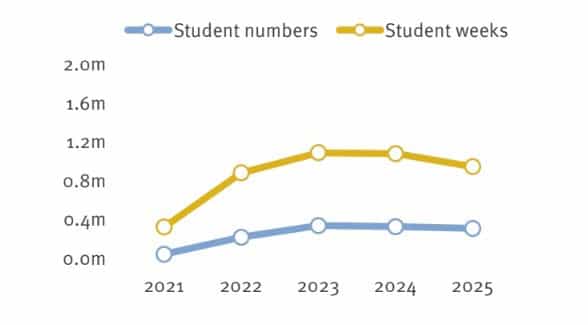
Of all ELT students studying with private providers, 64% were juniors. Though a smaller segment numerically, adult learners tend to spend more time on their courses in the UK and represent two-thirds (65%) of all student weeks.
Türkiye and Argentina were the outliers among top 20 source countries for private providers in 2025: they were the only growth markets. Türkiye (#3) contributed +21% more student weeks than in 2024 and +33% more students, while Argentina (#14) was up +24.5% in student weeks and +28.9% in student numbers.
The private sector’s two top markets, Italy and Saudi Arabia, dropped by -7.6% and -6.4%, respectively, in terms of student weeks.
China accounted for one of the largest declines in weeks (-33.4%), and between 2024 and 2025, it moved from fifth to eighth place among the top 10 markets for the private sector. Asia as a source region is weakening significantly (-26.2%), with weeks from Japan and South Korea down by -16.4% and -10.2%, respectively.
The following table provides a detailed picture of private sector trends in 2025 compared with 2024.

Commenting on the 2025 trends, English UK chief executive Jodie Gray said that in a challenging global context, the UK’s ELT sector is proving resilient and working quickly to adapt to change.
“The story in this year’s statistics will surprise few in UK ELT. Yet in a challenging global environment, the UK continues to perform comparatively well. The strong foundations and adaptability sustaining us now will underpin our future.
We have been preparing for an uncertain world shaped by geopolitics, technological change and intensifying international competition. This week, we launch two documents setting out how we will act and advocate for the future of UK ELT.
Our updated position paper calls on government to move further and faster to create a more supportive operating environment. Initiatives including the Youth Experience Scheme, ID-card group travel, the return of Erasmus+, and our role in supporting delivery of the UK Government’s International Education Strategy offer renewed opportunity.”
Roz McGill, English UK’s market development & insights manager, added:
“Overall, the data suggests a market under pressure but still active, with patterns of demand shifting rather than disappearing. It also highlights the importance for ELT centres of remaining adaptable in their pricing, product mix, and market focus."
“A challenging environment”
About 40% of English UK’s membership (116 private and state centres) submitted data for English UK’s Quarterly Intelligence Cohort (QUIC) Q1 2026 report. Compared with Q1 2025, there was a -7% decrease in student weeks.
The decline was driven by weaker adult demand: adult student weeks fell by -10%, while juniors went up by +7%. However, Q1 is generally adult-dominated, with adults responsible for 85% of all student weeks, so the increase from younger students couldn’t significantly mitigate the decline in adult weeks.
English UK says:
“These findings highlight a sector operating in a challenging environment and underscore the need for members to remain responsive to both short-term fluctuations and longer-term structural characteristics.”
For additional background, please see:
- “US ELT weeks fell by nearly -8% in 2025”
- “Malta: Non-EU students keeping ELT weeks stable in the face of falling enrolment from Europe"
- “Canada’s language training sector reinvents pathway programme model in response to policy settings”
- “Australia: Latest enrolment data challenges the government’s assertion of stability for international education this year”
Most Recent
-
Why sharper English-language guidance is becoming an agent’s sharpest tool for student success Read More

-
Breaking: US Department of Homeland Security publishes rule to end Duration of Status for international students Read More
-
Joint sector alert sends a clear compliance message to Australian higher education and VET providers Read More