Australia: Full-year data for 2025 reveals impact of AUD$2,000 study visa application fee on ELICOS sector




- Since July 2025, international students have had to pay a non-refundable AUD$2,000 fee to apply for a study visa for Australia
- This is the world’s most expensive study visa fee, and it is inflicting serious damage on education sectors offering shorter courses
- Visa refusal rates are also affecting demand for study in Australia, especially for English-language programmes
Australia’s Department of Home Affairs (DHA) has released full-year data on student visa applications and grants in 2025. Among other insights, the data reveals the severe impact of the current study visa application fee (AUD$2,000) on the ELICOS sector (English Language Intensive Courses for Overseas Students).
English Australia, the peak body for the ELICOS sector, has published a Market Analysis Report exploring the data. The report does not include information on enrolments and commencements because full-year numbers have not yet been released by the government, but it does give a detailed picture of demand for study in Australia under the country’s updated immigration settings and fee structures.
ELICOS visa applications down nearly 40%
On average (across all education sectors), study visa application numbers were down -14% in 2025 compared with 2024, and this is on the heels of a -21% decrease the previous year.
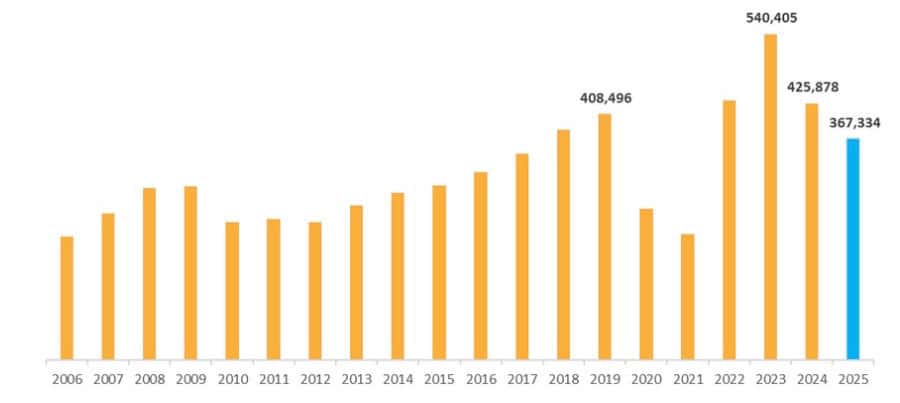
However, unlike for other sectors, demand for university studies in Australia remains strong: the number of visa applications filed in 2025 was greater than in 2019 despite a -2% drop compared with 2024.
It is demand for other kinds of study – especially short courses – that is plummeting. Between 2024 and 2025, visa applications fell:
- -35% for VET
- -14% for K-12 schools
- -39% for ELICOS programmes
The effect of visa application increases
The Australian government has rapidly increased study visa application fees over the past two years. In 2023, the fee was AUD$710. This increased +125% to $1,600 in 2024, then to $2,000 in July 2025.
ELICOS providers deliver courses that are far shorter, and less expensive, than university degree programmes. English Australia explains the disproportionate impact of the fee hikes on demand for English-language-only programmes:
“In 2025, the Labor government confirmed it would raise the world’s most expensive student visa application charge [then $1,600] another 25% to AUD$2,000. By this stage ELICOS applicants were experiencing the highest rate of student visa application refusal on record and were being asked to pay an average of 30% to 40% of the cost of their study to apply for a student visa that saw 1 in 4 applicants refused. The application numbers fell immediately again … These step-down shifts at the point of introduction of these visa fee hikes make it very clear that the AUD$2,000 non-refundable charge has made Australia far less attractive for short term students.”
The lowest volume of visa grants in 20 years
Overall, the number of visas that Australian immigration officials granted to international student applicants fell -2% between 2024 and 2025. Again, the decrease was not felt equally across education sectors:
- The higher education sector experienced a marginal -1% decline in visa approvals compared with 2024, and visa grants were actually up +14% when compared to 2019 levels.
- The VET sector saw a small increase in visa grants in 2025 compared with 2024, but this was still -45% lower than in 2019.
- K-12 schools saw -17% fewer visas granted in 2025 than in 2024. Since 2019, the decline has been -28%.
For the ELICOS sector, the severity of the decline in visa grants is illustrated in the fact that in the last six months of 2025, fewer visas were granted for study at an ELICOS provider than at any other time over the past 20 years.

The damage to the ELICOS sector since 2024 can be seen across several measures, including job losses. The visa application fee is estimated to have resulted in 5,000 to 9,000 full-time job losses over two years in ELICOS institutions.
Of all the statistics, job losses should give readers serious pause. They represent the impact to staff, institutions, and schools that have contributed greatly to the development of the ELICOS sector over many years, and, by extension, to Australia's economy.
The stakes are very high going forward. Speaking to ICEF Monitor late last year, David Scott, the managing director at the Sydney-based English Language Company (ELC) said:
"If the student fee is not reduced significantly and very soon, the English language teaching sector, especially private independent colleges, is likely to disappear in the next 12–24 months. The introduction of the ‘extortionate, world’s worst, non-refundable visa charge of AUD$2000’, combined with the unprecedented increase in student visa rejections, has basically dealt a mortal blow to the English language sector in Australia. The once thriving sector is disappearing quickly as students turn their backs on Australia. Why would anyone pay AUD$2000 to study a short English course in a country that is likely to reject your visa and keep the fee? It makes no sense."
No urgency for government
English Australia notes: “The report reveals what the ELICOS sector well knows – that 2025 saw ELICOS student numbers plummet further to new record lows even after very low numbers in 2024.”
“While there were initially signs that the government was considering lowering the student visa application charge for ELICOS and other non-award enrolments, discussions appear to have stalled, and Canberra has shown no urgency on the matter.”
For additional background, please see:
“Australia: With ELICOS under pressure, peak bodies push for reduction in 'extortionate' visa fees"