


Australia: As visa applications from foreign students fall, the government has set the national target for new international students in 2027




- Australia’s university and vocational education (VET) sectors will receive the same allocation in 2027 for new international students as in 2026 – 295,000
- The government is satisfied that its National Planning Level (NPL) system is achieving its aim of slowing the growth of international student numbers in Australia
- Visa applications and commencements are down – or trending downwards – across the industry
- The VET sector hosted -49% fewer international students in 2025 than in 2024
- Chinese applications to Australian universities are falling significantly, and visa rejection rates are high for other top markets
The Australian government has announced overall settings for “managing the growth” of the country’s international education sector for the coming academic year.
It has set the National Planning Level (NPL), its system for controlling the flow of foreign students into universities and vocational (VET) education providers, at 295,000 new student spaces distributed across those institutions. This is the same number as last year, and the government considers this a continuation of a managed growth approach that “has been effective in returning student numbers to a more sustainable level in 2025, and so far in 2026.”
For background, the NPL system dictates that visa applications are processed normally for an institution that fills up to 80% of their allotted new student spaces. Beyond that 80% threshold, visa processing slows for that institution relative to others that stay within the threshold. The system aims to curtail over-aggressive international recruitment.
The NPL, however, is not the only way in which the government is constraining growth. On top of visa processing controls, a range of other recent policies make it more difficult for international students to choose Australia as a study destination. These include:
- Visa application fees that have risen repeatedly over the past couple of years and which now stand at AU$2,500 for a study visa and AU$5,750 for a post-study work visa. These are the highest in the world, and they are non-refundable for students who end up being rejected.
- High visa rejection rates, especially for Indians, Bangladeshis, and Nepalis.
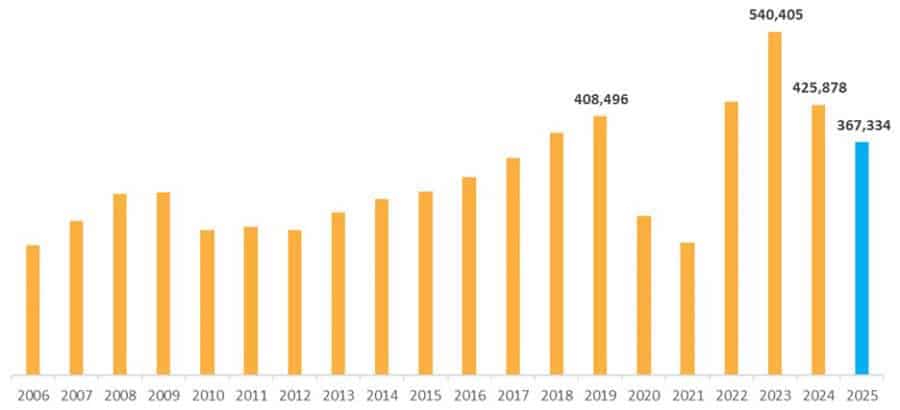
The government’s satisfaction with how the National Planning Level is working obscures the fact that higher fees and rejection rates are causing international student demand to fall well below what might be considered “sustainable.” Some Australia institutions are not able to reach their allocation levels due to declining volumes of applications and enrolments.
The following chart shows trends in commencements (new student arrivals) over time, and it illustrates the sharp decreases from 2023–2025.
What is the real target?
A joint press release from minister of education Jason Clare, assistant minister for international education Julian Hill, and skills minister Andrew Giles acknowledges:
“Current tracking indicates international student commencements are on track to be below the NPL for both 2026 and 2027. Commencements in 2026 are down 8 per cent compared to the same period in 2025, and 13 per cent lower than 2019.”
So, the NPL may be set at 295,000 in 2026 and 2027 – but the fact that commencements are coming in well below that threshold appears not to be an issue for the government. This seems quite likely given the follow-up statement in the press release:
“The decision to freeze the NPL at current levels accompanies adjustments to student visa fees.”
Mr Clare, Mr Hill, and Mr Giles all issued comments about the 2027 arrangements:
- Mr Clare: “International education is an incredibly important export industry for Australia, but we need to manage it sustainably. This is about making sure international education supports students, universities and the national interest.”
- Mr Hill: “The Albanese Government inherited a mess from the Liberals in 2022, with unsustainably high growth in student numbers in the least reputable parts of the sector and student visas being misused by crooks and shonks. The Government will not back off from managing the size and the shape of the onshore international student market and ongoing moderation in student numbers towards a more sustainable sector. Australia continues to welcome genuine international students seeking a premium Australian education which is great for our unis, domestic students and research.”
- Mr Giles: “International VET strengthens outcomes for students and supports our workforce, while deepening valuable global partnerships. Today’s announcement provides certainty for the international VET sector, enabling it to continue delivering sustainable growth and high-quality skills outcomes.”
Universities Australia Chief Executive Officer Luke Sheehy issued his own statement on behalf of the sector:
“Sustainability and integrity matter, and universities support both. Keeping new overseas commencements steady gives the sector something to plan around, but it is a long way from the sustainable, managed growth the government promised two years ago.
"Today’s announcement confirms there will be no growth next year. We recognise this may be appropriate in the current context, but the bigger problem is that the policy settings behind the number are making even this steady target harder to reach.
"If the government keeps making Australia more expensive and more difficult for genuine students to choose, we’re going to fall short – and we’re already seeing that risk emerge.
"That’s bad for our sector and Australia. It means fewer skilled workers, weaker productivity and a $55 billion export sector supporting 250,000 jobs put at risk.
"Many universities, particularly in regional and outer suburban Australia, are ready, willing and able to welcome more international students.
"International education is one of Australia’s great success stories, but it’s being steadily eroded by policies that do not serve our universities, our economy or our skills needs.
"A big number on paper means little if the policies behind it make it harder to deliver in practice.
That’s the contradiction at the heart of the current approach. The government says it wants almost 300,000 new international students, while keeping in place policies that make that harder to achieve.
"Unless the broader settings change, the 2027 allocation risks being just another number – not a plan that delivers the skills, jobs and growth Australia needs.”
More details about the NPL arrangements for 2027
None of the education providers subject to the NPL will receive fewer applications in 2027 than in 2026
The following are exempted from the NPL’s allocations:
- Schools
- Students studying standalone ELICOS courses
- Higher degree by research students
- Non-award students, including short term exchange students
- Students studying at TAFE and students enrolled in VET courses at Dual Sector public universities
- Students awarded certain scholarships including from foreign governments, multilateral organisations and Australian governments
- Students that are part of certain Australian Transnational Education (TNE) arrangements in higher education or VET approved by the Department of Education or the Department of Employment and Workplace Relations
- Students from the Pacific and Timor-Leste
- Students in pilot training courses
- International students transitioning from secondary school studies in Australia to tertiary study (higher education or VET)
- Students transitioning from embedded pathway providers or TAFE institutes to affiliated publicly funded universities
- Students transferring providers as a direct result of a provider closing or otherwise being unable to continue training.
For additional background, please see:
- “Australia: Multiple data indicators signal further declines ahead for international student numbers”
- “Surprise hike in international student visa application fees ‘a direct hit to Australia’s competitiveness’”
- “Australia: Latest enrolment data challenges the government’s assertion of stability for international education this year”
Most Recent
-
Decline in Indian demand a major factor in softer outlook for foreign enrolment in US higher education in 2026/27 Read More

-
Australia: As visa applications from foreign students fall, the government has set the national target for new international students in 2027 Read More
-
Independent K-12 schools in the UK hosting fewer international students this year Read More







