


UK: Visa application withdrawals surpass refusals in Q1 2026




- Visa application withdrawals have been climbing steadily over the last two years in the UK and, for the first time in 20 years, the number of withdrawals exceeded the number of refusals in the first quarter of this year
- The withdrawals are being triggered by students and institutions alike, and are fairly concentrated by student nationality with applicants from Pakistan alone accounting for more than 40% of Q1 withdrawals
UK higher education is bracing up to some challenging trends through the first half of the year. Visa applications volumes are down significantly, and approval rates are trending below the norm as well. To take just one indicator, visa grant rates were down -32% in Q1 2026 and those intertwining patterns of fewer applicants, more rejections, and, ultimately, fewer visa issuances are continuing into the second quarter of the year as well.
We reported last month on another important factor affecting UK student visa issuance: withdrawals. Indeed, there have been growing indications in recent months that the number of withdrawn visa applications has been rising quickly.
There appear to be a couple of factors at work. On the one hand, students may choose to withdraw in the face of lengthy processing delays or out of concern that they would have a visa refusal on their record. On the other hand, institutions may withdraw a student's Confirmation of Acceptance for Studies (CAS) if they feel the visa application could be rejected.
This is all happening of course in the context of the heightened compliance requirements under the UK's Basic Compliance Assessment (BCA) framework and its accompanying Red-Amber-Green (RAG) banding system. As of 1 June 2026, the RAG system obliges UK institutions to maintain a visa refusal rate of less than 5%. Universities whose refusal rates reach above that benchmark can be subject to sanctions or even to the suspension of their license to sponsor international students.
The stakes, to say the least, are high. And that underscores the growing role that withdrawn visa applications appear to be playing this year. Home Office data on the clearance outcomes for student visa applicants highlights that, for first time in decades, there were more student visa applications withdrawn in Q1 2026 than there were applications refused.
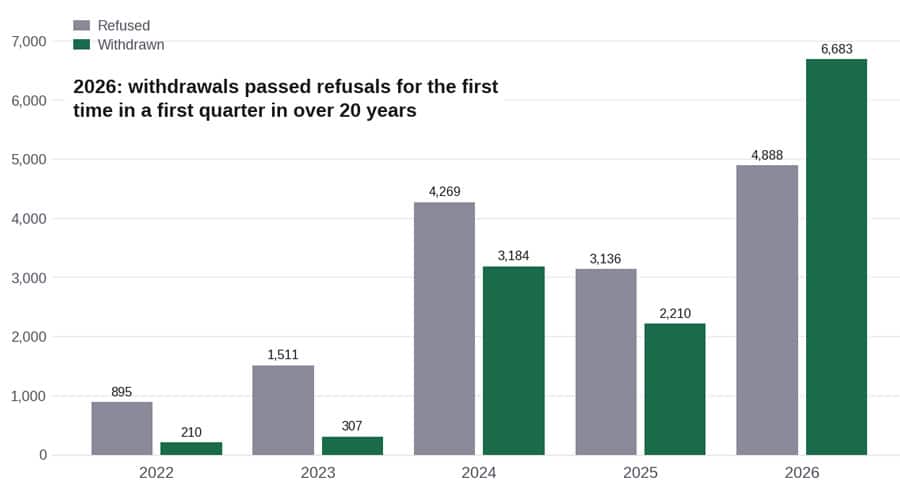
Writing in The Admit newsletter, Spencer Withrington explains:
"Why withdraw rather than be refused? Delays and incentives, on both sides. Processing ran badly behind on the January intake, hitting applicants from South Asia and parts of Africa hardest, with some students still waiting weeks after submitting their biometrics. A student facing a likely refusal, or a start date they will now miss, is often better off withdrawing than carrying a refusal on their record. Universities have the same incentive, and frequently withdraw the [CAS] themselves, because a withdrawn application does not count against their compliance rating and a refused one does."
This has not been widely understood among students or stakeholders, but a university may withdraw a CAS at their discretion, if, for example, the student has missed important deadlines or has not paid required tuition deposits or filed any outstanding documents. An institution might also move to withdraw a CAS if they discover inconsistencies in the student's documents or if concerns otherwise arise in internal credibility checks conducted by the university.
The CAS is withdrawn when the issuing institution cancels it with UKVI (UK Visas and Immigration). Once it has been cancelled, the CAS can no longer be used to support a student's visa application. The university must notify UKVI in such cases; the student may or may not be notified.
A related analysis from ApplyBoard points out that the surge in visa application withdrawals in Q1 was especially concentrated among students from South Asia, and from Pakistan in particular: "Prospective students from Pakistan shouldered 43% of all withdrawals. Additionally, only eight student populations withdrew over 50 applications," including those indicated in the following chart.
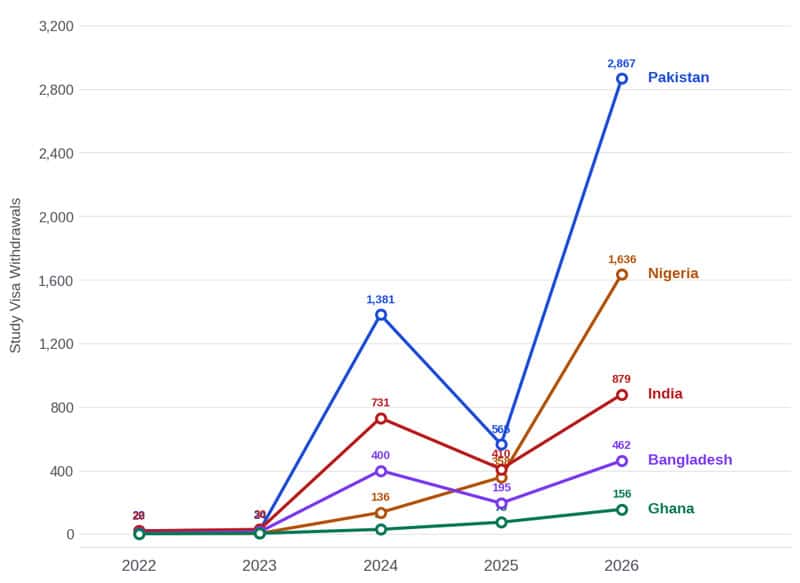
"Pakistani students were also among the most affected by the UK government’s processing delays for the January 2026 intake," adds ApplyBoard. "These delays were largely driven by attempts to clear an application backlog and run additional checks on students from populations considered more likely to stay in the UK beyond their allotted time or claim asylum. While the government encouraged UK institutions to extend their last day of acceptance for students still waiting on a visa decision, some institutions reported that as many as 50% of their students’ visa decisions were outstanding as admission deadlines neared."
In a situation like that, where every visa refusal counts and where a few too many can tip an institution into an amber or red RAG band, it is easy to understand why both institutions and students would choose to trigger a withdrawal.
This is a significant development, says Mr Withrington, because "it changes recruitment behaviour directly. A CAS withdrawn before the visa decision drops out of the refusal-rate sum entirely. For a provider sitting near the 5% line, the difference between a refused application and a withdrawn one is the difference between a metric that bites and one that does not. That is an uncomfortable incentive the rules have now codified."
For additional background, please see:
Most Recent
-
Decline in Indian demand a major factor in softer outlook for foreign enrolment in US higher education in 2026/27 Read More

-
Australia: As visa applications from foreign students fall, the government has set the national target for new international students in 2027 Read More
-
Independent K-12 schools in the UK hosting fewer international students this year Read More







