


New data provides early signals that Canada’s popularity as a study destination is on the rise




- Canada’s attractiveness as a study destination is improving
- Policy stability and clarity is a main reason
Demand for study in Canada appears to be on the rebound, according to search data from two major international student recruitment companies, Keystone Education Group and IDP. This recent trend contrasts with plummeting student interest in 2024 and 2025 linked to frequent policy changes by the Canadian government.
Those policies were introduced to limit the number of new international students coming into the country after years of double-digit growth. But they overshot their target: far fewer students have come to Canada since 2024 than the government predicted. The confusing rollout of each new rule reduced international students’ confidence in the benefits of applying to Canadian institutions.
However, a significant policy reversal in November 2025 appears to have (1) sparked new interest in Canada, and (2) improved Canadian institutions’ potential to recruit international students in the current immigration context.
Dramatic increase in search interest
Keystone Education Group says that in December 2025, there was a +55% year-over-year increase in international student searches for Canada on its platform – a major change after two years of decline.
The turning point for the rebound was the government’s 6 November 2025 announcement that master’s and doctoral-level students would be removed from the 2026 cap on new international enrolments.
Incoming postgraduate students no longer need a Provincial Attestation Letter (PAL) for a study permit, and they are now permitted to bring their families with them. Canadian immigration (IRCC) processes those students and families’ applications together, eliminating any uncertainty about whether partners/dependent children will have to wait longer than students for a visa decision.
Keystone’s data also shows an uptick in master’s-level interest. In October 2025, searches for this level were down by -6% compared with October 2024. Then in November, they grew by +28%. Following that, there were sustained, monthly increases:
- +55% in December 2025
- +50% in January 2026
- +21% in February 2026
- +45% in March 2026
Keystone says this pattern suggests “a structural shift in student interest, not a momentary spike.”
Mark Bennett, VP of Research and Insight at Keystone, says:
“Prospective students react clearly and often very consistently to policy changes, and our search data is a great way of tracking that. What’s important here is that it’s the relative calm and clarity that seems to be having a positive effect on Canadian interest. Audiences who may have been struggling to understand Canada’s position on international education are responding to a clearer signal here.”
More evidence of an upturn
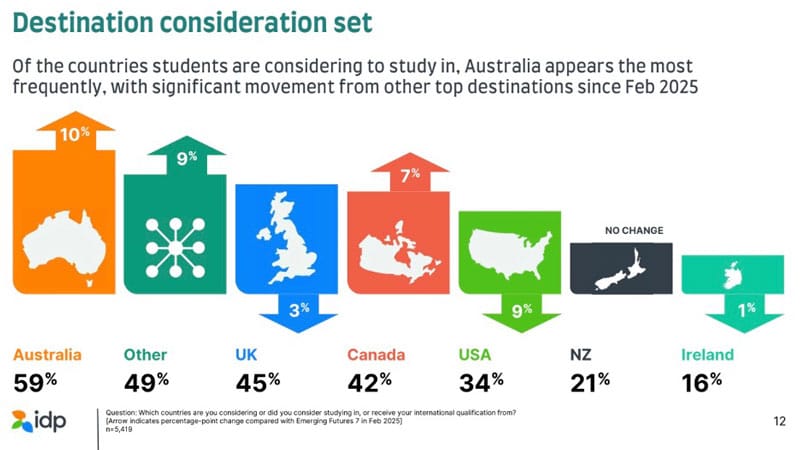
Findings from IDP’s most recent Emerging Futures survey, EF9, also show that Canada is regaining popularity. As the following chart illustrates, Australia (+10%), Canada (+7%), and “other” destinations (+9%) gained significant traction this year as destinations students are considering. This is in contrast to lower interest for the UK (-3%) and especially the US (-9%). The comparison is the data from EF9 (conducted in March and April 2026) versus data from EF7 (February 2025).
Will Canada’s momentum continue?
International students’ growing interest in Canada this year comes amidst a more beneficial external and internal environment than in 2024 and 2025.
External factors include:
- Significantly lower interest in the US given the second Trump administration's immigration policy direction;
- More cautious recruitment on the part of UK universities given strict new compliance thresholds (including a requirement that institutions maintain a visa refusal rate of less than 5% to avoid sanctions).
Internal factors include:
- The postgraduate exemption from the cap;
- The ability of postgraduates to bring their families;
- Greater policy stability, which leads to (1) more confidence among international prospects, and (2) improved ability of institutions and agents to advise students given less confusion and volatility;
- More clarity on which programmes are eligible for the Post-Graduation Work Permit (PGWP);
- Higher visa approval rates for university programmes: according to IRCC data, undergraduate approvals rose from a 22% share of all approvals in 2024 to 35% in 2025, and at the postgraduate level, the jump was from 18.5% in 2024 to 30% in 2025;
- Last but not least – more targeted recruitment strategies by Canadian institutions.
The question of whether or not Canada can regain its footing as a preferred leading destination depends especially on the internal factors above – including policy stability.
For additional background, please see:
- "New international student permit approvals for Canada fell below COVID levels in 2025"
- "Canada: Government audit finds impact of international student cap far greater than expected"
- "Canada’s foreign enrolment has fallen by nearly 300,000 students over the last two years"
- "Canada announces international student cap numbers for 2026 and updated programme guidance"
Most Recent
-
China in 2026: Slowing outbound student mobility, accelerating inbound momentum Read More

-
Surprise hike in international student visa application fees “a direct hit to Australia’s competitiveness” Read More
-
ICEF Podcast: “Good, steady, and disciplined”: New Zealand’s plan for sustainable international enrolment growth Read More







