


Ascending in world university rankings and highly affordable, Azerbaijan is strengthening its offer to international students




- In this new era of geopolitics, some countries that have historically had very small international student populations are spotting opportunities to become regional higher education hubs
- Azerbaijan, situated right between Eastern Europe and Western Asia, is quickly internationalising its higher education system
- Azerbaijan’s universities are soaring in world university rankings, and affordable tuition makes them even more compelling
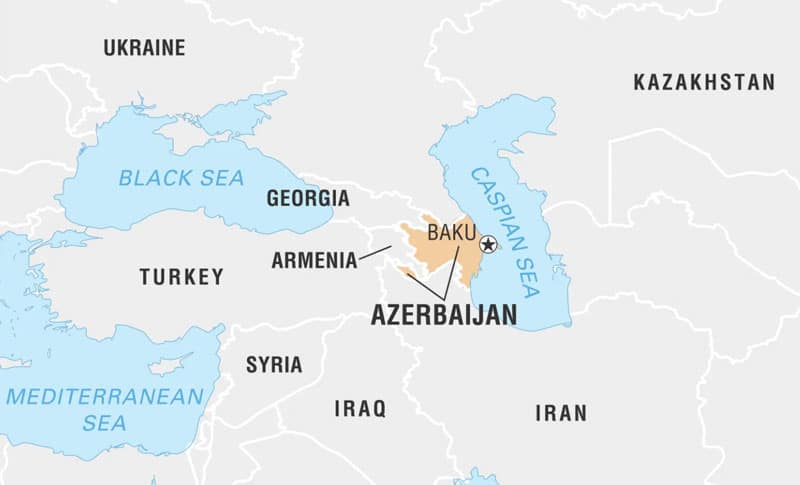
Azerbaijan – located on the western shore of the Caspian Sea, bordering Russia to the north, Georgia to the northwest, Armenia to the west, and Iran to the south – is a nascent study abroad destination and an interesting one at that.
Students in the region – and farther afield – are becoming aware of Azerbaijani universities’ strengths, especially in medicine, energy, and engineering, and of the relative affordability of tuition.
Azerbaijan’s other advantages include:
- Scholarships;
- Degree recognition across Europe under the Bologna Process and participation in Erasmus+;
- Proximity to Southeastern Europe and Central Asia, and not too far from North Africa, Pakistan, China, and India;
- Languages (Azerbaijani, which is closely related to Turkish; Russian, which has hundreds of millions of speakers across Eastern Europe, Central Asia and parts of Western Asia; and English, which is now a language of instruction in several universities, mostly private);
- Increasing importance as a middle power with ties to Europe, Russia, China, and the US.
The religious characteristics of Azerbaijan are also compelling to Muslim students. More than 90% of Azerbaijanis are Muslim (60/40 spilt between Shia and Sunni), but the state is secular. Citizens and visitors have freedom to practise – or not practise – any religion. A thriving minority population of Jewish Azerbaijanis clustered around the capital (and largest city) of Baku coexists peacefully with the Muslim majority.
While the country enrols a relatively small number of international students, there is solid – and government-endorsed – potential for more. In 2024/25, nearly 11,000 foreign students attended Azerbaijani universities, which represents year-over-year growth of +10% and five-year growth of +70%.
Geopolitical strengths
The world is becoming more multipolar, with power and influence diffused across the US; the European Union; and the BRICS+ (including China, India, Russia , and Brazil as well as six other countries in Africa and the Middle East). Countries that are able to manage multiple economic and diplomatic relationships across geopolitical divisions have a major advantage because they are not dependent on one ally or trading partner.
Azerbaijan is one of those countries. It was once part of Iran, then Russia, until it left the USSR in the 1990s and became independent. Despite rising tensions with Iran and Russia, it maintains diplomacy and trade with those countries. At the same time, Azerbaijan has formal “strategic partnerships” with the US, Türkiye, China, Italy, and Romania.
The US/Iran war and Western sanctions on Russia have elevated Azerbaijan’s importance to European allies because of its vast reserves of crude oil and natural gas. Italy is the top importer of these fossil fuels, but Azerbaijan also sends hundreds of thousands of tons to Romania, Czech Republic, Portugal, Germany, Croatia, Greece, Bulgaria, and Thailand. The main export route flows directly into Turkiye territory via the Baku-Tbilisi-Ceyhan (BTC) pipeline.
As Azerbaijan’s diplomatic and economic ties proliferate, its ability to attract international students and forge educational partnerships with foreign universities increases.
Most students are from Türkiye, but demand is rising in South Asia
The following chart shows the top nationalities represented in Azerbaijani universities. Türkiye, by far Azerbaijan’s closest ally and defence parter, accounts for over a third of the overall international student population.
However, diversification is well underway,
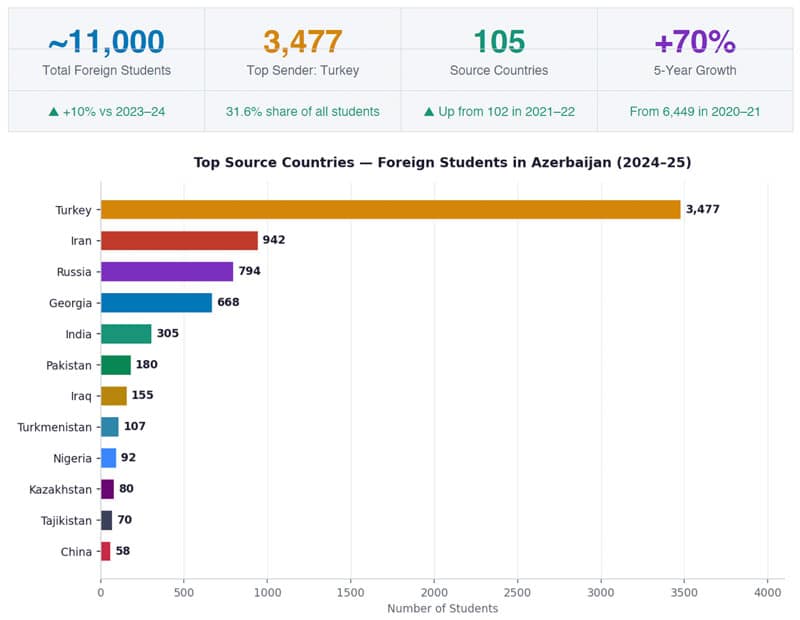
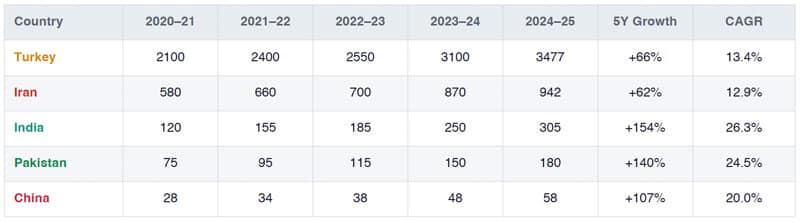
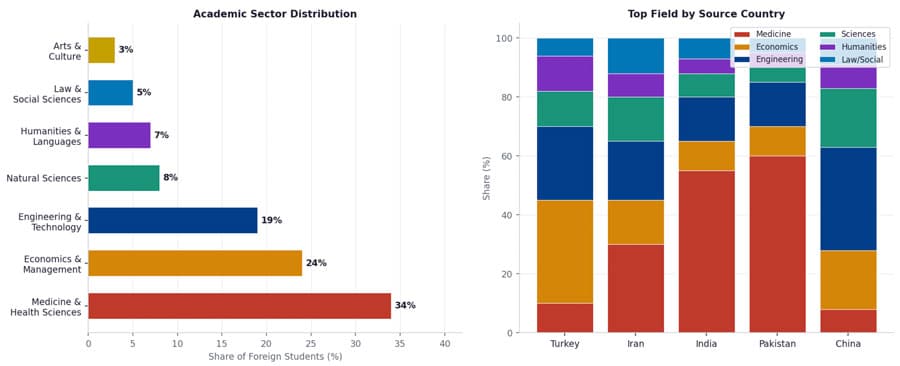
South Asia is a new regional opportunity for Azerbaijan. For example, India, Pakistan, Bangladesh, and Sri Lanka are the fastest-growing markets mainly due to intense student interest in affordable, World Health Organisation-approved (WHO) medical degrees, especially those offered by Azerbaijan Medical University. Medicine and health sciences programmes enrol more than a third of all international students in the country.
Institutions rising in the rankings
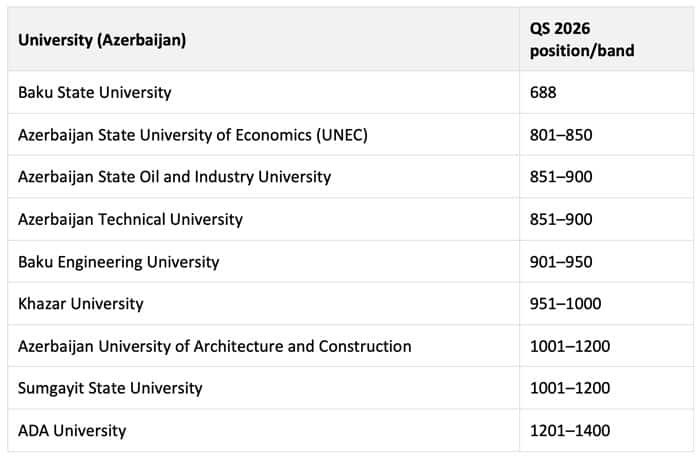
This year was historic for Azerbaijani’s education system: nine Azerbaijani universities made QS’s 2026 World University Rankings – six of them for the first time. India and Azerbaijan stand out (in a field of 106 countries) for having the highest number of universities enter the ranking for the first time.
Another first was Azerbaijan’s highest placing university, Baku State (BSU), having its petroleum engineering programme appear in QS’s top 100 subject rankings. BSU also had several other programmes in the top 500.
Across the higher education system, seven of the country’s universities were represented across 22 subject fields, with many improving their positions over 2025.
Affordability
International tuition fees vary across Azerbaijan’s over 50 public and private institutions, but most international students can expect to pay about US$1,500–$5,000 per year, and to budget for up to US$600 in living expenses. To get a study visa, they need to show proof of funds of at least US$5,000.
Private institutions offer more English-taught programmes, and these are priced higher (up to US$8,000).
Government support for internationalisation
The “State Strategy for the Development of Education in the Republic of Azerbaijan,” plan, launched in 2028, prioritises internationalisation. Specific goals are:
- Establishing more dual-degree programs between Azerbaijani higher education and prestigious foreign institutions;
- Funding doctoral education abroad to build research-oriented academic staff for Azerbaijani universities.
Some of most prominent examples of internationalisation include “joint universities” overseen by the Ministry of Science and Education but launched through bilateral agreements with countries such as France, Italy, and Türkiye. Joint universities:
- Lead to qualifications recognised by both countries;
- Promote student and faculty exchanges and collaborative research – especially in engineering in energy (oil and gas) fields.
Azerbaijan’s joint universities include:
- The French-Azerbaijani University (UFAZ) in Baku. This institution was founded in 2016 through collaboration between the Azerbaijan State Oil and Industry University (ASOIU) and the University of Strasbourg and University of Paris 1 Panthéon-Sorbonne. UFAZ offers many courses, but specialisations are petroleum and chemical engineering.
- The Italy-Azerbaijan University (ADA), whose campus opened in October 2025 in Baku, is a partnership with five Italian institutions: Luiss Guido Carli University, University of Bologna, Politecnico di Milano, Sapienza University of Rome, and University of Padua. Two main schools are design and architecture and agriculture and food sciences, but other programmes are also available.
- The Türkiye-Azerbaijan University (TAU) in Baku specialises in education, health sciences, engineering, and informatics.
Scholarships
The government has launched a “Study in Azerbaijan” (SIA) portal to promote the country to international students as well as a major new five-year scholarship programme beginning in 2026/27: the Heydar Aliyev - International Education Grant. This programme provides 100 students with full scholarships covering tuition fees, international flights, monthly allowance, medical insurance, and visa and registration fees. It is open to students from 100 countries.
There are also scholarships that promote two-way mobility, including the Hökumətlərarası Təqaüd Proqramları (intergovernmental) scholarships for Azerbaijani students wanting to study abroad and for foreign students wanting to pursue higher education in Azerbaijan. Scholarship recipients have their tuition and accommodation covered and a stipend for living expenses. Partner countries include China, Hungary, Kazakhstan, Latvia, Romania, and Russia.
Finally, several top Azerbaijani universities participate in Erasmus+ and Germany’s DAAD exchange programmes.
Big ambition
In 2024, at an event called "Opportunities of International Education in Azerbaijan," Deputy Minister of Science and Education Hasan Hasanli stated that Azerbaijan’s goal was to host 75,000 foreign students by 2026.
There is no indication that this target has been met, but growth of 70% over the past five years, new demand from Asia, and the rapid introduction of joint universities and programmes suggests that expansion of Azerbaijan’s international student population is well underway.
For additional background, please see:
Most Recent
-
Ascending in world university rankings and highly affordable, Azerbaijan is strengthening its offer to international students Read More

-
Netherlands reports first-ever decrease in foreign enrolment for 2025/26 Read More
-
What is happening to student mobility flows between the Global South and Global North? Read More







