UNESCO confirms growing trend of intra-regional student mobility




- A UNESCO analysis of recent higher education data from 146 countries finds that international student mobility is increasingly concentrated within regions
- In addition, more mobility is flowing from so-called Global South countries to other Global South countries such as Egypt and India
UNESCO’s first Higher Education Global Trends Report confirms that while traditional destinations for study abroad continue to be the most popular choices for international students, there are important changes afoot, with countries such as Türkiye, Egypt, Japan, and others picking up share of interest and enrolments.
The report draws on the most recent data available from 146 countries, and it covers 10 interrelated themes. This article focuses on the international student mobility findings and analysis.
More mobile students than ever
As of 2024, there were 7.3 million students studying abroad, a more-than-tripling over the past two decades. This growth is expected to continue for the next several years at least.
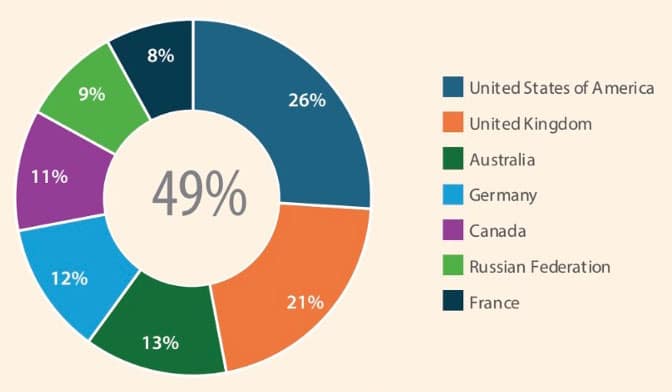
While seven countries host almost half of the world’s international students (see chart below), emerging destinations are increasingly popular. UNESCO names several of these:
- Argentina
- China
- Egypt
- Japan
- Malaysia
- South Korea
- Türkiye
- The United Arab Emirates (UAE)
The report highlights Türkiye and UAE in particular:
“In Türkiye alone, the number of students surged within 10 years by more than six-fold, from 38,590 in 2012 to 244,027 in 2022 (the last year of data availability). In the United Arab Emirates, the figure grew five-fold to reach 237,034 in 2023, compared to 54,162 in 2012 (no data is available from 2013 to 2016).”
We can also point to recent Monitor data on some of these other emerging destinations:
Regional mobility has grown substantially
When we look at the increasingly popular emerging destinations highlighted by UNESCO, part of the story for their ascendence is the growing tendency of mobile students to stay within their own region for study. For example, UNESCO notes: “In East Asia, the number of international students travelling to study within the region is growing at a faster rate than those travelling outside the region.”
This is a major competitive issue for institutions in the West because of the sheer volume of mobile students from Asia. In 2023, nearly half of all outbound students came from Asia, with East Asia and the Pacific accounting for 26% and South Asia and West Asia responsible for another 21%. Those students used to gravitate mainly to the West, but this historical flow is weakening. Asian students are increasingly choosing destinations such as China, Japan, Malaysia, and South Korea.
UNESCO uses the example of China to underline the fact that several Asian destinations are now both major sources and hosts of international students:
“China plays a dual and dominant role in this [intraregional] trend. Not only is it the world’s primary source of outbound international students, but it also serves as the main host country within East Asia and the Pacific.”
In other parts of the world, too, the intra-regional movement is strong:
- Latin America and the Caribbean: “The proportion of students choosing to study in other countries within the region nearly doubled between 2000 and 2022, climbing from 24% to 43% [with Argentina the main recipient].”
- Middle East: “In most reporting countries, the majority of international students come from within the region. This is particularly pronounced in Jordan, Bahrain, Oman, Qatar, Saudi Arabia, Mauritania, and Algeria [where at least half of all inbound students are from Arab States].”
South-South mobility
Another crucial part of the evolution of global student mobility is the “South-South” phenomenon, where students travel between Global South countries. The trend is often fuelled by ambition and investment on the part of Global South countries aiming to be education hubs. UNESCO elaborates:
“Emergent examples include Egypt, whose scholarship programmes and package of initiatives under the Study in Egypt programme make it a top choice for students from Africa and the Arab States, and Malaysia, where low costs and expanding degree options attract students from East Asia and the Pacific. In India, students from sub-Saharan Africa are the second largest population group behind those from South and West Asia, which may be explained by the English-language programmes offered and cultural initiatives on the part of the Indian government, such as the Study in India programme which seeks to motivate students primarily from the Global South to undertake higher education in the country.”
The South-South trend is especially important considering that of the 10 countries responsible for almost half (45%) of all outbound mobility (see chart below), more than half are in the Global South (seven are in Asia and one is in Africa).

Towards better access to higher education?
The rest of the UNESCO report explains that while participation in higher education has never been higher, there are still pronounced differences in access and mobility, with poor students from less developed nations at a disadvantage:
"Despite growth expectations, the proportion of higher education students benefiting from academic mobility remains low, just under 3%, underscoring the elitist nature of mobility as still only a privileged few individuals gain access to higher education opportunities abroad.”
To this point, perhaps the wider availability of compelling, more affordable options outside the West is an opportunity to expand academic mobility to more than just that 3%.
For additional background, please see:
Most Recent
-
Breaking: US Department of Homeland Security publishes rule to end Duration of Status for international students Read More

-
Joint sector alert sends a clear compliance message to Australian higher education and VET providers Read More
-
Academic support and learning resources in TNE: Delivering student success across borders Read More