

Five things we learned from this year’s International Student Barometer




- The latest edition of Etio’s International Student Barometer finds that a strong majority of students rate their study abroad experience highly
- Career impact remains a primary driver of student decision making and the survey highlights room for continued improvement in career services and outcomes for foreign students
Etio's International Student Barometer (ISB) is the world’s largest international student experience survey of enrolled students.
The most recent edition of the ISB gathered responses from 93,843 international students from 135 universities during a September–December 2025 survey window.
Here are five important takeaways from this year's top-level findings.
Students are mostly satisfied with their study abroad experience
When asked in the 2025 ISB cycle, "Overall, how satisfied are you with all aspects of your experience at this institution?", 90% of respondents said they were "satisfied" or "very satisfied."

A related question asked respondents how likely they are to recommend their institution to a family member or friend. Etio uses the responses to generate a Net Promoter Score (NPS). Using a response scale of 0–10, students who provide a score of 6 or below are classified as "Detractors," whereas those who give a 7 or 8 are classified as "Passives," and those who give a 9 or 10 are "Promoters." The Net Promoter Score is arrived at by subtracting the percentage of Detractors from the percentage of Promoters.
The ISB shows that, globally, the Net Promoter Score has been on the rise since 2019, where the aggregated NPS value across the survey was 15, to 2025 with its NPS of 22. As with overall satisfaction ratings, there are big differences within institutions (by faculty or student nationality, for example), and by destination.
Students feel they are getting good value for their investment in study abroad
When asked, "To what extent do you feel that your current course is good value for money?", 85% of students either agreed or strongly agreed that they were getting good value.
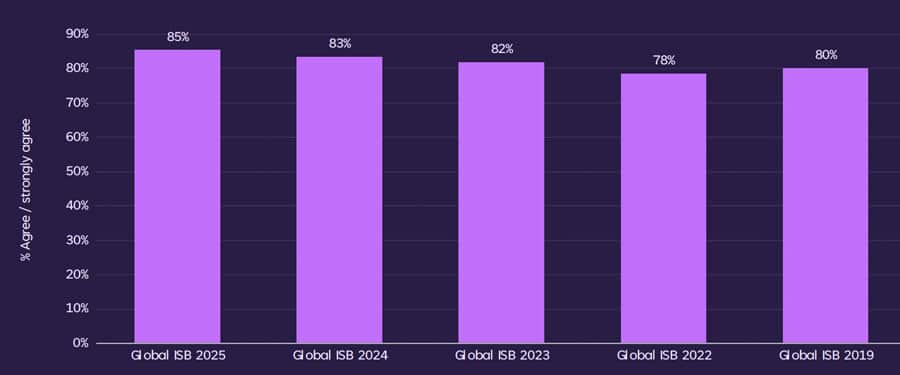
As we see in the chart, ratings for value for money have been climbing steadily since 2019. "That 85% as we are now is a pretty good result for the sector," says Etio's Head of Surveys Robin Hallows. "It suggests that [institutions] are by and large delivering on their promise."
"I do wonder if there is a link between the improvements we have seen over time around graduate outcomes, employability, and career readiness – if there is a link to student perceptions of value for money."
"Institutions are also managing expectations around cost," adds Guy Perring, Etio's Regional Director for APAC and the Middle East. "Singapore, for example, does very well in this regard. It's not a cheap option; in fact, Singapore is one of the most expensive cities in the world. But they manage the expectations of the students so that students know how much the cost of living will be [in advance]."
Career impact remains the key driver
This year's ISB results underscore that decision making for study abroad is heavily influenced by future career considerations, and by a return on investment calculation that weighs the costs of study and living abroad against anticipated future earnings.
Those priorities come through loud and clear when the ISB asked students, "How important were the following factors when deciding where to study?"

"The impact the [foreign qualification] has on their future careers is the most important decision factor," says Mr Hallows. "And it's always been the most important decision factor since 2019."
"It is important for institutions to understand what drives decision making," Nannette Ripmeester, Etio's Regional Director for Europe, Africa, and North America. "This generation of students is completely different. [Study abroad] has to provide return on investment for them."
Online information sources are having a greater impact on student decisions
When asked, "Which of the following helped your decision to choose this institution?", students noted institutional websites and education agents as the most important influences on their study abroad decision, followed by friends and family.
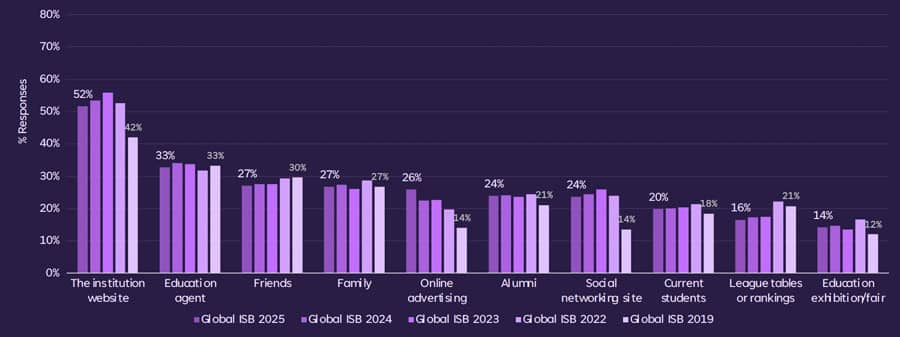
It is interesting that the influences that have seen the greatest change over time are all digital, including the institutional website, online advertising, and social media channels.
There is a satisfaction gap in career services
The ISB asked a number of questions around career services, including "How satisfied are you with the following types of employment / careers support from this institution?"
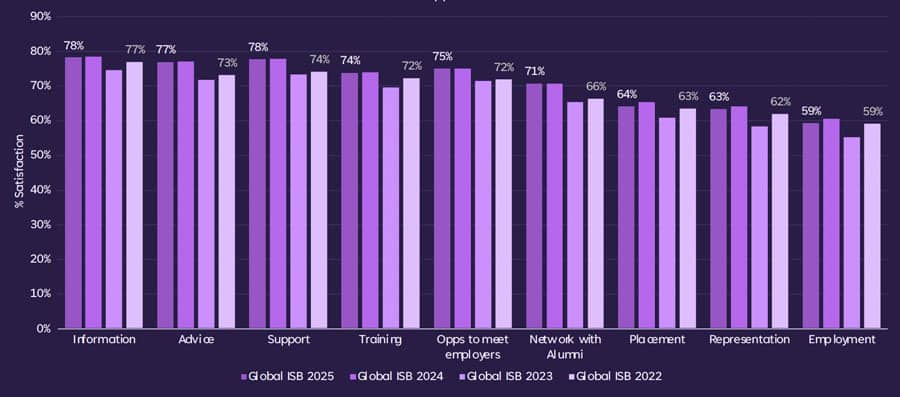
"There is a bit of a variance [in satisfaction] within career support," adds Mr Hallows. "Satisfaction with 'information' is quite a bit higher at 78% than employment – i.e., getting a job – at 59%. What I see when I see this is the potential for further improvement; for growth."
For additional background, please see:
Most Recent
-
Decline in Indian demand a major factor in softer outlook for foreign enrolment in US higher education in 2026/27 Read More

-
Australia: As visa applications from foreign students fall, the government has set the national target for new international students in 2027 Read More
-
Independent K-12 schools in the UK hosting fewer international students this year Read More







