


Vietnam: Students encouraged to obtain advanced technology degrees abroad




- Vietnam is determined to reduce its reliance on foreign investment
- It wants to join countries at the forefront of advanced computing and technology industries
- The ambition stands to profoundly affect the choices Vietnamese students make about where to study abroad
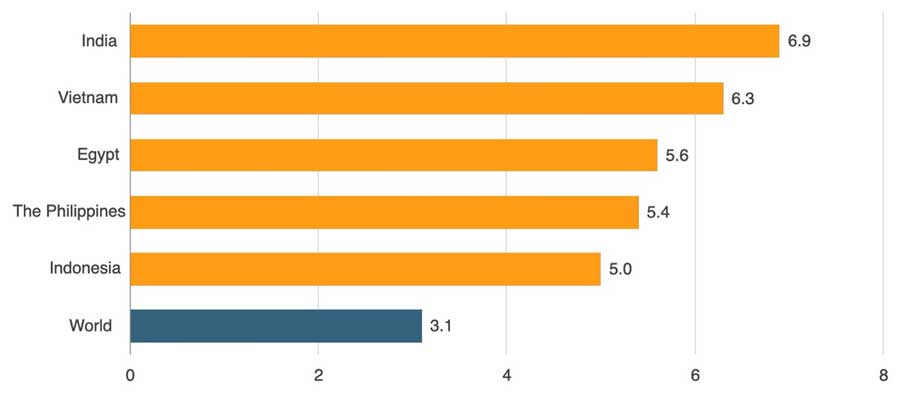
Vietnam boasts one of the fastest-growing economies in the world (+8% in 2025), but its workforce cannot yet be described as highly skilled. The manufacturing and processing of electronics and textiles, the services sector, and agriculture remain the major drivers of growth.
The Vietnamese government plans to change this. The goal is to position Vietnam as a global semiconductor power by 2050 and a leader in other advanced technologies. This requires a rapid infusion of high-tech talent into the workforce and, correspondingly, a massive investment in education at all levels. Already, the government’s commitment to this ambition is changing the shape of student mobility from Vietnam to other countries.
C = SET + 1
In 2024, the government announced the “National Strategy for the Development of Vietnam’s Semiconductor Industry to 2030 with a vision to 2050,” backed by a formula called C = SET + 1, where:
- C stands for Chip;
- S stands for Specialised (Application-Specific Integrated Circuits);
- E stands for Electronics (as the foundational manufacturing base);
- T stands for Talent (engineers, researchers, technicians);
- +1 refers to positioning Vietnam as a new, safe, and reliable destination in the global semiconductor supply chain.
Deloitte explains:
“This integrated approach reflects Vietnam’s understanding that becoming a semiconductor hub demands an ecosystem that blends technical specialisation, supply chain depth, and a skilled workforce – all anchored in long-term policy stability and international cooperation.”
The vision is that Vietnam will transform from its current role as an assembly and testing hub for semiconductors to a leadership role in their design and fabrication.
The link to student mobility
The government announced in December 2025 that it will support 1,500 Vietnamese students every year for the next 10 years to study abroad in fields such as artificial intelligence, semiconductors, defense, and medicine. This scholarship programme falls under a larger commitment to send more Vietnamese students out to study in Russia, China, Eastern Europe, and Central Asia. Most scholarship recipients will go to Russia, while the remaining recipients will study in one of 15 or so other partner countries.
The scholarship programme is funded both by Vietnam and host countries. Vietnam Law magazine elaborates:
“Host countries will waive tuition fees and provide monthly living allowances and dormitory accommodation. Vietnam will cover round-trip airfare, travel expenses, passport and visa fees, and health insurance, and will supplement living costs if support from host countries falls short.”
The full list of priority study fields includes cloud computing, quantum physics and computing, blockchain technologies, advanced materials, rare earth extraction and processing, aerospace engineering, nuclear technologies, semiconductor technologies, biotechnology, and medicine and pharmaceuticals.
Top destinations for Vietnamese students
As it stands, the countries hosting the most Vietnamese students are:
- South Korea: 107,805 students in 2025, up +50% since 2023
- Japan: 40,325 in 2024, up +10 over 2023
- Taiwan: 39,695 in 2025, up 30% from 2023
- Australia: 36,415 in 2025, down -3.2% since 2024
- United States: 25,585 in 2024/25, up 15% since 2023/24
- China: 24,000 (up +100% from 2020)
- Canada: 10,550, down -1.8% since 2023 and -35% since 2022
Not surprisingly, five of the destinations experiencing notable growth in Vietnamese enrolments – Taiwan, South Korea, the United States, Japan, and China – are leaders in semiconductor industries.
Learning AI from primary school onwards
Higher education is not the only level the Vietnamese government is prioritising for technological and digital training in 2026. A pilot is currently underway to integrate AI into K-12 school curriculum. VN Express notes:
“The AI education framework is organized around four main knowledge areas: human-centered thinking, AI ethics, AI techniques and applications, and AI system design. Content will be tailored to students' age and cognitive development across two stages: basic education for primary and secondary (6th-9th grades) levels and career orientation (high school).”
When the pilot ends in May 2026, results will be reviewed and used to guide a wider rollout of AI-integrated education.
Implications
An ApplyBoard article published in 2025 posited that strong student demand from Vietnam could “help stabilise sustainable growth” in Western destinations for years to come. To attract this generation of Vietnamese students, however, institutions in the West should be aware of the current nature of demand from Vietnam and especially the growing emphasis on training in advanced technologies and medicine.
For additional information, please see:
Most Recent
-
Decline in Indian demand a major factor in softer outlook for foreign enrolment in US higher education in 2026/27 Read More

-
Australia: As visa applications from foreign students fall, the government has set the national target for new international students in 2027 Read More
-
Independent K-12 schools in the UK hosting fewer international students this year Read More







