
Market intelligence for international student recruitment from ICEF
6th Sep 2017

China’s college-aged population to decline through 2025

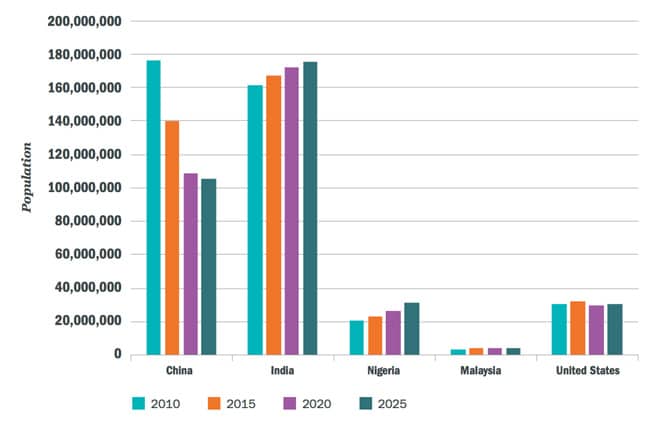
It is no secret that China accounts for a major share of both total international enrolment and enrolment growth for major study destinations around the world. In the US, students from China account for nearly a third of all foreign enrolments. Chinese students also drove roughly 57% of overall foreign enrolment growth in the US over the past decade. The numbers are similar in the UK where Chinese students account for three of every ten foreign students in the country, and again where Chinese enrolment growth has outpaced overall growth for some years. The situation is the same in Canada and Australia, but also in a number of non-English-speaking destinations, such as South Korea and Taiwan, which rely disproportionately on Chinese students to maintain or build their international programmes. These destinations have come to count on China as the world’s leading outbound market, and not just to occupy a large proportion of seats in campuses and classrooms but also to help meet enrolment targets with brisk year-over-year growth. The problem with this is obvious and has been ringing in the ears of many international educators for some years now: what happens if Chinese outbound growth slows down? Indeed, there is some indication that this is starting to happen. Over the last two years, annual outbound growth, while still strong, has fallen notably below the levels we have seen for decades. Average annual growth has been about 19% going back many years, but that long-term trend began to level off around 2013. Between then and 2015, year-over-year growth has slowed to 11-13% annually. At current outbound levels, this slowing growth rate has been hardly noticeable so far and China remains a major driver of overall enrolment levels in both established and emerging study destinations. But the point here is that many institutions and schools have come to rely on that underlying, consistent growth out of China to hit their annual enrolment targets. And if China slows down any more, some recruiters are going to find those goals harder to make. We recently looked at the case of Chinese enrolment in US high schools and there again we see a distinct levelling off enrolment growth from about 2013 on. At the same time, the number of US secondary schools recruiting foreign students has increased considerably. The result is a larger field of schools recruiting a shrinking pool of students, and a more intense competitive context for all. The specific case of secondary recruitment in the US takes on greater significance when we consider the long-term demographic forecast for China. A recent report from Universities UK highlights the projected numbers of college-aged students in China and other major sending markets through 2025. As the following chart illustrates, the trend line in China is markedly different from other key source markets, such as India or Nigeria. The college-aged population in China – that is, the 18-to-24-year-old group – is projected to decrease by more than 40%, from 176 million to 105 million, between 2010 and 2025. college-aged-populations-actual-and-forecast-in-selected-sending-markets-2010–2025 College-aged populations, actual and forecast, in selected sending markets, 2010–2025. Source: Universities UK, World Bank As the Universities UK report puts it, “Projected demographic trends indicate that the UK may face an increasingly challenging environment in recruiting students from some overseas countries on which the sector has relied in the past.” On a brighter note, the chart also highlights continued growth in this key college-aged cohort in other major growth markets, especially in India. Along with China, India has been the primary driver of overall enrolment growth in many study destinations and has certainly come to play a greater role in driving global mobility trends within the past decade. Even so, the implications for recruiters is clear: competition for Chinese students is likely to intensify going forward and many programmes will have to more actively build student numbers outside of China in order to continue to hit their enrolment targets. For additional background, please see:
Most Recent

  • Year in review: What we learned in 2025 Read More
  • US extends travel ban, Nigeria now included on “restricted” list Read More
  • Search and enrolment data foreshadows international enrolment trends for 2026 Read More

Most Popular

  • Which countries will contribute the most to global student mobility in 2030? Read More
  • Research shows link between study abroad and poverty alleviation  Read More
  • Beyond the Big Four: How demand for study abroad is shifting to destinations in Asia and Europe Read More

Because you found this article interesting

US extends travel ban, Nigeria now included on “restricted” list The Trump administration has announced an expanded list of countries whose nationals – including students applying for F,...
Read more
Search and enrolment data foreshadows international enrolment trends for 2026 The following is a guest post contributed by Keystone Education Group. Keystone Education Group’s 2025 data reveals a...
Read more
The number of Indian students abroad fell in 2025 More than 1.2 million Indian students were enrolled in higher education abroad in 2025 – a hefty number,...
Read more
Global higher education enrolments expected to grow through 2035, but new challenges must be addressed Times Higher Education’s new report, Towards 2035: Projecting the Future of Global Higher Education, predicts that university-level enrolments...
Read more
Canada: A case study of immigration policy impacts on postsecondary institutions and the wider economy In January 2026, Canadian higher education institutions will enter the third consecutive year of caps on new international...
Read more
UK: Rule changes could be coming for Master of Research programmes If there is a lesson that international education stakeholders in the Big Four have learned in the past...
Read more
Global trends in international enrolments and policies as we head into 2026 At the end of 2025, educators across major study abroad destinations are facing markedly different circumstances than in...
Read more
There are now more than 400,000 international students in Germany Continuing a years-long trend, the number of international students in German universities rose again this year according to...
Read more
What are you looking for?
Quick Links