Demand for “future proofing” programmes rising fast among college-aged students




- International students have always been drawn to STEM programmes because of employability and salary goals
- This remains true, but just as important for many students now is that their studies – whether in STEM or other fields – integrate AI training in some capacity
- Global studies show that youth are increasingly worried that AI will jeopardise their career prospects
- This is leading students to choose programmes with AI “future proofing” in mind
- Surveys show that higher education needs to catch up with students’ needs and employers’ requirements when it comes to AI skills
As we speak, many international student prospects are changing their minds about what they should study.
Over just a couple of years, the simple equation of a science, technology, engineering, or math (STEM) programme = best chance at a well-paying and secure job is becoming more complex. This is because of increasingly sophisticated artificial intelligence (AI) in the workplace and the profound worry among young adults that AI could jeopardise their career prospects. “Future proofing” (for the impact of AI) may end up being the Oxford Word of the Year.
This is radically changing the way students decide what to study, and it is prompting institutions to review their programming, curricula, and marketing. Educational agents, too, are noticing the shift. They are directly in touch with students in local markets who now consider an AI-resistant – or AI compatible – career to be essential.
In the 2010s, the big disruption for higher education was MOOCs (Massive Open Online Courses). In the 2020s, it is most definitely AI.
How international students choose programmes
For international students, a strong return on investment (ROI) from higher education is crucial. Often, they pay more in tuition than domestic students do; have significant travel costs; and must navigate visa settings that affect their ability to work in host country. They are taking an even bigger risk by pursuing higher education than domestic students are.
They choose STEM programmes not just out of interest, but also because host countries tend to have more favourable visa policies for STEM graduates than graduates from other fields. For example, the STEM extension of Optional Practical Training (OPT) in the US provides three years of work experience rather than one with regular OPT. In Germany, international STEM graduates can more easily be hired through the EU Blue Card system than other international graduates because employers do not have to prove an EU professional could just as easily fill the position.
STEM students are also more likely to find a scholarship than students choosing other programmes. In the US, for example, SEO firm Search Logistics has found that 17% of STEM-interested students receive scholarships compared to 12% of non-STEM-interested students. Across major destinations, there are dozens of major STEM scholarships – often fully funded – offered to international students by governments and private organisations.
These advantages are huge for international students. Consider that:
- On average across OECD countries, 30% of international students choose STEM programmes compared to 19% of domestic students.
- In the US, 57% of international students were in STEM fields in 2025.
- More than half (53%) of all Canadian programme searches by international students on the ApplyBoard platform in 2025 were for STEM fields.
- In Australia, 1 in 5 international bachelor’s graduates emerges with a STEM degree.
Why is decision-making changing?
STEM graduates have historically experienced stronger employment outcomes and higher earnings compared to non-STEM majors, but recent data reveals important variations within STEM fields. For example, the Federal Reserve Bank of New York analysed 70 popular majors in 2025 and found that the unemployment rate for recent graduates with physics and computer engineering degrees was 7.8% and 7.5%, respectively, compared to an all-major average of 3.9%. Only anthropology graduates fared worse (9.4% unemployment).
As an article in Money puts it:
“Cracks in STEM supremacy were beginning to emerge [in 2024]. And now, in a stark reversal [the Federal Reserve Bank of New York research] found that art history grads are far more likely to be employed than computer-engineering, mathematics, chemistry, industrial-engineering and physics majors.”
While some STEM graduates still earn far more than other graduates, says the article, the trend is not as broad-based as it used to be: “It’s starting to look like some letters in STEM are more valuable than others.”
Similarly, National College of Colleges and Employers (NACE) statistics show that in 2014, only about 6% of engineering graduates were unemployed six months after completing their degree. In 2023, that proportion more than doubled to 14%. And in 2024, bachelor’s-level engineering and computer sciences were among the disciplines that lost the most ground in terms of employment outcomes for graduates.
Statistics like these are circulating among students choosing majors, and they are adding anxiety to the process. A 2025 poll of more than 2,000 American youth by the Institute of Politics at the Harvard Kennedy School found that 7 in 10 college students see AI as a threat to their job prospects.
As an article in Associated Press notes: “Today’s college students say that picking a major that’s ‘AI-proof’ feels like shooting at a moving target as they prepare for a job market that could be fundamentally different by the time they graduate.”
Where are students pivoting?
Because technology is arguably the area where most AI automation of formerly human tasks is happening, many students are looking into programmes – both STEM and non-STEM – that emphasise “human skills.” They are interested in interpersonal/relationship‑heavy roles that seem most immune to automation. And there is a distinct trend of students already more than a year into their current programme switching it for AI-proofing reasons.
Associated Press interviewed Josephine Timperman, a student at Miami University in Ohio, who said:
“You don’t just want to be able to code. You want to be able to have a conversation, form relationships and be able to think critically, because at the end of the day, that’s the thing that AI can’t replace.”
Another interviewee for the piece was Courtney Brown, a vice president at Lumina, an education nonprofit that encourages high-school students to progress to higher education. Ms Brown said:
“We see students all the time change majors. That’s not new or different. But it’s usually for a ton of different reasons. The fact that so many students say it’s because of AI — that is startling.”
Hiring trends are reinforcing the shift
In the first six months of 2025, AI job postings on LinkedIn from employers around the world more than doubled over the same period in 2024 (+110%). And in April 2026, global LinkedIn data show that workers with AI expertise earn about 56% more on average than other workers, and job postings that mention AI pay roughly 28% more than similar postings without AI requirements.
The LinkedIn data is only one indication of the trend; other surveys and anecdotal evidence point to the real urgency felt both by job candidates and employers about the need for AI skills.
Does that mean everyone should pursue AI-specific degrees?
The short answer is: no. Rather, AI capability is fast becoming a core employability advantage rather than an optional skill, and this is happening across business, health, engineering, social sciences, and more. Across sectors, there is growing demand for professionals who can manage, direct, or complement AI systems.
Global learning organisation Knowledge City says: “[What we] are navigating now is a labour market where the rules have changed at the role level, the skill level, and the career pathway level simultaneously.”
Further:
“Across enterprise learner data covering millions of professionals, the fastest-growing skill among people actively building AI capability is Content Creation. AI skill demand runs across every function. The assumption that AI upskilling is an IT or engineering priority leaves the majority of your workforce behind.”
Many non-technical roles, for example in marketing or HR, increasingly need “AI translators”: professionals who can integrate AI copilots into workflows and design prompts, and who can evaluate AI output. Titles for these roles include Citizen Data Scientist, or AI Business Analyst. Essentially, the work is cognitive, strategic, and creative – but it requires a capacity to work with and alongside AI.
Higher education is moving slower than the jobs market
A six-country study by Pearson and Amazon Web Services with over 2,000 students, higher education leaders, and employers found a serious discrepancy between what employers need and what higher education institutions are delivering:
- More than half (53%) of employer respondents said that finding AI-ready graduates is their main challenge.
- Over three-quarters (78%) of university respondents said they thought their programmes were meeting employer expectations.
- And only 28% of employers believed that universities are keeping pace with AI-driven change.
The study report says:
“AI readiness does not falter at the point of intention. It falters at the points of alignment and execution, where what institutions deliver and employers require are not synchronised, and where learning is expected to translate into applied capability at work.”
Of course, some institutions are ahead of the pack and rethinking how they provide value to students. They are not making vague promises about being able to provide students with AI readiness; they are showing concrete evidence such as AI‑specific course requirements, work‑integrated learning with AI tools, and graduate outcomes linked to AI skills. And they are running these themes through all programmes: not just STEM. The screen shot below is an Instagram post by Elmhurst University's admissions department announcing its English department's technology-focused coursework for the September 2026 intake.
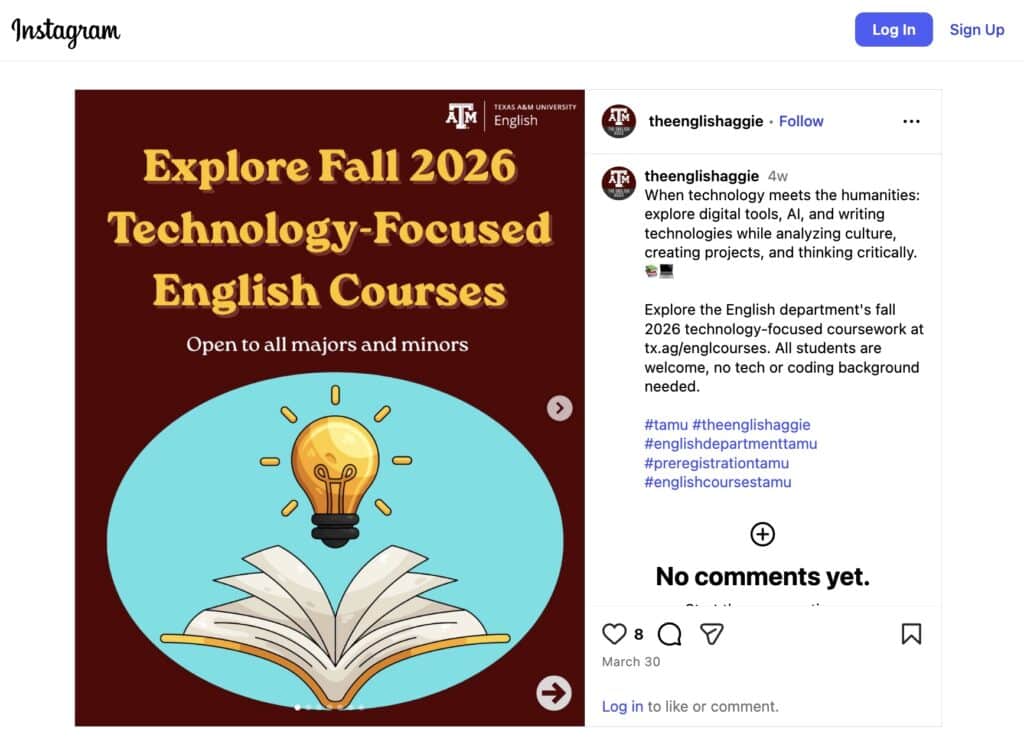
In an era where youth are increasingly cautious about where and what to study, institutions that recognise intense interest in AI skills are the ones that have the best chance of converting students – and of ensuring graduates can compete for desirable jobs. Today's students – international and domestic alike – expect nothing less than an education that is relevant for the AI present ... and future.
For additional background, please see:
Most Recent
-
Breaking: US Department of Homeland Security publishes rule to end Duration of Status for international students Read More

-
Joint sector alert sends a clear compliance message to Australian higher education and VET providers Read More
-
Academic support and learning resources in TNE: Delivering student success across borders Read More