


New international student permit approvals for Canada fell below COVID levels in 2025




- The number of new study permit approvals dropped by nearly two-thirds between 2024 and 2025
- That declining trend is strongly linked to two more: study permit application volumes were down significantly in 2025 and approval rates were also notably lower than in 2023 or 2024
- Meanwhile, two recent government reports make it clear that the impacts of Canada’s international enrolment cap have been far greater than policy makers intended
Canada approved only 75,372 new study permits in 2025. This represents a -64% drop year-over-year, and an -18% decline from the previous low in 2020 at the peak of the COVID-19 pandemic.
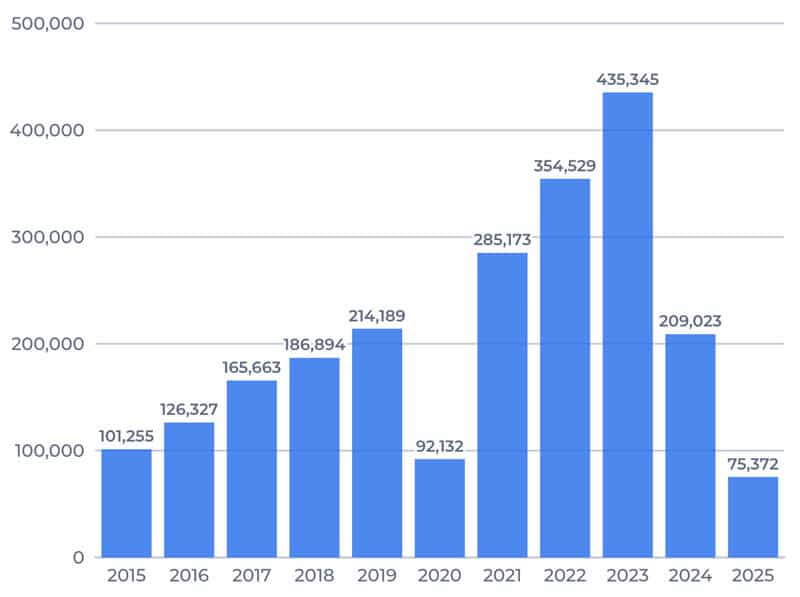
The decline is unfolding as Canada's new policy settings – a cap on international enrolments and other measures – continue to impact international students and the Canadian education system alike. The government's reforms, which were intended to reduce the number of international students in Canada and improve programme integrity, have considerably overshot the mark.
A recent report from The Office of the Auditor General of Canada (OAG) found that the Canadian government significantly underestimated the effects of its enrolment cap and did too little to improve the integrity of the system. The Auditor General also observed: “The department did not know why [study permit] approval rates were lower than projected.”
The full-year data for 2025 from Immigration, Refugees and Citizenship Canada (IRCC) provides the answer: lower-than-expected permit grants were due to (1) the erosion of international student demand and (2) historically low approval rates for new study permit applications.
"Last year, IRCC processed 211,000 new post-secondary applications from prospective international students," says a new analysis from ApplyBoard. "Compared to 2024, demand was -55% lower year-over-year." In other words, much fewer international students applied for a study permit last year than was the case in 2024, and this was on the heels of another substantial applications drop in 2023.
At the same time, approval rates have fallen sharply over the last five years. In 2021, 57.9% of new study permit applications were approved. That approval rate fell to 44.9% in 2024 and then took another significant step down to 35.7% – in 2025.
These two declining trends are closely linked. Simply put, students do not need to wait for official statistics to understand that many of their peers are having their applications rejected and that they should perhaps consider other options.
Can we talk about the overcorrection?
Another newly released study, this time from the House of Commons Standing Committee on
Citizenship and Immigration, reinforces the point: "The [enrolment] cap and related reforms are reducing [international student enrolment] in excess of the provincial and territorial allocation targets, because they damage the brand and reputation of Canada’s International Student Program…After two years of caps, the 2024 policy changes seem to have reduced new study permit applications and enrolments much more than IRCC planned – and much more than provinces, territories and DLIs expected."
The Committee's study of the International Student Program was carried out from September to November 2025 and included testimony and written briefs from dozens of expert witnesses and organisations.
The Standing Committee finds that, "Although education and the regulation of learning institutions fall under provincial and territorial jurisdiction, the federal government was responsible for issuing an unsustainable number of study permits and allowing the system to be abused." However, "While IRCC is attempting to reduce the number of international students in some provinces and territories, and to address overreliance on international students by colleges, its policies are impacting enrolment in regions and institutions across the country and in higher numbers than anticipated. Despite the government’s complex allocation formula, the policy is too broad and ignores regional institutional realities…While universities in some regions, such as Quebec, have not generally had problems with growing international student populations too quickly, nor with housing these students, the cap has decimated enrolment from coast to coast to coast."
In his testimony during the Committee hearings in September 2025, Alex Usher, President of Higher Education Strategy Associates, said:
"What we ended up with was a federal government that barely understood what was going on, lashing out, acting alone, doing anything it could to bring the numbers down with only the barest understanding of the system it was regulating…We have almost no instinct anymore for co-operative federalism. This was a clear case where governments should have been talking to one another, and they weren’t. They should have been including institutions, as well. We have brutally siloed decision-making."
Among the 10 recommendations put forward to the Government of Canada by the Standing Committee, perhaps the most compelling one is the related point that: "To give time for all actors in the international student system to adapt, and to give more certainty to current and prospective international students, the [committee recommends] that Immigration, Refugees and Citizenship Canada consult more extensively with the provinces and territories about long-term plans for the International Student Program."
Needless to say, the stakes are high – both for the country and for prospective students seeking access to education – and there is an urgent need for more thoughtful and effective policy making. The issues at hand transcend international student statistics and extend to the larger questions of Canada's long-term social and economic development, in particular its ability to attract talented students, scholars, and researchers and what that means to larger national goals of innovation and productivity.
As Larissa Bezo, President and Chief Executive Officer of the Canadian Bureau for International Education, said in her Committee testimony:
"We need to be clear that this isn’t solely an immigration issue. Talent development and attraction cuts across departments and needs whole-of-government coordination."
For additional background, please see:
Most Recent
-
Recruiting in Colombia demands a long-term presence and communication with parents Read More

-
UK’s ELT sector reports declining enrolments through first quarter of 2026 Read More
-
US visa processing centres in Africa to be reduced by more than half; only the latest barrier for African students Read More







