China opens up to global STEM talent with new visa class




- China has announced a new K visa, targeted specifically at STEM students and graduates
- The visa is notably open and flexible, offering STEM talent the opportunity to more easily enter China for study, research, or work
The contrast offered by the global news headlines over the past couple of weeks could not have been much sharper. First, there was the story of deteriorating diplomatic relations between the United States and India. Earlier in the summer, the US suspended trade negotiations with India. More recently, it imposed sweeping, higher tariff rates, alongside additional penalties on India's oil purchases from Russia, and otherwise slighted India's leadership. In the end, Indian Prime Minister Narendra Modi was left fuming as US-India relations dipped to a low not seen in years. "After more than two decades of bipartisan effort to transform the relationship between New Delhi and Washington, including during his own first term, US President Donald Trump is now in the process of dismantling this painstakingly built relationship," said Evan Feigenbaum, a vice president with the Carnegie Endowment for International Peace.
So it was all the more striking to see Prime Minister Modi literally hand-in-hand with Chinese President Xi Jinping last week for their first meeting on Chinese soil in seven years. The visit marked a distinct thawing of China-India relations on the occasion of the annual summit of the Shanghai Cooperation Organization (SCO). The two were joined by leaders of the eight other SCO member-states: Kazakhstan, Kyrgyzstan, Russia, Tajikistan, Uzbekistan, Pakistan, Iran, and Belarus. And the summit was widely seen as a demonstration of the closer ties among the members at a time when the global economy has been badly disrupted by US trade policies and tariffs.
The SCO's membership accounts for nearly a quarter of the world's geography, and 42% of the global population. It is a striking demonstration of how global power continues to shift this decade, and of China's rising influence in particular. Where the US has come to represent uncertainty and disruption in global trade, China has been quick to position itself as a reliable, stable partner. As CNBC reports, "In a thinly-veiled swipe at the US President Donald Trump’s global tariff campaign, Chinese President Xi Jinping told his counterparts in his opening speech Monday that the 'shadows of Cold War mentality and bullying have not dissipated, with new challenges mounting.'…The world has entered 'a new phase of turbulence' with global governance at a 'new crossroads,' Xi said, calling for joint efforts to build a 'more just and balanced international governance framework.'
Introducing the K visa
Against that broader context of realigning global flows of capital and brainpower, China has taken what appears to be an important step in its bid to attract global STEM talent, and to further reinforce its position as a global technology leader. On 7 August 2025, The State Council of the People's Republic of China amended the "Regulations of the People’s Republic of China on the Administration of the Entry and Exit of Foreigners" to add a new visa category.
The changes amount to two small revisions: (i) the creation of a new K visa, to be issued to foreign young science and technology talent and (ii) a specification that “applicants for a K visa must meet the conditions and requirements for foreign young science and technology talent stipulated by the relevant Chinese authorities and submit corresponding supporting documents.” The new visa policy comes into effect on 1 October 2025.
In order to be eligible for a K visa, applicants must hold a STEM degree (in science, technology, engineering, mathematics) at a bachelor's level or higher, or be engaged in relevant studies or research at a recognised institution.
What makes the K visa so interesting otherwise is that, compared to other existing visa classes, it offers more flexibility (with no requirement for a Chinese employer or other sponsoring/inviting organisation for application) and more convenience with flexible terms around entry frequency, validity period, and duration of stay. K visa holders will also be allowed to participate in a relatively wide range of activities while in China, including study, research, cultural exchange, entrepreneurship, and work.
"China's development requires the participation of talent from around the world, and China's development also provides opportunities for them," said a statement from China’s State Council.
And there are some early signs that young STEM talent from around the world is paying attention to those opportunities.
The AI proxy
A lot of the global investment in technology – and the competition for talent and investment – currently revolves around Artificial Intelligence. And recent data observations from Studyportals finds that international student interest in Artificial Intelligence degrees in the US fell by -25% year-over-year, whereas interest in AI studies in China increased by 88%. Those indicators of relative demand are based on student searches on Studyportals websites from January to July 2025 compared to the same period in 2024. And, given the prominence of AI in the broader technology landscape, we can imagine the patterns around demand for AI degrees to be something of a proxy for where STEM talent is going generally.
We see those contrasting trends reflected in the chart below, which measures market share of the global demand for AI studies for both the US and China, and where "market share" refers to the percentage of all student interest in AI degrees globally that is captured by the US and China. "The US’ share of global demand for AI degrees is shrinking," says Studyportals, "while China’s share of the total is growing." Astute observers will note that the trend described in the chart pre-dates the announcement of the K visa in August 2025.
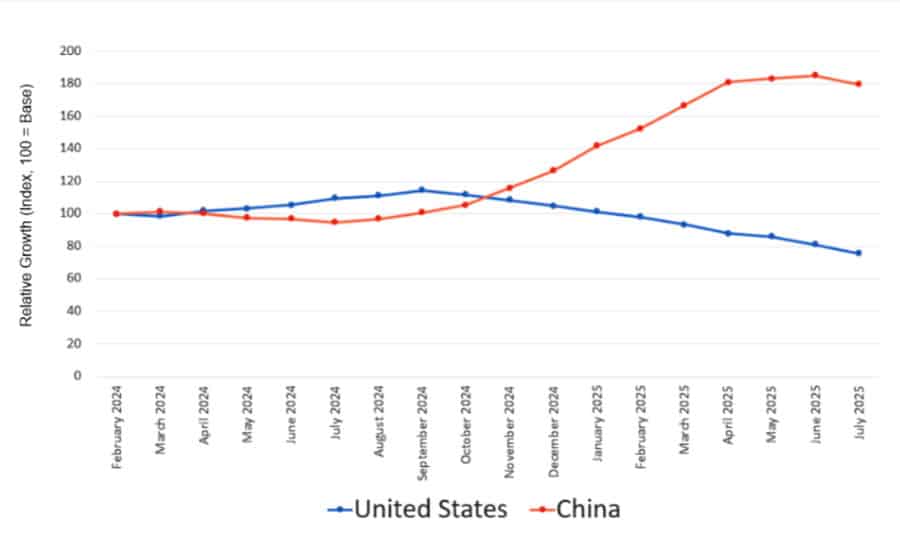
The linkage here between STEM talent and AI advancements is not subtle. International graduates have historically played a significant role in technology leadership in the US, for example. Four in ten US AI startups have at least one founder who came to the US as an international student, and roughly half of foreign STEM graduates in the US remain in the country to work after their studies. Those percentages would suggest that a shift in student interest from US to China could have a significant impact beyond enrolment statistics: it could also materially impact technology entrepreneurship, innovation, and competitiveness in the US economy.
Studyportals CEO Edwin van Rest echoes the point in saying, “Nations that succeed in drawing the brightest minds and in creating an environment for innovative business to thrive, will not just advance their economies, they will command the future of technology, security, and influence. International students do not only bring revenue to local economies and soft power, they also fuel innovation, startups, and job creation.”
For additional background, please see:
Most Recent
-
Breaking: US Department of Homeland Security publishes rule to end Duration of Status for international students Read More

-
Joint sector alert sends a clear compliance message to Australian higher education and VET providers Read More
-
Academic support and learning resources in TNE: Delivering student success across borders Read More