New agreement aims to expand online learning in Africa
Population growth, a massive expansion in access to basic education, and growing household incomes are all contributing to tremendous growth in the demand for higher education in sub-Saharan Africa.
By 2050, 2.4 billion people will live in Africa, up from just over one billion today, with Nigeria set to become the world’s third most populous country. And by some estimates the African middle class has tripled in size over the past 14 years, growing from 4.6 million households in 2000 to 15 million today across the continent’s 11 largest economies.
The current higher education enrolment ratio for sub-Saharan Africa is 8%, and a 2015 action plan aims to increase participation to 50% of college-aged students by 2063. A great deal needs to happen in order for the continent to reach that ambitious target: existing universities will need to expand and strengthen their programmes, new institutions will have to open their doors, and new delivery models will be needed to bring higher education to many more African students.
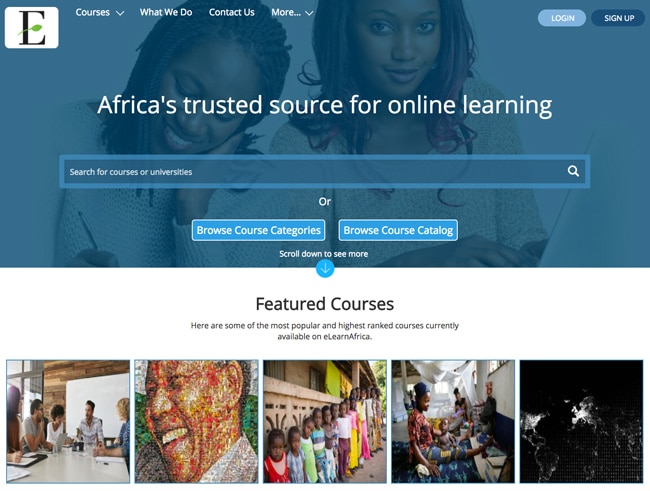
A new agreement announced this month between eLearnAfrica - a new online course provider – and the Association of African Universities (AAU) aims to do just that by expanding the online programmes available to students at the AAU’s 380 member-universities. eLearnAfrica delivers MOOC-type courses (Massive Open Online Course) from major providers and institutions, including EdX, FutureLearn, Harvard, MIT, and Cambridge, as well as professional development courses in 175 high-demand vocational and career paths such as software development and business administration.
eLearnAfrica offers courses from EdX, FutureLearn, and a number of other partner institutions in higher education and vocational training
The initial focus of the new partnership will be to make the more-than-1,000 courses currently offered by eLearnAfrica available to students at AAU universities, with the goal of expanding the learning options available via all member institutions. But association members will also have access to the online learning systems and support of eLearnAfrica in bringing new programme options online, suggesting that the new MOU with AAU may cast eLearnAfrica in the role of an online programme management (OPM) provider - that is, as an expert partner that can help traditional institutions bring their programmes online more quickly and effectively.
"As an association, challenges of limited access to quality higher education continue to haunt us," said AAU Secretary General Prof. Etienne Ehouan Ehile. "Therefore building capacities of African universities to be innovative in their teaching and learning methods for increased access to quality higher education is top priority for the AAU. This partnership with eLearnAfrica will help us achieve this goal."
OPMs (and MOOC providers generally) have been catalysts for major expansions of online learning in other world markets, including in the US, and that may be the more significant, long-term prospect emerging from the new eLearnAfrica-AAU MOU.
"Online degrees are a great way for universities to extend and diversify their academic reach in a sustainable and scalable manner," adds eLearnAfrica CEO Brook Negussie. "We hope to significantly increase the number of students earning degrees in the next few years by literally putting in the palms of their hands the tools they need to succeed."
More broadly, online learning is increasingly seen as an important counter to some of the persistent challenges that limit access to higher education for African students, including high costs, limited university spaces, and access to higher education in proximity to the student’s home community or region.
Speaking to IT Web Africa, Moira de Roche, director of the Institute of IT Professionals South Africa, sees e-learning as a means of levelling the playing field for African students. "Quality e-learning is accessible to anyone, anywhere, if they have connectivity, she says. "Learning can be completed at any time, at a learner's own pace. Transference of skills to the job are proven to be better than with classroom training, especially for training on digital skills - probably because you can try out what you learn immediately."
For additional background on higher education in Africa, and also on online learning, please see: