
Global education outlook anticipates major growth but also downward pressure on post-secondary fees




- New analysis from HolonIQ projects significant growth in global demand for education through 2050
- But the forecasts also anticipate deflation in post-secondary fees in the near term, and a much greater role for education technology and microcredentials in addressing global student demand
A recent Global Education Executive Briefing from market intelligence platform HolonIQ forecasts dramatic growth in worldwide demand for education, but with downward pressure on student fees, a greater role for technology, and an expanded footprint for microcredentials and alternate qualifications.
Speaking at the August 2021, briefing, HolonIQ Co-CEO Patrick Brothers outlined projections for nearly a billion more post-secondary learners over the next 30 years and another 1.2 billion secondary students. As we see in the graphic below, this reflects a higher rate of growth – compared to the previous 30 years – for post-secondary in particular.
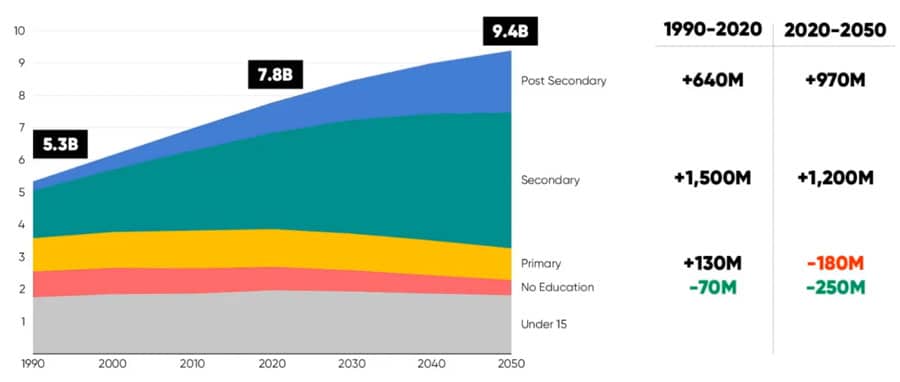
"We're concerned about our ability to support two billion more learners compared to the way we are supporting the learners we have today," said Mr Brothers. "It appears at face value that we won't deliver the kind of education we want to with the current systems and processes we have. We need to change in order to scale."
Even with that increasing demand, HolonIQ's analysis expects a continuing downward pressure on global education spending, and this led the company to downgrade its long-term global revenue projections mid-way through 2020.
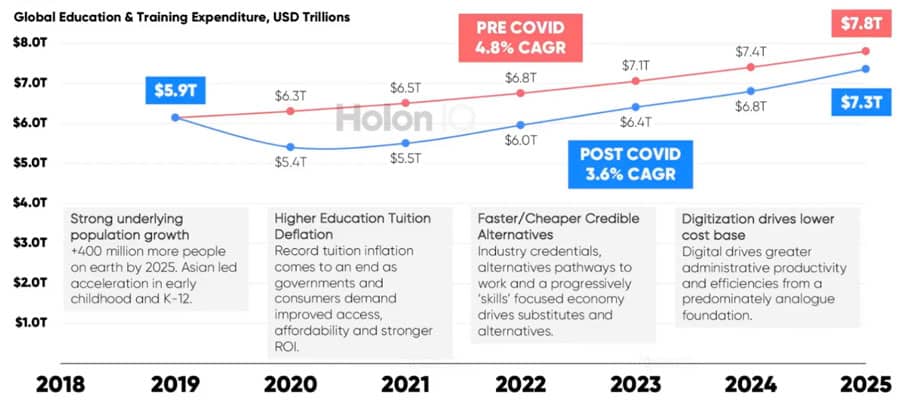
Mr Brothers attributes that softening forecast to a number of factors, including that 2020 effectively marks the end of a long inflationary period of rising higher education fees. Going forward, governments and consumers alike are expected to place more pressure on rising fees – and to actually trigger fee deflation – with greater concerns around the affordability and return on investment for post-secondary study.
HolonIQ expects that the growing footprint of shorter-term, credible alternate qualifications (alternate, that is, to full degree study) will also play an important role here.
"What is the post-secondary market? It's not just long-form learning at university any more," explained Co-CEO Maria Spies. "The micro and alternative credential conversation is evolving very rapidly. We're seeing governments start to embed microcredentials inside qualifications frameworks. This is a game changer. Once governments start to create a policy around this funding usually follows policy. And so we are going to see some changes here in pretty much every country."
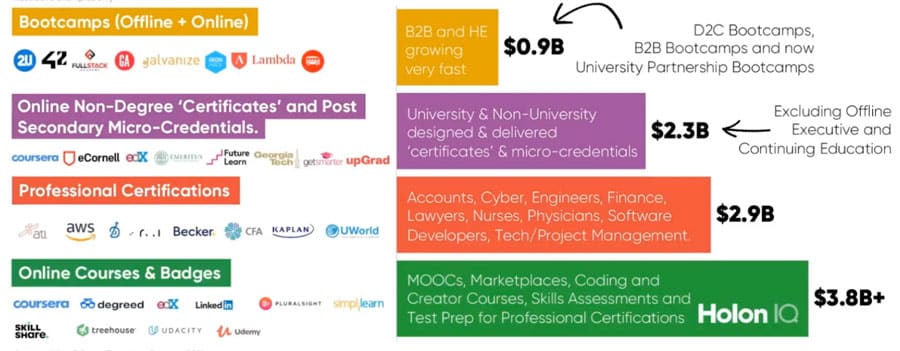
HolonIQ believes the global micro and alternative credential market was worth roughly US$10 billion as of 2019, with most of that value (as illustrated in the graphic below) relating to professional certification programmes and online courses delivered by MOOCs and others. But it notes as well that this is one of the fastest growing segments in education globally.
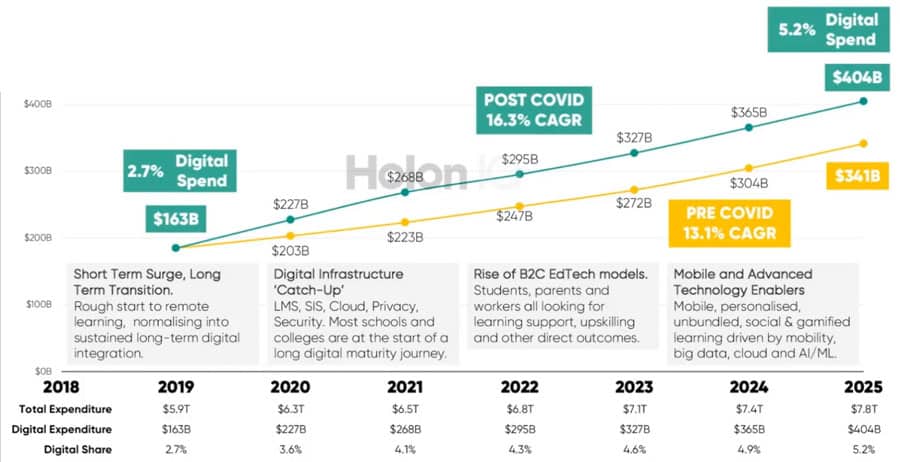
More broadly, spending on education technology is expected to boost global education revenues through 2025. HolonIQ projects that digital's share of education spending worldwide will nearly double between 2019 and 2025 (to just over 5% of global spending by that point) and with a little more than half of those revenues tied to direct-to-consumer services.
If those forecasts hold true, total digital education spending worldwide will be trending toward US$500 billion by mid-decade, and digital education revenues will grow roughly four times as quickly as overall education spending during that period.
Not surprisingly, the education technology sector continues to attract considerable investment, and that trend has accelerated during COVID. HolonIQ notes that 74 edtech companies worldwide have raised a collective total of 107 "mega rounds" of investment since 2010. (Where a "mega round" refers to a capital raise of US$100 million or more.) Seven in ten of those (53 in total) have occurred in the last 18 months.
For additional background, please see:
Most Recent
-
Offering reassurance to international students after they apply is increasingly key to securing enrolments Read More

-
Ireland’s ELT sector reports modest growth in student numbers but weeks are down amid “real and consequential” challenges Read More
-
Japan: Japanese proficiency essential for foreign graduates staying on to work Read More