


Slowing growth in foreign secondary enrolment carries important implications for US recruiters




A new report from the Institute of International Education (IIE) highlights that the number of international secondary students in the US more than tripled between 2004 and 2016.
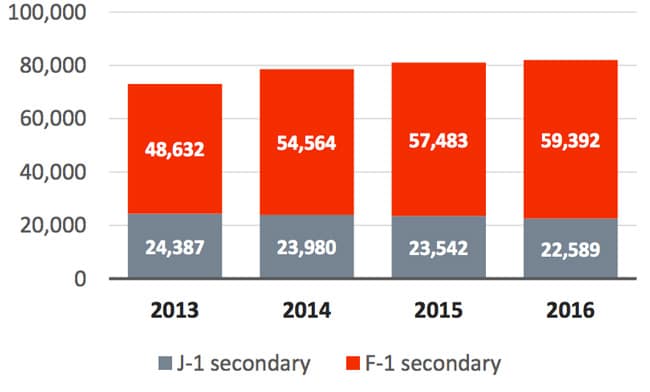
Globally Mobile Youth: Trends in International Secondary Students in the United States, 2013–2016 estimates that there were just under 82,000 foreign students in US schools as of fall 2016, with most seeking a US high school diploma in preparation for university study in America.
In fact, just over seven in ten (72%) of those enrolled in 2016 were studying on F-1 visas, indicating a longer-term study orientation on a path to a US diploma (as opposed to shorter-term exchange students on J-1 visas). While the overall growth pattern in secondary enrolments, and the drive to earn a diploma in the US, are both well-established by now, the report also highlights that the number of US schools hosting international students has increased markedly over the past few years. “The number of US schools enrolling international students grew from 2,300 in 2013 to 2,800 in 2016,” says IIE. “The increase in schools enrolling international students outpaces the growth in student numbers, suggesting that there may be greater competition for students among high schools hosting international students.”
This increasing competition will now likely be further exacerbated by what is clearly a slowing of enrolment growth from 2013 onward. “The annual growth rate of F-1 diploma-seeking students was 8% from fall 2013 to fall 2014, followed by 3% growth in fall 2015 and 1% growth in fall 2016,” adds the report. “At the same time, the number of J-1 exchange students has fallen, declining annually by 2% each year in 2014 and 2015, and 4% in 2016.”
The four-year trends for both major visa types are summarised in the chart below, and clearly reflect an overall flattening of enrolment growth.
The China story
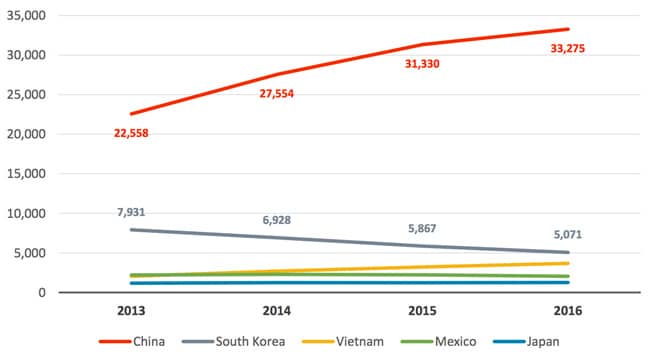
Not surprisingly, China has been an important driver of secondary enrolment growth in the US over the past decade and this remains the case today. But this is also what makes any notable slowing in Chinese enrolment growth especially notable. As the following chart illustrates, the numbers of Chinese secondary students are so significant that any flattening of demand from China has an important effect in shaping the overall foreign enrolment in US high schools.
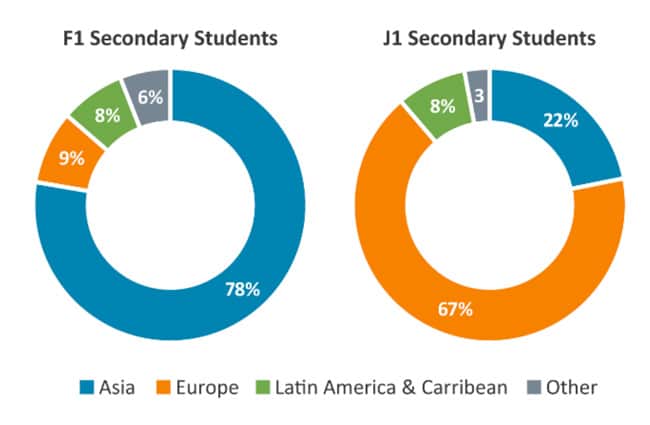
In fact, the top six sending countries for diploma-seeking students – China, South Korea, Vietnam, Mexico, Japan, and Canada – account for nearly eight in ten (78%) of F-1 secondary students in the US. And China alone accounts for nearly 60% of total enrolment.
Competing for students
These latest findings carry some important implications for recruiters in the US. First, the overall scale of foreign enrolment in US high schools continues to grow, at least with respect to diploma-seeking students. This means that secondary schools will in turn continue to be an important pathway for higher education recruitment going forward, and perhaps increasingly so. However, the flattening growth curve in secondary enrolment – especially with respect to China – along with the expanding field of schools hosting international students, means as well that competition will also increase. While not exactly competing for a shrinking pool of students, we now see a situation where there are more schools competing for a pool of students that is not growing nearly as quickly as it has in the past. Even so, as IIE Head of Research Rajika Bhandari recently said to The Washington Post, “There’s a realisation that recruiting future international students to colleges and universities in the US is not just going to be about going overseas. A lot of them are actually right here in our backyard.”







