Market intelligence for international student recruitment from ICEF
27th Feb 2017

Bangladesh: Middle class growth helping to drive demand for study abroad

South Asia - Bangladesh, India, Nepal, Pakistan, and Sri Lanka - is home to about 25% of the world’s population. Perhaps somewhat overshadowed by its larger neighbours, Bangladesh nevertheless has a population of around 160 million all by itself, almost half of which (48%) is under the age of 24. With that burgeoning college-aged population, it is no surprise that tertiary enrolment in the country has also been booming. More than three million Bangladeshis are now enrolled in higher education, and the country’s University Grants Commission projects that that total will climb to 4.6 million by 2026. Even so, tertiary participation rates have lagged behind regional leaders, such as India and China, and the domestic system has struggled to keep pace with demand, in terms of the number of available spaces, the quality of education, and employment outcomes for graduates. As we noted in an earlier report, private providers have come to play an increasingly important role in expanding domestic access to higher education. New legislation, first brought forward in May 2014, has also opened the door to foreign universities setting up joint ventures in Bangladesh with local partners. Nearly three years on, however, there has been little progress in this respect and recent reports indicate that Bangladesh’s Education Ministry has moved to block University Grant Commission-backed branch campus applications from British and Australian universities. "Private university owners have routinely opposed government moves to allow foreign universities to open branches in Bangladesh, and have been influential," reports University World News. "Sources suggested lobbying by these groups may have been behind the refusal by the ministry to grant approval to foreign branch campuses."

A big bump in outbound

As domestic capacity continues to lag behind demand, growing numbers of Bangladeshi students are pursuing post-secondary education abroad. The latest data from UNESCO indicates that nearly 31,000 Bangladeshis were enrolled abroad in 2015, a 33% increase over the two years from 2013. The leading destination, Malaysia, received about 20% of those students in 2015, with other major receiving countries, including the US, the UK, Australia, and Germany rounding out the top five destinations for Bangladeshi students.

A surging middle class

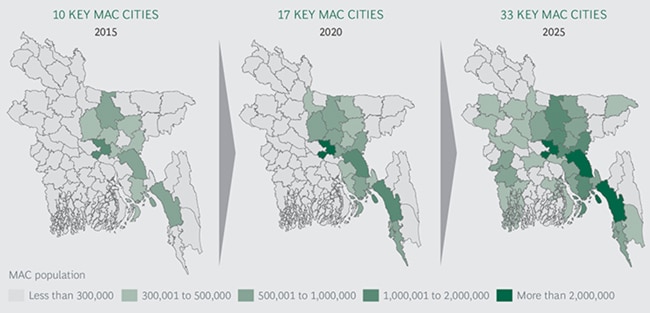
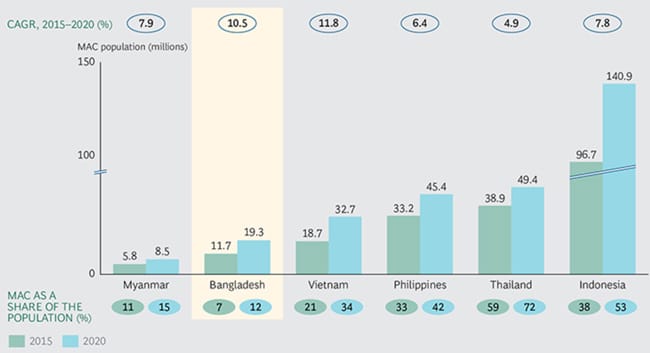
A recent report from the Boston Consulting Group (BCG) describes Bangladesh as "the surging consumer market nobody saw coming." On the strength of steady economic growth, stable inflation, low public debt levels, and growing remittance inflows, the population of “middle and affluent consumers” (or MACs) has grown to about 12 million people, or about 7% of the population. This is still small compared to more advanced economies in the region, such as Vietnam (21% MACs) or Indonesia (38%). But, as the following chart reflects, that middle class base is growing quickly in Bangladesh, at around 10% or 11% per year, and at a pace that outstrips many other Asian markets. “If Bangladesh can maintain this pace, its MAC population will grow by 65% over the next five years,” says BCG. “By 2025, it is expected to nearly triple, to about 34 million.” the-current-and-project-proportion-of-middle-class-and-affluent-consumers-in-bangladesh-and-other-selected-markets The current and project proportion of middle-class and affluent consumers in Bangladesh and other selected markets. Source: Boston Consulting Group The other notable characteristic of Bangladesh’s middle class is just how concentrated it is geographically. While this will change over the next decade, as reflected in the illustrations below, Bangladeshi MACs are heavily concentrated in two urban areas today. the-geographic-concentration-of-mac-consumers-in-bangladesh-2015-2015 The geographic concentration of MAC consumers in Bangladesh, 2015-2015. Source: Boston Consulting Group "Currently, around 80% of Bangladesh’s MAC population is concentrated in two cities: Dhaka and the eastern port city of Chittagong," adds BCG. "We see the dispersion of wealth unfolding in two waves. In the first wave, most of the MAC population growth will occur in Dhaka and Chittagong and will begin to take off in smaller cities in the eastern half of Bangladesh." The BCG report concludes that, “Very few global companies saw this market coming, so market leadership is very much up for grabs.” It cautions that the market is very value-conscious and that any marketing effort should stress both quality and value-for-money, or ROI. It notes as well that mobile technologies are being widely and rapidly adopted by Bangladeshi consumers and that digital marketing programmes must be well-optimised for mobile. For additional background on this important emerging marketing, please see:
Most Recent

  • Narrowing bands of compliance: How the UK’s new RAG system will impact international student recruitment Read More
  • Irish higher education reports a fourth straight year of foreign enrolment growth Read More
  • Mexico: A personalised, supportive approach is the key to success in this growing study abroad market Read More

Most Popular

  • Which countries will contribute the most to global student mobility in 2030? Read More
  • Research shows link between study abroad and poverty alleviation  Read More
  • Beyond the Big Four: How demand for study abroad is shifting to destinations in Asia and Europe Read More

Because you found this article interesting

Narrowing bands of compliance: How the UK’s new RAG system will impact international student recruitment The UK Home Office has circulated draft guidance to expand on forthcoming changes to the Basic Compliance Assessment...
Read more
Irish higher education reports a fourth straight year of foreign enrolment growth The number of international students enrolled in Irish universities has been growing steadily from a COVID-era dip in...
Read more
Mexico: A personalised, supportive approach is the key to success in this growing study abroad market Mexican students have traditionally gravitated to the US and Canada for study abroad, but President Trump’s anti-immigration agenda...
Read more
UK ELT reports challenging enrolment trends continued through last quarter of 2025 Continuing a pattern from the first half of the year, English UK’s latest QUIC release (Quarterly Intelligence Cohort)...
Read more
British Council says student recruitment to UK higher education will get a boost this year from South Asia and the “Trump effect” “Demand for UK education will remain resilient over the coming year despite increased competition from intra-regional mobility in...
Read more
New Zealand expands post-study work opportunities for international students In late 2026, New Zealand is rolling out a new Short Term Graduate Work Visa and extending eligibility...
Read more
As Iran retaliates across the Middle East, schools close, students worry, and institutions reassess transnational education The US/Israel-Iran war has touched down in several countries in the Middle East, and international educators and students...
Read more
US: Student visa issuances fell by -36% in summer 2025; OPT uncertainty among factors affecting international student demand The US government has renewed its focus on the Optional Practical Training (OPT) programme that allows international students...
Read more
What are you looking for?
Quick Links