
Market intelligence for international student recruitment from ICEF
6th Apr 2016

A record number of Chinese students abroad in 2015 but growth is slowing

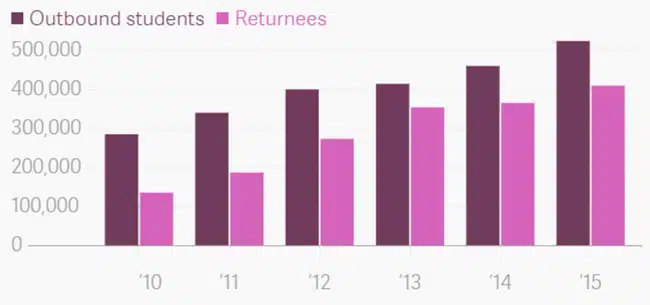
New data from the Chinese Ministry of Education reveals that both the total number of outbound students as well as the number of returnees from study abroad reached record levels in 2015. However, growth has slowed over the last two years and is notably below the average annual growth of recent decades. A "blue book," or government report, published by the Ministry on 25 March 2016 indicates that 523,700 Chinese students headed abroad to study in 2015. This represents a 13.9% increase over 2014 levels but marks the second consecutive year - after 11.1% growth in 2014 - of growth levels below the 19.1% average annual growth over the past four decades. number-of-chinese-outbound-students-and-returnees-2010-2015 Number of Chinese outbound students and returnees, 2010-2015. Source: Chinese Ministry of Education This puts the total number of Chinese students who have studied abroad at four million since the start of reforms leading to a great openness in the country in 1978. Nearly all (97%) of those currently abroad are self-funded and the average term of study overseas is just under two years. A related blog post calculates, "Given that 459,800 Chinese left China to study abroad in 2014, the average of students leaving in 2014 and 2015 combined would be (459,800 + 523,700)/2 = 491,750, and based on an average duration of 22 months (more precisely 21.47 months) of studies abroad among the 2015 returnees, this would mean that about 901,542 Chinese students would currently be abroad." Observers are watching the Chinese economy closely, as well as the increasing capacity of the Chinese higher education system, to see if the slower growth of the last two years is the beginning of a longer-term trend, or if it might even foreshadow a contraction in the key Chinese market. As we noted in a 2015 report, "China has been a major driver of the global growth in mobility in recent decades, and it remains the world’s leading source of international students today. No other country sends as many students abroad, and none has had such a dramatic impact on the global marketplace for education. Yet the Chinese market continues to evolve, and we can only anticipate further change in the years ahead. It has its own elite institutions and, for a growing field of prospective students, names like Tsinghua and Fudan are educational brands to rival the top tier of institutions abroad. The country has also become a major education destination in its own right, particularly for students from within Asia." Most, however, expect demand for study abroad to remain strong going forward as foreign degrees remain an excellent calling card with Chinese employers.
A new record for returnees as well

In fact, the Ministry data also indicates that Chinese students abroad are being drawn home in greater numbers, due in part to the strong Chinese economy. A record 409,100 Chinese students returned from overseas last year, bringing the total number of returnees to 2.2 million as of 2015. Xu Peixiang, the deputy director of the Ministry’s Overseas Students’ Support Center, noted that in recent years between 70 and 80% of outbound students return to China after their studies abroad. At a press conference announcing the report, Qi Mo, head of the Ministry’s Overseas Study Department, noted that returnees are coming home in greater numbers because the domestic job market is more appealing that those overseas. The press conference to release the 25 March report. Source: Ministry of Education This may be especially true for students of Business or other non-STEM subjects in the US, for whom opportunities to stay and work are more limited than is the case for graduates of science, technology, or engineering programmes. A related survey of 25,000 new returnees, or "sea turtles" as they are popularly known indicates that the most popular study destinations remain the US, the UK, Australia, South Korea, and Japan. The US was noted as the most-popular choice for PhD studies among responding returnees, and South Korea for undergraduate studies. Nearly half of survey respondents intended to work in one of China leading cities - Beijing, Shanghai, Guangzhou and Shenzen - and nearly three in ten (29%) hoped to work in a multinational company. Roughly a third (30%) planned to work in the financial sector, 10% in education, 8% in culture, and 7% in software and IT services. Six in ten returnees tracked in the survey were women and most are between 23 and 33 years old (with an average age of 27).

Most Recent

  • Survey highlights a growing “engagement gap” between international student expectations and institutional response Read More
  • Foreign recruitment of American students and researchers is intensifying Read More
  • Inside Spain’s growing appeal for international students Read More

Most Popular

  • Which countries will contribute the most to global student mobility in 2030? Read More
  • Research shows link between study abroad and poverty alleviation  Read More
  • Beyond the Big Four: How demand for study abroad is shifting to destinations in Asia and Europe Read More

Because you found this article interesting

Foreign recruitment of American students and researchers is intensifying The US, along with the UK, has always been a preferred destination for top international students. Now, it...
Read more
Inside Spain’s growing appeal for international students Along with Italy, France, and Germany, Spain is positioning itself as a more compelling destination than ever for...
Read more
Canada struggling to attract and retain global talent  In Canada, two years into the government’s introduction of caps on international student enrolments and related reforms to...
Read more
Canada’s foreign enrolment has fallen by nearly 300,000 students over the last two years Speaking in the East Coast city of Halifax last month, Canadian Immigration Minister Lena Metlege Diab said that...
Read more
China: Two-thirds of new TNE partnerships are with countries outside the Big Four China has been ramping up its transnational education (TNE) partnerships with other countries, with the Ministry of Education...
Read more
Vietnam: Students encouraged to obtain advanced technology degrees abroad Vietnam boasts one of the fastest-growing economies in the world (+8% in 2025), but its workforce cannot yet...
Read more
The Netherlands: Foreign enrolment slowdown driven by declining undergraduate numbers In 2024/25, 131,000 international students – including 51,800 new students – were enrolled in a degree programme offered by...
Read more
UK: International student numbers fall for second year, especially in postgraduate programmes A sharp year-over-year decline in non-EU students enrolling in UK universities in 2024/25 (-5%) is the main contributor...
Read more
What are you looking for?
Quick Links