Market intelligence for international student recruitment from ICEF
7th Oct 2015

India’s employability challenge

India is home to 1.27 billion people and so many other dizzying statistics. More than half of the population is under the age of 25, and, with a projected average age of 29 years, India will be one of the world’s youngest countries by 2020. It also has the world’s second-largest population of higher education students, and is projected to surpass China in that respect in the next decade. india-enrolment-institutions Charts excerpted from Higher education in India: Moving towards global relevance and competitiveness As this forecast suggests, India’s higher education capacity has been on a strong growth curve for some years now. It already has the largest system in the world in terms of the number of institutions. Higher education participation as a percentage of college-aged students (the Gross Enrolment Ratio, or GER) has more than doubled over the past decade but, at 24.69% in 2013, it still sits below the global average of 27%. The Indian government aims to increase the GER (higher education) to 30% by 2020. But, even in the context of the system’s rapid expansion over the last several years, this will require a further expansion on a scale the world has never seen. The challenge is immense in that India must accommodate an additional 14 million students, on top of the current enrolment of 26 million, in order to hit that 2020 target. The government is being urged on in its expansion plans by some profound underlying shifts in the Indian economy. India is projected to be the world’s third-largest economy by 2030 (after only China and the US). And current forecasts have it that, also by 2020, 90% of the country’s GDP and 75% of its employment will be derived from the services and manufacturing sectors. "This structural shift in employment will increase demand for sophisticated workers, innovators, and thinkers who can thrive in a globally-connected and dynamic economy," says a recent report from the consulting firm EY. "India, with its large workforce and increasing pool of higher education graduates, is strategically positioned to reap the benefits of this shift. However, the ‘demographic dividend’ will be squandered unless India is able to create a globally relevant and competitive higher education system."

The quality challenge

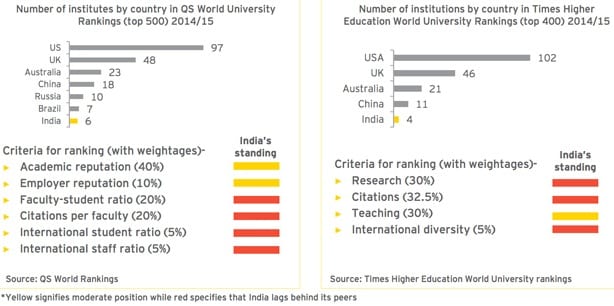
The obvious question that accompanies such a rapid expansion of higher education is whether or not quality can be maintained, and India is already facing some serious hurdles in this respect. In spite of the massive scale of its higher education system, for example, very few Indian institutions are globally ranked. As the following charts reflect, Indian higher education lags behind the systems of other key emerging markets on a number of important benchmarks. india-university-ranking Another recent report, this time from the British Council, puts it bluntly that the quality challenges start with a shortage of faculty but are amplified by other systemic problems: "Arguably, the greatest challenge facing higher education in India is the chronic shortage of faculty. Various reports estimate that 30-40% of faculty positions are unfilled. Most faculty have had no training in teaching. Other issues in teaching and learning which compound the problems include:
  • Outdated, rigid curricula and the absence of employer engagement in course content and skills development.
  • Pedagogies and assessment are focused on input and rote learning; students have little opportunity to develop a wider range of transversal skills, including critical thinking, analytical reasoning, problem-solving and collaborative working.
  • High student:teacher ratio, due to the lack of teaching staff and pressure to enrol more students.
  • Separation of research and teaching; lack of early stage research experience.
  • An ineffective quality assurance system."

The link to employment

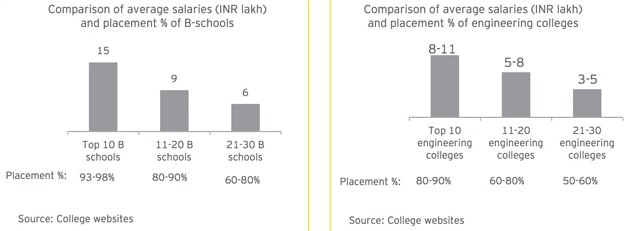
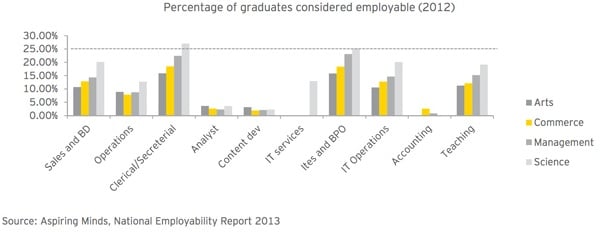
Global rankings are one thing but perhaps the most telling indicator of the quality of higher education in India currently is the employment outcomes of its graduates. As the following chart reflects, the vast majority of graduates - on the order of 75% or more - are not considered employable. india-employability A recent analysis from EY points out that the problem is particularly acute outside of a very small number of top-tier institutions in the country. Outside of that elite group, both average salaries and placement percentages for graduates fall off sharply. India-placement-salary These findings are echoed by a number of similar studies over the last two to three years. The estimates may vary, in terms of the percentage of employable graduates in particular, but the various reports share an inescapable conclusion:
Most of the graduates from Indian higher education are not receiving an education that sufficiently prepares them for the demands and opportunities of the country’s rapidly changing economy.

The British Council points out, however, that "excellence" is a core priority for the current five-year planning cycle in Indian higher education, and plans for 2013-2017 emphasise the following:

  • "improvements in teaching and learning, and a focus on learning outcomes;
  • faculty development to improve teaching;
  • increased integration between research and teaching;
  • more international partnerships in teaching as well as research;
  • better links between industry and research to stimulate innovation;
  • connecting institutions through networks, alliances and consortia."

Even so, the scale of the challenge is daunting to say the least. Not only is the government striving to remedy widespread quality issues arising from the rapid expansion of the previous decade, it is also in the midst of a similar further expansion that will roll out over the next several years.

A vision for the future

A recent paper from the Federation of Indian Chambers of Commerce and Industry (FICCI) and EY sets out some bold targets for a more competitive and globally prominent Indian education system. Higher education in India: Moving towards global relevance and competitiveness calls for 20 Indian higher education institutions to be ranked among the world’s top 200 by 2030. It also advocates a target of 500,000 foreign students enrolled at Indian institutions by that same year (and 5% international faculty in the system). This is a fair cry from the 20,000-30,000 foreign students that have studied in India in a typical recent year, and illustrates the distance to travel between the current reality and any such 15-year target. The same is true of employability. The FICCI/EY study proposes that 90% of graduates be "readily employable" by 2030, and not just at home. The paper argues that India could be the world’s largest supplier of talent by "enabling higher education graduates with global skills, who can be employed by or serve workforce-deficient countries." These targets are potentially transformative in both their scale and ambition. They also notably include a significant international dimension, in terms of faculty, student mobility, movement of graduates, recognition and ranking, and international collaboration. This suggests nothing less than a nearly complete transformation of India’s current position in global education, from one of the world’s most important sending markets to a more complete player in international education. It also anticipates a higher education system that can truly address the profound economic and social change the country is undergoing today.

Most Recent

  • Canada announces international student cap numbers for 2026 and updated programme guidance Read More
  • Building the bridge to campus: The first stage of student satisfaction begins long before admission Read More
  • The power of data and narrative in building public support for international students Read More

Most Popular

  • Which countries will contribute the most to global student mobility in 2030? Read More
  • Research shows link between study abroad and poverty alleviation  Read More
  • Beyond the Big Four: How demand for study abroad is shifting to destinations in Asia and Europe Read More

Because you found this article interesting

Canada announces international student cap numbers for 2026 and updated programme guidance Immigration, Refugees and Citizenship Canada (IRCC) announced this week that it expects to issue up to 408,000 study...
Read more
UK confirms international fee levy of £925 per student starting August 2028 On 26 November 2025, Chancellor of the Exchequer Rachel Reeves delivered the UK’s new budget, complete with details...
Read more
Canada and the US are losing international student enrolments to Europe and Asia  Canadian and American universities are struggling amidst government policies meant to curb immigration and/or international student numbers. Meanwhile,...
Read more
Drivers of study abroad in Côte d’Ivoire, Cameroon, and Senegal Last week, we looked at market fundamentals (e.g., GDP, size of the middle class, size of the youth...
Read more
There are more international students in the US than ever in 2025, but commencements are declining The IIE’s 2025 Open Doors Report on International Educational Exchange shows that the number of international students in...
Read more
Is your institution doing enough to boost career outcomes for students? Throughout this year, ICEF Monitor has covered the implications of students’ growing expectation that their university/college experience will...
Read more
The changing face of international student mobility The following article is adapted from the 2026 edition of ICEF Insights magazine, which is freely available to...
Read more
Australia continues its path towards “managed growth” of international student enrolments with Ministerial Direction 115 A year ago, the Australian government introduced a policy called Ministerial Direction 111 (MD111) with the stated goals...
Read more
What are you looking for?
Quick Links