


There are now more than 400,000 international students in Germany




- There were slightly more than 402,000 foreign students in German higher education as of the 2024/25 academic year
- Enrolments are highly concentrated in engineering and natural sciences, with international candidates making up a notable proportion of master’s and doctoral enrolments as well
- India is now the leading country of origin, and the fastest-growing market among the top sending countries for Germany
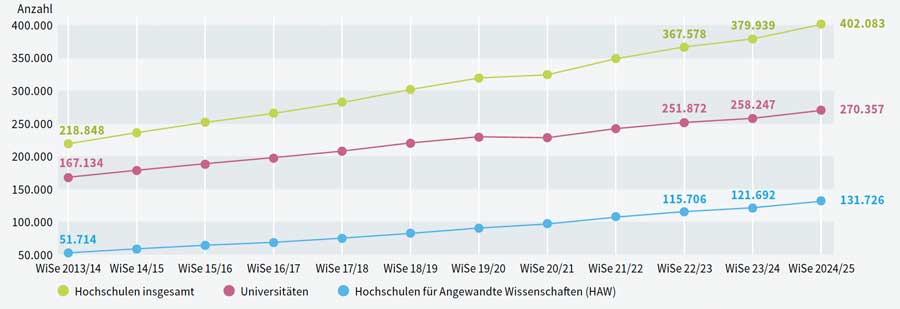
Continuing a years-long trend, the number of international students in German universities rose again this year according to the latest data from the German Academic Exchange Service (DAAD). In the 2024/25 winter semester, just over 402,000 foreign students were enrolled, an increase of +6% compared to 2023/24. This tracks with the prediction that numbers would move past the 400,000-student threshold in 2025 based on a December 2024 snapshot survey of 200 German universities in which 90% of institutions reported stable or rising international enrolments.
The Wissenschaft weltoffen 2025 (Science Open to the World) report, published by DAAD in collaboration with German Centre for Higher Education Research and Science Studies (DZHW), notes that of the 402,000 international enrolments, 116,600 were new students – a record high number of commencements.
Germany’s goal of attracting more international students stands in contrast with restrictive policies in Australia, the United States, the UK, and especially Canada (which has introduced hard caps on the number of new international students permitted into the country). Germany is also achieving success in recruiting foreign students at the master’s and doctoral programmes.
Dr Marcus Beiner, Scientific Director of the DZHW, noted that the country’s internationalisation is also benefitting the health of the higher education sector:
"It is not only the growing numbers of international students and researchers that show that the internationalisation of Germany as a centre of science is continuing to progress. This development is also evident in the structures that support internationalisation processes. For example, the number of international employees in university administration has risen sharply in recent years. The vast majority of higher education institutions in Germany now have an International Office. Almost all higher education institutions offer at least one English-language degree programme. The number of international higher education partnerships is also continuing to grow."
DAAD points out that, as of summer 2025, “state-recognised universities offered almost 2,400 English-language programmes, including around 420 bachelor's and 1,930 master's degree programmes. The proportion of English-language courses at master's level is thus a good 18%, while at bachelor's level it was only 4%.”
Where are students coming from now?
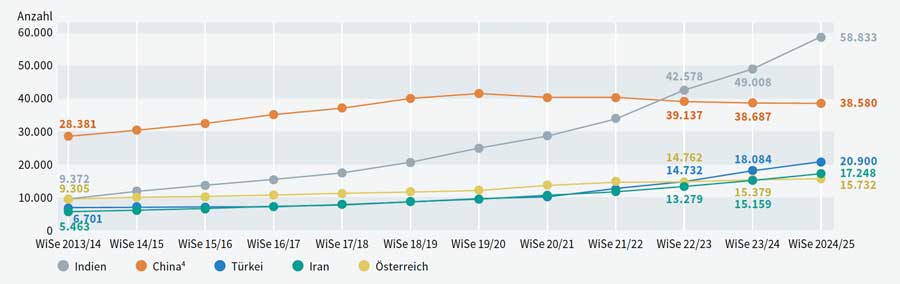
India (59,000) now significantly surpasses China (38,600) as the most important origin country for Germany, up 20% over 2023/24. Overall, Asia-Pacific represents by far the largest share of all international enrolments for Germany (33%). Africa is also a significant contributor, accounting for about a quarter of all foreign enrolments (19.3% North Africa and 5.4% Sub-Saharan Africa).
Most international students in Germany are enrolled in engineering (43%) and economics, law and social sciences (25%). The proportion of international candidates in master's and doctoral programmes is also notably high (26% and 28% respectively).
For additional background, please see:
Most Recent
-
Surprise hike in international student visa application fees “a direct hit to Australia’s competitiveness” Read More

-
ICEF Podcast: “Good, steady, and disciplined”: New Zealand’s plan for sustainable international enrolment growth Read More
-
OECD: International students may be underinformed about job prospects in top destinations Read More







