


Canada announces international student cap numbers for 2026 and updated programme guidance




- Canada has provided a detailed breakdown of its targets for study permit issuance in 2026
- The targets outline the distribution of Canada’s foreign enrolment cap across provinces and territories, and also by level of study
- The totals provided for 2026 suggest that study permit approval rates are expected to return to historical norms and considerably above current approval levels
- IRCC has also provided updated guidance for students transitioning from secondary to post-secondary studies within Canada, as well as those enrolled in joint programmes
Immigration, Refugees and Citizenship Canada (IRCC) announced this week that it expects to issue up to 408,000 study permits in 2026. That number includes the 155,000 new study permits previously announced in the Immigration Levels Plan, along with 253,000 extensions for current and returning students.
For context, IRCC notes that that projected total for 2026 is 7% lower than the 2025 target of 437,000 and 16% lower than the 2024 target of 485,000.
There are three additional points of context that are important to considering those cap limits for next year.
First, the cap now excludes master’s and doctoral degree students enrolled at public institutions. Those students are currently counted under the cap but will be exempt as of 2026.
Second, Canada is nowhere close to its current cap limits. Study permit application volumes and study permit issuances are trending well below IRCC targets for 2025.
Finally, study permit approval rates are significantly lower than historical norms this year. The approval rate for new study permit applications through the first half of 2025 was just over 30%. That compares to an approval rate of 51% for applications processed in the same period in 2024.
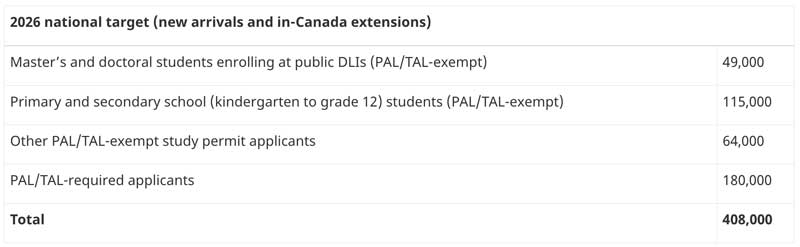
The following chart from IRCC breaks down the 2026 target into key student categories, both those exempted from the enrolment cap (masters, doctoral, and K-12 students) and those that require a provincial or territorial attestation letter (PAL/TAL) in order to apply for a study permit under the enrolment cap.
IRCC's updated cap breakdown for 2026 provides detailed allocations and targets for each province and territory in Canada, both in terms of expected study permit issuance and with respect to the allocation of PAL/TALs for each region as well.
Perhaps the most important observation about those totals is that they suggest there will be less rigid permit processing next year. The expectation is that approval rates will return to something closer to historical norms of 50%+.
The IRCC outline anticipates nearly 310,000 study permit applications for students captured under the enrolment cap, from which the ministry expects to issue 180,000 study permits. Those totals indicate a projected approval rate of 58%, which is nearly double the current approval rate in 2025.
Updated programme guidance
In updated guidance issued on 24 November 2025, IRCC provided some important updates for Canada's international student programme.
First, "Students who are transitioning from secondary to post-secondary studies and have submitted their application for a post-secondary study permit prior to their current study permit expiring may begin their studies at the post-secondary designated learning institution (DLI) while they wait for their application to be finalised."
Second, IRCC has also provided some clarifying detail for students enrolled in a joint programme (that is, at two institutions) resulting in a single credential. IRCC advises that such students require a PAL/TAL for the province or territory in which the institution issuing the credential is based. Those students will also require a single study permit for the institution issuing the credential for the entire duration of their studies.
For additional background, please see:
Most Recent
-
Decline in Indian demand a major factor in softer outlook for foreign enrolment in US higher education in 2026/27 Read More

-
Australia: As visa applications from foreign students fall, the government has set the national target for new international students in 2027 Read More
-
Independent K-12 schools in the UK hosting fewer international students this year Read More







