


Canada cuts foreign enrolment cap by nearly 50% as current year trends below COVID levels




- The Government of Canada has announced new foreign enrolment cap levels for 2026, 2027, and 2028
- The published cap limits represent roughly half of the previously projected limits for each year
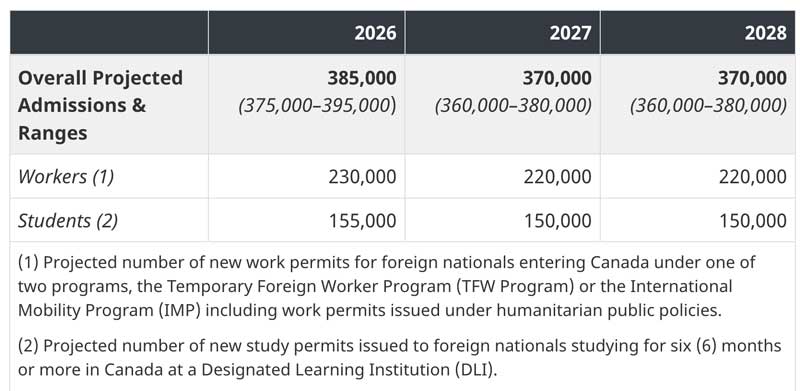
- They amount to a cap of 155,000 new study permits for 2026 (a -49% reduction from 2025 levels) and then 150,000 per year for 2027 and 2028
- Actual study permit issuance, however, fell far below the cap limits for 2024, and the number of new permit issues for 2025 is projected to be roughly a third of the enrolment limit prescribed under the cap for this year
The Government of Canada introduced a new budget on 4 November 2025. It includes an Immigration Levels Plan which sets out detailed targets for the numbers of new permanent residents and temporary residents that will be admitted for each year through 2028.
The plan dramatically reduces the cap limits for new study permits. From a foreign enrolment cap of 316,276 new study permits in 2025, the government has now set limits of 155,000 new study permits for 2026 (a -49% reduction from 2025 levels) and then 150,000 per year for 2027 and 2028.
Those new targets also represent a significant change from the previously projected limits of 385,000 in 2026 and 370,000 per year for 2027 and 2028.
In short, the government has set out in its new plan that Canada's foreign enrolment cap is here to stay, at least for the foreseeable future, and that the cap limit will be much lower than first expected.
As before, the cap applies to college students, undergraduate students, language students in programmes of more than six months, students in graduate diploma programmes, and those in master’s and doctoral programmes. Taken together, those student segments make up most of the study permit applications submitted every year.
“Over time, [the] complexity [of Canada's immigration system] has grown and its efficiency has waned," explains the budget document. In recent years, the system became even harder to manage and less functional, and the pace of arrivals began to exceed Canada's capacity to absorb and support newcomers in the way we are used to doing…In 2018, 3.3% of Canada's population were temporary residents. By 2024, that number had more than doubled to 7.5%, an unprecedented rate of growth that put pressure on housing supply, the healthcare system, and schools…We are taking back control over the immigration system and putting Canada on a trajectory to bring immigration back to sustainable levels."
The document adds that the new Immigration Plan will "reduce the target for new temporary resident admissions from 673,650 in 2025 to 385,000 in 2026, and 370,000 in 2027 and 2028…These targets keep permanent resident arrivals at less than 1% of the population beyond 2027 and will reduce the total number of temporary residents to less than 5% of Canada's population by the end of 2027.”
Catching up with reality?
As drastic as that reduction in new study permit numbers is, it needs to be said that Canada is not going to come anywhere close to its much higher cap limit for 2025 in any case.
In fact, thanks largely to a dramatic decline in study permit application volumes and surging rejection rates, the volume of new study permits issued has never reached the limits allowed under Canada's foreign enrolment cap.
In 2024 (which was the first year under Canada's current cap on new international student enrolments), the total number of new study permits issued was 267,890 – a roughly -48% reduction from 2023 levels and nearly 100,000 study permits below the official IRCC target for the year.
Study permit application volumes have continued to fall away in 2025. Data from Immigration, Refugees and Citizenship Canada (IRCC) reveals that the department processed only 104,980 study permit applications between January and June 2025 (less than half of the 2024 volume). Of those, only 31,580 were approved. That approval rate of just over 30%, compares to an approval rate of 51% for applications processed in the same period in 2024.
A new analysis from ApplyBoard now projects that Canada will approve only 80,000 new study permits in 2025 – more than 230,000 below the cap for this year. If that projection holds, that will be the lowest volume of new study permits issued in a decade, and it will fall even below the 2020 COVID level.
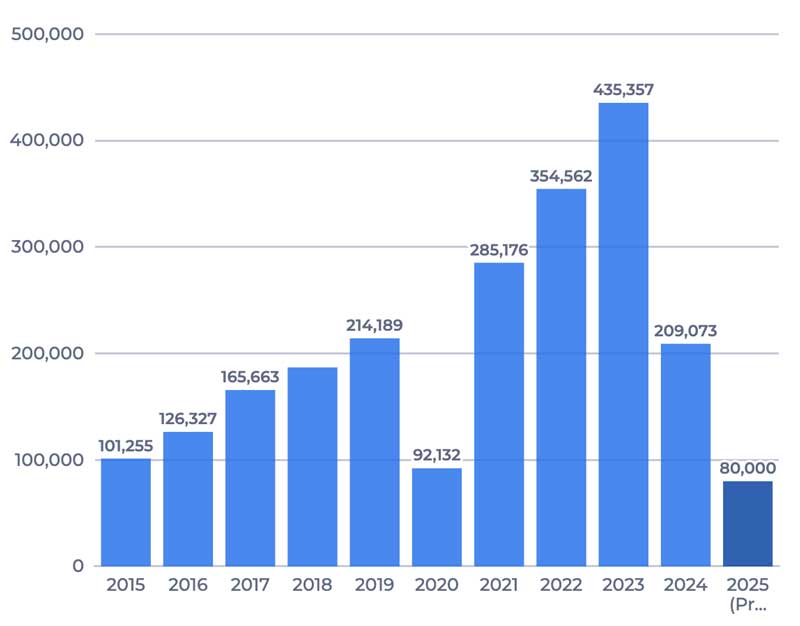
"We project that only 80,000 new study permits will be approved for international post-secondary students in 2025, representing a -62% decline from 2024," says ApplyBoard. "This decrease is caused not only by weakening student demand towards Canada, but also by a significant decline in study permit approval rates. Initial cap calculations were based on a 60% study permit approval rate, yet post-secondary approval rates reached only 37% through the first eight months of 2025."
For additional background, please see:
Most Recent
-
Offering reassurance to international students after they apply is increasingly key to securing enrolments Read More

-
Ireland’s ELT sector reports modest growth in student numbers but weeks are down amid “real and consequential” challenges Read More
-
Japan: Japanese proficiency essential for foreign graduates staying on to work Read More







