
US warns of expanded travel ban that could affect key African markets




- The US State Department has warned the governments of 36 additional countries that their citizens may be facing a full or partial ban on travel to the United States
- Two-thirds of the countries are in Africa, which was the fastest-growing sending region for US education in 2024
- In fact, the list includes two top 20 senders from 2024: Nigeria and Ghana
"The United States is considering restricting entry to citizens of an additional 36 countries in what would be a significant expansion of the travel ban announced by the Trump administration early this month," reports The Washington Post.
The Post's report is based on a State Department memo, which was obtained by the paper, signed by Secretary of State Marco Rubio, and sent on 14 June to US diplomats posted in the listed countries.
The governments of the countries listed in the memo were given 60 days to meet new benchmarks and requirements set out by the State Department. The memo also set a deadline of 18 June – mere days later – for each country to provide the US with a preliminary plan for meetings those new benchmarks. Countries that do not respond, or that do not otherwise satisfy the State Department, may find their citizens subject to a full or partial ban on entry to the United States – thereby adding to the travel bans already in place from 4 June.
The issues raised in the memo are various and vary from country to country. They include: concerns around a country's ability to produce bona fide identity documents, about “widespread government fraud," or “antisemitic and anti-American activity," or large numbers of citizens from the country overstaying their US visas.
The countries targeted for additional scrutiny in the memo are: Angola, Antigua and Barbuda, Benin, Bhutan, Burkina Faso, Cabo Verde, Cambodia, Cameroon, Democratic Republic of Congo, Djibouti, Dominica, Ethiopia, Egypt, Gabon, Gambia, Ghana, Ivory Coast, Kyrgyzstan, Liberia, Malawi, Mauritania, Niger, Nigeria, Saint Kitts and Nevis, Saint Lucia, Sao Tome and Principe, Senegal, South Sudan, Syria, Tanzania, Tonga, Tuvalu, Uganda, Vanuatu, Zambia, and Zimbabwe.
Roughly two thirds of the countries on that list are found in Africa, a continent that – because of its extremely large and youthful population and persistent issues with higher education supply – has become an increasingly important source of students for foreign institutions in recent years.
A recent brief from the Institute of International Education (IIE) points out that, "Some higher education systems in Sub-Saharan Africa will struggle to keep pace with the growth in their university-age student populations. In Nigeria, the youth population has grown so quickly that the country’s universities can only admit one-third of the two million students who apply each year."
The latest SEVIS by the Numbers report highlights that Africa was, by far, the fastest-growing sending region for US higher education in 2024.
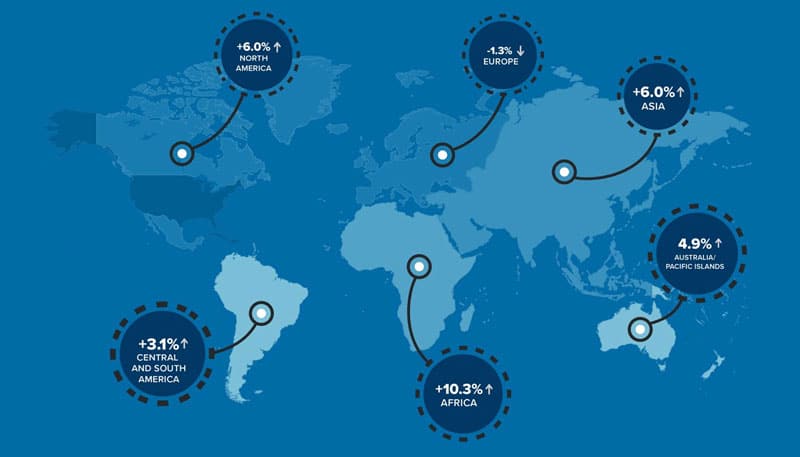
Two of the countries listed in the memo – Nigeria and Ghana – were among the top 20 international student markets for the US in 2024. Nigeria was America's 9th largest sending market last year, and Ghana was the fastest-growing African market for US educators.
"Attracting global talent is crucial for driving the US economy's growth and maintaining the country's leadership in research and development," adds the IIE brief. "International students play a crucial role in ensuring that key STEM industries have access to top talent in fields such as health, technology, and manufacturing, among others. The American economy also benefits; international students contribute over [USD]$50 billion each year to the US economy and create nearly 400,000 jobs. The U.S. will continue to drive the development of new industries, and building a domestic and global pipeline of talent will advance this pivotal role."
For additional background, please see: