


Supply and demand for international higher education increasingly aligned in Asia




- Several Asian countries are redefining their role in global education
- Some of the most important source markets for Big Four institutions are now drawing increasing numbers of Asian students, and also attracting interest from the US, UK, and Nigeria
- The expansion of English-language programmes (ETP) is a key factor in Asia’s rise as a regional destination
A new report from Studyportals and the British Council, “Asia, Latin America, and MENA in global education,” demonstrates the continued rise of study abroad destinations outside of the Big Four anglophone countries. Of the three featured regions, Asia is an especially notable hub of consolidated supply (especially of English-taught programmes) and student demand.
The report’s introduction notes that “regions that were once seen primarily as sources of outbound demand are now positioning themselves as destinations in their own right.” We can see that in international education strategies, rising foreign enrolments, and growth targets in countries such as Japan and South Korea.
A key strength for Asia is that it now collectively offers 20,000 English-taught programmes (ETPs), which allows Asian institutions to:
- Attract demand from students who might otherwise be deterred by language barriers;
- Compete more effectively with the Big Four destinations.
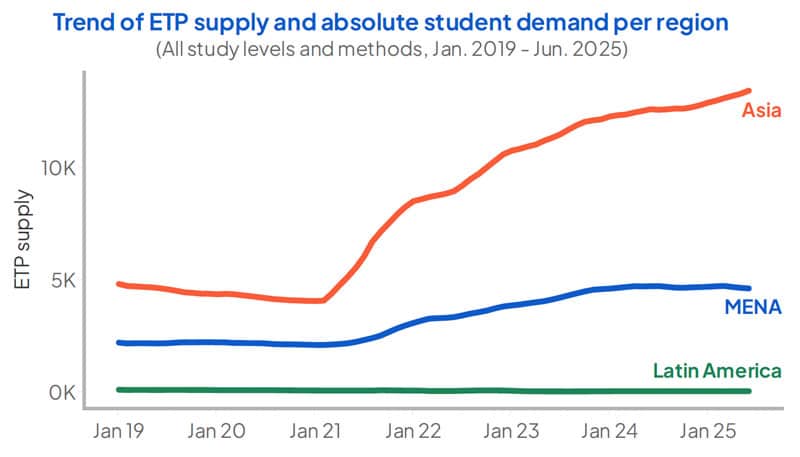
In addition, Asia (1) hosts the most transnational campuses and partnerships of any region, and (2) now has almost 600 institutions in the major world university rankings.
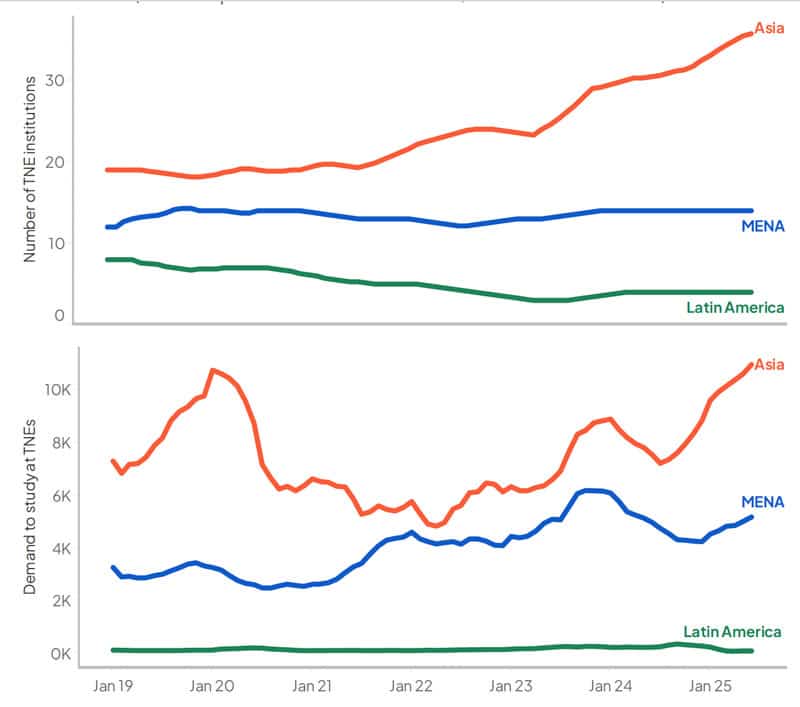
Taken together, this means that Asia is highly competitive on many fronts, including:
- Proximity to key regional source markets;
- Expanding work rights;
- Lower tuition and living costs;
- Highly ranked institutions;
- English-language programmes.
As the report notes, these attractions are perfectly timed for “students who are increasingly weighing value-for-money, online/blended learning, and clear career pathways in their decision-making.”
It is not coincidental that as countries such as China, Japan, Taiwan, South Korea, and Malaysia gain Asian enrolments, Australia, Canada, the UK, and US are losing traction in many Asian markets. Top origin markets for Asian destinations include India, Pakistan, Bangladesh, and several others.
Demand by level
Of Asian destinations, Japan and China are attracting most student interest, as demonstrated in Studyportals pageviews. Japan is the leader for master’s degrees, while Chinese bachelor’s programmes are rapidly gaining interest (+33% between 2023 and 2025). Vietnam has also gained share of student demand, up 101% for bachelor’s programmes. However, demand has weakened over the past couple of years for Singapore and South Korea.
Supply dynamics
Changes in supply on English-taught programmes (ETPs) can be signals of a destination’s ambition of becoming a study hub. For example, India expanded its supply of both bachelor’s (+54%) and master’s programmes (+53%) between 2023 and 2025. Its international enrolment target is 200,000 by 2030, up from just over 72,000 right now.
Other countries increasing their ETP supply include Singapore, Sri Lanka, and Brunei.
Important source markets
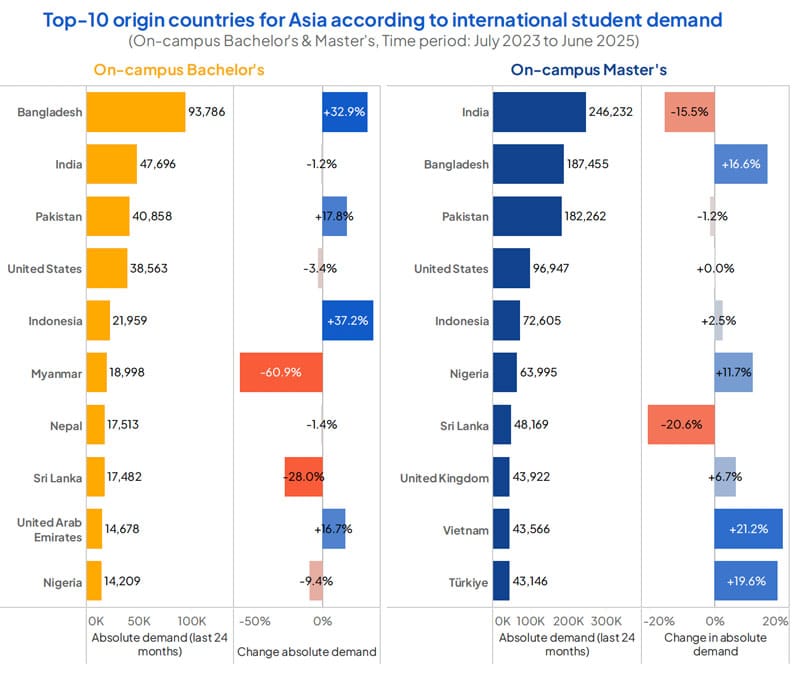
Across Asia, the most important sources of students for bachelor’s programmes include Bangladesh, India, and Pakistan, which the report says, “underscores the pull of regional proximity, affordability, and growing ETP availability across Asia.” At the master’s level, demand is most pronounced from India, but growth in demand is highest in Bangladesh and Pakistan.
Most popular programmes
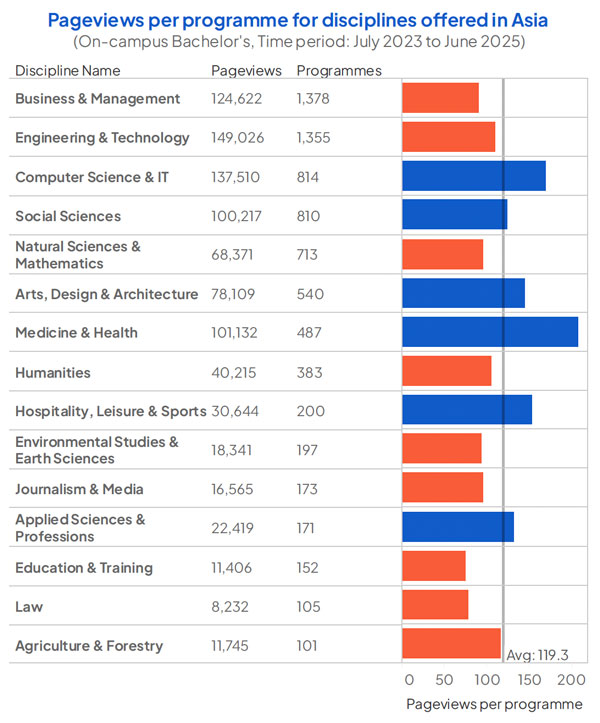
As in other destinations, students are gravitating to STEM studies. Demand for these programmes offered in Asia outpaces supply. Other disciplines could stand to attract more students.
Regional perspective
The Studyportals/British Council report considers “Asia to be a consolidated destination, MENA as having policy-driven momentum, and Latin America having a more cautious trajectory.” These regions, as well as Europe, are increasingly on the radar of the world’s international students. The report concludes:
“This continuous recalibration is redrawing the map of international education and raising important questions about how institutions and governments can remain competitive.”
For additional information, please see:
Most Recent
-
Surprise hike in international student visa application fees “a direct hit to Australia’s competitiveness” Read More

-
ICEF Podcast: “Good, steady, and disciplined”: New Zealand’s plan for sustainable international enrolment growth Read More
-
OECD: International students may be underinformed about job prospects in top destinations Read More







