


Plans afoot to stimulate UK–EU student mobility under new terms




- Following a significant trade and defence deal stuck last week with the EU, UK Prime Minister Keir Starmer has announced that negotiations are underway for a new UK–EU student mobility agreement
- The details aren’t yet ironed out, with no word on whether European students will be privy to the lower tuition fees they enjoyed in the UK prior to Brexit
- We do know, however, that the door is open for the UK to rejoin Erasmus+ under new terms
The UK government has opened negotiations with the European Union to restart a youth mobility scheme to and from the UK. The expectation is that this may result in the UK rejoining the massive Erasmus+ mobility scheme (under new terms), or something similar.
As is often the case, international education provides glimpses into broader geopolitics. The negotiations reflect a movement towards a reset of the UK/EU relationship, which was disrupted by the Brexit process and its aftereffects. The chaotic new world order ushered in by US President Trump has prompted new economic and political alliances, including in Europe. Last week the UK and EU reached a deal including a security and defence pact and lowered barriers for British food exporters and visitors.
Aiming for balance
For now, the term being used for the new educational mobility agreement under discussion is “a balanced youth experience scheme.” The use of “balanced” alludes to the UK’s intent to control the number of students coming in from Europe to avoid disrupting the operations of universities. Before Brexit, many thought that UK institutions were disadvantaged by intra-European mobility flows, with tens of thousands of European students choosing to study in the UK while paying “home fees” (i.e., the same tuition fees as domestic students). Those lower fees did not add to most universities’ bottom lines, with the cost of hosting EU students often higher than tuition revenues. By contrast, the flow of UK students to other European countries was much weaker for a range of regions including many Britons' low interest in learning foreign languages.
So far, there has been no public mention of how much European students may pay to attend university in the UK. This element of the negotiations is likely contentious, as the university sector will worry about the financial impact and the prospect of losing places for domestic students.
Looking for improved financial terms
The official UK government announcement states:
- “We have agreed that we will work towards a youth experience scheme with the EU, creating new opportunities for cultural exchange between the UK and the EU. Any scheme would give young Brits the opportunity to travel, experience other cultures, as well as work and study abroad.
- We have agreed that any scheme will be time limited, on terms to be mutually agreed, and that the overall number of participants must be acceptable to both sides.
- The exact parameters will be subject to negotiation, but the UK has been clear that any scheme should be in line with the UK’s existing schemes including participants having no access to benefits and no right to bring dependants.
- We have also agreed to work towards association to Erasmus+, on mutually agreed financial terms.
- Erasmus+ association would offer a broad range of opportunities for UK learners and staff across our education, training, youth and sport sectors, from school exchanges, work placements, language courses, and semesters abroad, to international youth work projects and training for grassroots sport staff.
- We are taking forward the next stage of negotiations on the clear mutual understanding that the UK will only associate to Erasmus+ on significantly improved financial terms."
Majority of Britons in favour of closer ties
Prime Minister Keir Starmer is faced with an interesting dilemma in terms of satisfying the British public when it comes to European negotiations. On the one hand, polls show that most of the British public wishes Brexit hadn’t happened—only 3 in 10 agree that it was right for the UK to vote to leave the EU, the lowest proportion in years of tracking. Among Britons aged 18-24, that proportion falls to 1 in 10. On the other hand, opinion is more divided about whether the UK should rejoin the EU. Nearly two-thirds (64%) would like to see the UK become closer with the EU without rejoining it, and support for this option is broad-based across various political camps Another 55% would support rejoining the EU, but that average belies significant divisions within the voting public, as shown below.
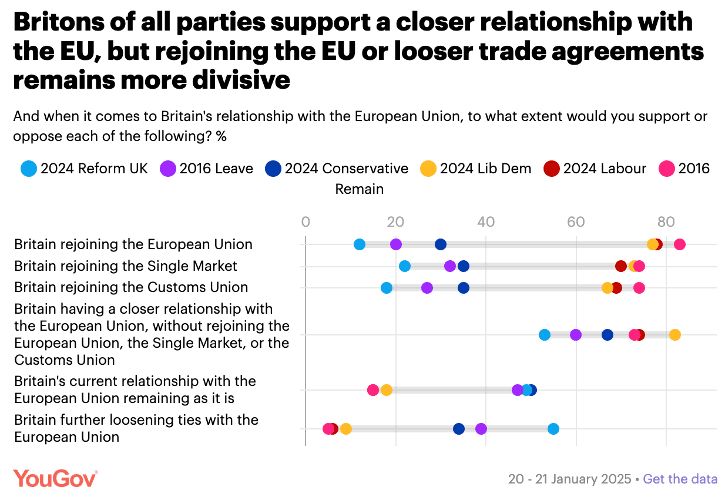
For now, Mr Starmer is referencing partnerships rather than a reunion with the rest of Europe, saying: "It’s time to look forward. To move on from the stale old debates and political fights to find common sense, practical solutions which get the best for the British people. We’re ready to work with partners if it means we can improve people’s lives here at home.”
Mr Starmer couched the wide-ranging trade and defence deal struck this month accordingly:
“So that’s what this deal is all about – facing out into the world once again, in the great tradition of this nation. Building the relationships we choose, with the partners we choose, and closing deals in the national interest. Because that is what independent, sovereign nations do."
For additional background, please see:
- "UK government sets out Brexit contingencies for student mobility"
- "New policies, Erasmus+, and booming tourism boost Spain’s international education sector"
- "Erasmus+ funding outlook for 2021 and beyond becomes more clear"
- "A closer look at post-Brexit trends in European student mobility"
Most Recent
-
Decline in Indian demand a major factor in softer outlook for foreign enrolment in US higher education in 2026/27 Read More

-
Australia: As visa applications from foreign students fall, the government has set the national target for new international students in 2027 Read More
-
Independent K-12 schools in the UK hosting fewer international students this year Read More







