


US stakeholders share priorities for a national international education strategy




- The US is the only major study destination without a national strategy for international education
- A new survey of international education professionals highlights the need for such a strategy and establishes clear priorities for reforming student visa policy, building a more diverse enrolment, and, in so doing, improving the competitiveness of the US and growing its market share
The US remains the only leading study destination without a national strategy for international education, and calls for – and indeed the prospects for – such a strategy have been building over the past year. That advocacy has most recently been focused through the newly established US for Success Coalition, a collective of peak bodies and stakeholder groups – including AIRC, NAFSA, and IIE – that aims to boost the competitiveness of the US in the global education market.
Many of those same groups have contributed to a just-released survey that explores priorities for, and issues involved with, the development of a national strategy for the US. The survey was administered by IDP in late 2023 in collaboration with AACRAO, ACCT, ACE, AIEA, AIRC, IIE, NACAC, NAFSA, The Presidents’ Alliance on Higher Education and Immigration, the US for Success Coalition, EnglishUSA and other stakeholders.
It gathered more than 400 responses from international education professionals in the US, with representation across all education sectors but with most responses (about 8 out of ten) coming from those working in higher education.
There were some clear points of consensus among those respondents, including:
- That any national strategy should prioritise a "modernisation of work pathways, visa policies, and opportunities for residency post-graduation".
- The study reports notes that, "Diversity also emerged as a key theme, with strategies proposed to address visa denial rates, provide scholarships for underrepresented groups, and promote study abroad opportunities to a wider range of students."
- Respondents were also strongly in favour of a central coordinating mechanism for such a strategy, whether established within the White House itself or via an independent cross-sectoral body.
The survey report defines a national strategy as "a coordinated plan that sets out a country’s objectives, policies, and initiatives to enhance global higher education engagement with an emphasis on optimizing participation and diversity in student exchanges, setting benchmarks for colleges and universities, fostering campus internationalisation, facilitating overseas partnerships, and developing initiatives to attract international students."
Most respondents said that they thought a national strategy would be key to enhancing the global competitiveness of the United States, but many also noted that achieving consensus across the diverse landscape of education stakeholders in the US could be the most significant barrier to establishing such a strategy.
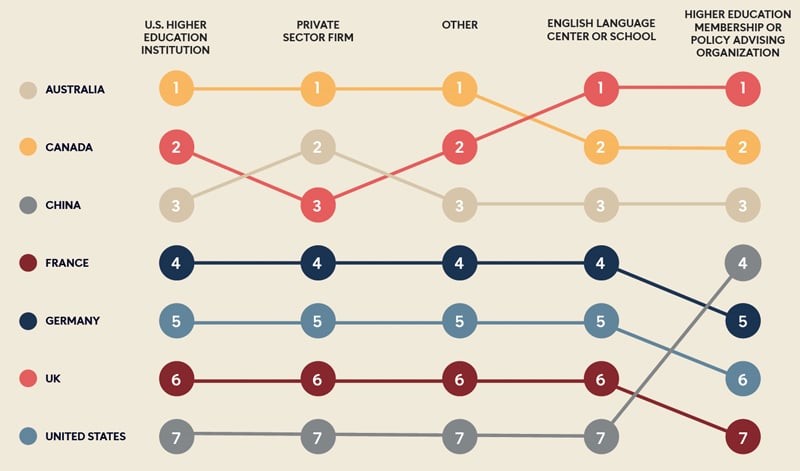
On the question of competitiveness, the following chart summarises how respondents ranked the United States' relative other major destinations.
Nearly four in ten respondents (37%) said that a key strategic goal for a national strategy should be to "significantly increase" the United States' share of international student markets over the next ten years.
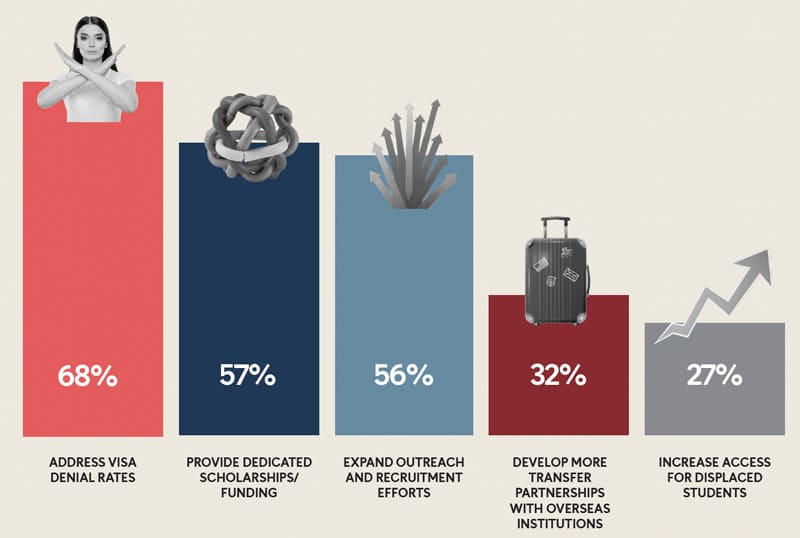
In terms of concrete strategies for expanding market share and achieving a more diverse international enrolment, most respondents cited the need to address visa denial rates, offer additional scholarship funding, and expand outreach and recruitment efforts, as summarised in the chart below.
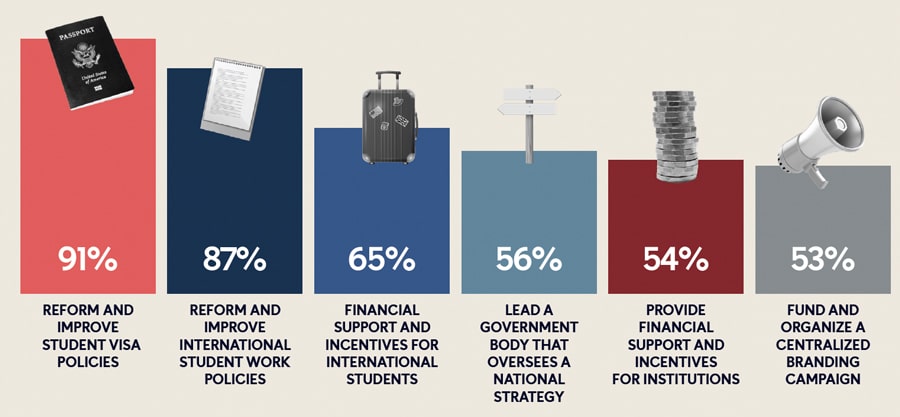
Finally, respondents also clearly envision an important role for the US government in the development and implementation of such a national strategy. This is especially true with respect to reforming student visa policies, expanding work rights for international students, and providing funding and financial supports.
"While much work is yet to be done," concludes the report, "the survey results identify key strategic priorities and action areas that will advance the national conversation and drive real progress in US international education." The complete survey report is available via IDP.
For additional background, please see:
Most Recent
-
Ascending in world university rankings and highly affordable, Azerbaijan is strengthening its offer to international students Read More

-
Netherlands reports first-ever decrease in foreign enrolment for 2025/26 Read More
-
What is happening to student mobility flows between the Global South and Global North? Read More







