

Survey shows that prospective students want more information during admissions




- A survey conducted in 77 countries shows that students want more information than they are getting about financing, employment opportunities, and career outcomes
- We researched several top universities and found that career outcomes were not as prominently placed as they should be
- There is an opportunity for educators to improve the design of their websites to respond to studetns’ top priorities
Schools and universities recruiting international students need to answer students’ questions quickly and well – whether through copy or video on the institutional website, webinars, chats and emails, or agents representing the school. Students from 77 countries responding to a survey by technology platform Interstride said they want “more complete information” in three areas in particular: financing, employment opportunities, and career outcomes.
The rationale for conducting the survey, said Interstride CEO Nitin Agrawal, was that:
“We wanted to know what international students' admissions experience is like, what can be improved, and how we can help admissions teams better engage them during this crucial time.”
The findings from the survey echo our own research this year, where top agents in 11 countries informed us that above all else, students want to know if they can work while studying when they are researching study abroad options.
In addition, the Interstride study reminds us that career outcomes are now more important to many students than a university’s rankings.
QS research from 2018, for example, found that prospects were more interested in current students’ satisfaction with an institution than a university’s brand, but that by far, prospects prioritised universities with high graduate employment rates.
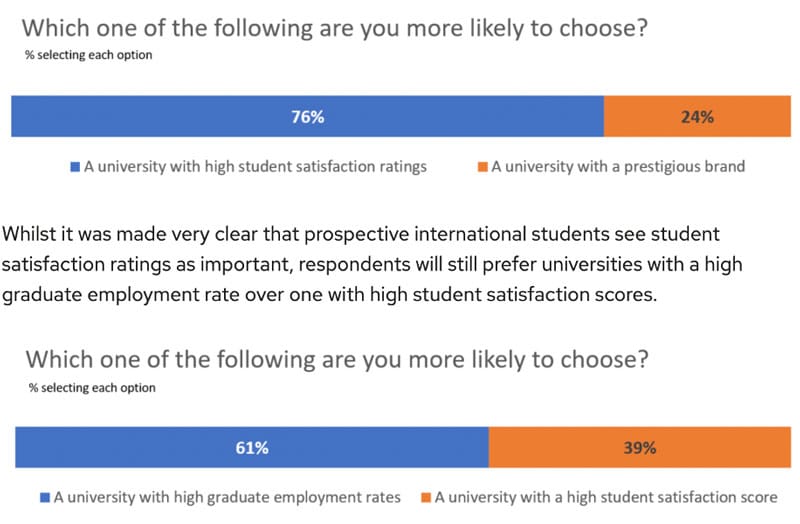
QS’s findings point to opportunities for institutions that may not be highly ranked to gain a competitive edge by promoting current student testimonials and graduate employability stats, especially on the institutional website.
A recent Unibuddy survey found that almost three-quarters (72%) of students said that checking out a college’s website was the first step in their research about where to study.
Buried competitive advantage
Interestingly, even universities that are highly ranked in QS’s Graduate Employability rankings do not often do a good job of promoting this massive competitive differentiator on their website. We looked up universities such as the University of Waterloo and University of Toronto in Canada, Northwestern University (US), University of New South Wales (Australia), Delft University of Technology (Netherlands), and University of Edinburgh (UK), for example – all ranked in QS’s top 50 in the world for graduate employability – and none of these institutions mentioned their ranking on their homepage. What’s more, none of them even broadly mentioned their reputation for connecting students with jobs on their main page.
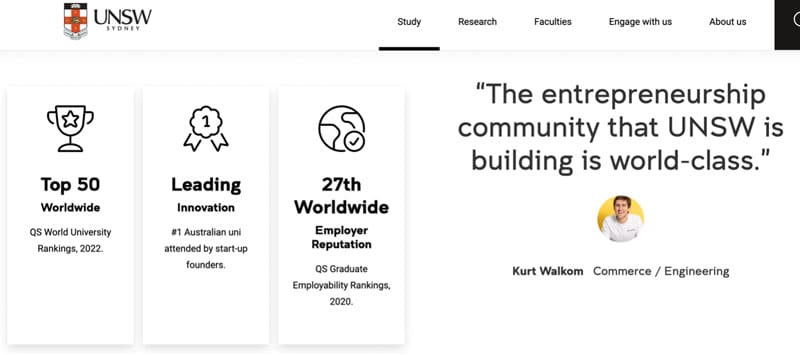
Even if they aren’t on the homepage, graduate employability details should be easy to find. For example, the University of Sydney (Australia) posts proof points about employability on their top-level “Study” landing page.
Ask students what they want to know
Posting extraordinary graduate employability statistics as prominently as possible on the institutional website – or, for that matter, anything related to superior career services – should be a no-brainer in 2022, and so should designing a homepage that asks students what they want to know. A good example of this is Toronto-based George Brown College’s homepage (below).
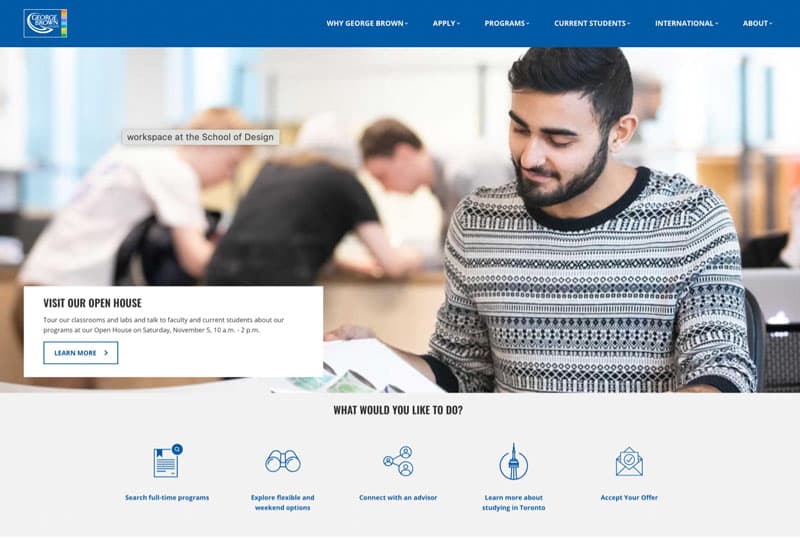
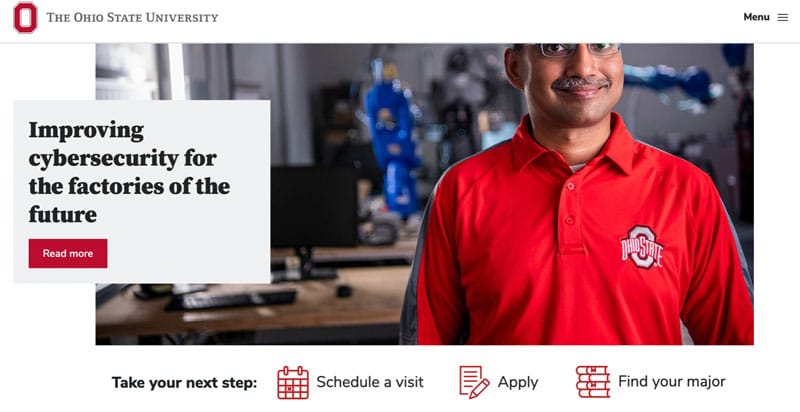
Similarly, Ohio State University asks prospective students to “take [their] next step” on their institutional homepage. The university could extend possible “next step” cues, however, as per the George Brown College example above.
Designing websites with international students’ top questions in mind, and remembering that graduate employability is one of the top qualities students are looking for, should be a focus in 2022 and beyond.
For additional background, please see:







