


Market intelligence for international student recruitment from ICEF
18th Sep 2019

Canada: Study permit rejection rates on the rise

New data released by Immigration, Refugees and Citizenship Canada (IRCC) charts a distinct increase in rejection rates for international students applying for a study permit (i.e., a study visa) for Canada.

From 2014 through 2018, total foreign enrolment in Canada grew by just over 73%, making the country the world’s fastest-growing study destination over those five years.

IRCC data supplied to Polestar Student Immigration News for year-to-date May 2019 shows that nearly four in ten applications for study permits (39%) were rejected in the first five months of this year. As the following chart reflects, this compares to a 28% rejection rate in 2014, and a 34% refusal rate in 2018.

As the chart shows, rejection rates vary by education sector, with refusal rates for those accepted to college programmes historically tracking above applicants for other sectors.

Rejection rates for Canadian study permit applications, 2014 (full year)
to 2019 (through May). Source: IRCC,
Polestar

This picture changed somewhat in 2018, however, with rejections for bachelor degree studies exceeding those for college applicants that year. As the chart below illustrates, more than half of all applicants for undergraduate studies were refused in the first five months of 2019. This compares to a 31% refusal rate for master’s studies, or 43% for college applicants.
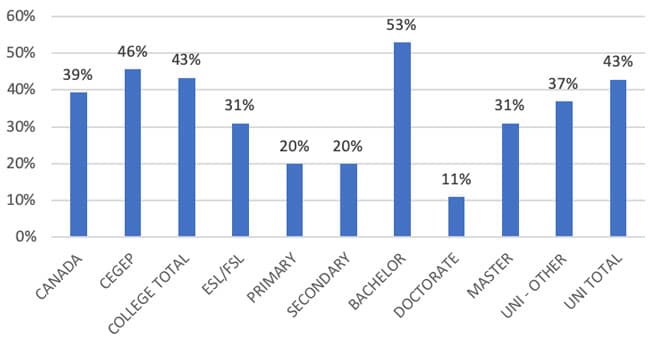
Study permit refusal rates by programme type,
year-to-date May 2019. Source: IRCC,
Polestar

A statement on the IRCC website explains that applications for study permits may be refused if the student does not:

  • “show proof that you have enough money to support yourself while studying in Canada
  • pass your medical exam, if you needed to get one
  • convince the visa officer that your main purpose in Canada is to study or
  • convince the visa officer that you’ll leave Canada at the end of your study period”

Speaking recently to AdvocateDaily.com, Toronto-based immigration lawyer Andrew Carvajal expanded on the third point above. He explains that an immigration officer may simply conclude that the applicant does not have a legitimate study plan for Canada, and may be using the study permit route as a way to quickly and legally enter the country.

"I've found more immigration officers are making that determination,” says Mr Carvajal. “Although an applicant has been accepted to a legitimate program in Canada, officials don't see those studies as legitimate. Officers have become like career counsellors, whether a programme makes sense or not. That we have seen increase.”

For additional background, please see:

Most Recent

  • UK: Visa application withdrawals surpass refusals in Q1 2026 Read More
  • Ascending in world university rankings and highly affordable, Azerbaijan is strengthening its offer to international students Read More
  • Netherlands reports first-ever decrease in foreign enrolment for 2025/26 Read More

Most Popular

  • Which countries will contribute the most to global student mobility in 2030? Read More
  • Research shows link between study abroad and poverty alleviation  Read More
  • Beyond the Big Four: How demand for study abroad is shifting to destinations in Asia and Europe Read More

Because you found this article interesting

UK: Visa application withdrawals surpass refusals in Q1 2026 UK higher education is bracing up to some challenging trends through the first half of the year. Visa...
Read more
Ascending in world university rankings and highly affordable, Azerbaijan is strengthening its offer to international students Azerbaijan – located on the western shore of the Caspian Sea, bordering Russia to the north, Georgia to...
Read more
Netherlands reports first-ever decrease in foreign enrolment for 2025/26 Peak body Nuffic reports that Dutch higher education institutions enrolled 129,764 international students in 2025/26. That total is...
Read more
What is happening to student mobility flows between the Global South and Global North?  In 2026, students in many of the fastest growing markets for schools and universities in the Big Four...
Read more
Ireland’s ELT sector reports modest growth in student numbers but weeks are down amid “real and consequential” challenges The English Language Training (ELT) sector in Ireland delivered 609,734 weeks of English instruction to 124,789 students in...
Read more
Japan: Japanese proficiency essential for foreign graduates staying on to work An increasing number of fast-growing study abroad destinations – outside of the so-called Big Four of Australia, Canada,...
Read more
Why are so many international students choosing to study in Türkiye? Türkiye used to be a niche study abroad destination, but not anymore. A rapidly growing number of international...
Read more
Recruiting in Colombia demands a long-term presence and communication with parents A new report from EdCo LATAM Consulting explores the culture within which Colombian students and families make choices...
Read more
What are you looking for?
Quick Links





