


OECD: International students may be underinformed about job prospects in top destinations




- An OECD analysis of six major study destinations finds a tension between recruitment messaging and the reality of post-graduation opportunities
- Policies, employer preferences, and language barriers create significant challenges for international graduates competing with domestic graduates for skilled jobs
For many students from emerging markets in Asia, Africa, and Latin America, there is a dream pathway attached to study abroad: Obtain internationally recognised credentials > stay and work in the host country after graduation > and, for some, obtain permanent residency.
This dream is one that is often referenced by universities promoting their programmes abroad, and it tends to be presented as universally possible. But the truth is that only some students are able to progress along that pathway.
The OECD (Organisation for Economic Co-operation and Development) has produced a report called “A comparative analysis of trends, challenges and policy responses in Australia, Canada, France, Germany, the Netherlands, and the United Kingdom.” The analysis shows that institutions in major destinations may be:
- Overpromising a route that is attainable only by a segment of their foreign graduates;
- Not providing the level of language and career supports needed by many graduates to have a good chance of working in-country after their studies and/or gaining permanent residency.
The report also reveals that government policies – and policy volatility – can present unforeseen challenges for international graduates hoping to find jobs that match their hard-won skills.
The OECD observes: “There appear to be tensions between recruitment messaging, which suggests future employment and possible residence, and the realities of post‑graduation opportunities.”
This can lead to false confidence among international students, who, “not always having all relevant information, have at times, an unrealistic expectation of the ease with which they can find a job, secure visa/permit and obtain permanent residency or even citizenship.”
Retention is an issue
Across the six countries analysed, the highest five-year retention rates were in Canada and Germany (52% each). This dipped significantly to about a third in Australia and France (34% and 33%, respectively) and to 19% in the Netherlands. In the UK, only 7% of international graduates were still in the country on a work permit or other immigration permission after five years.
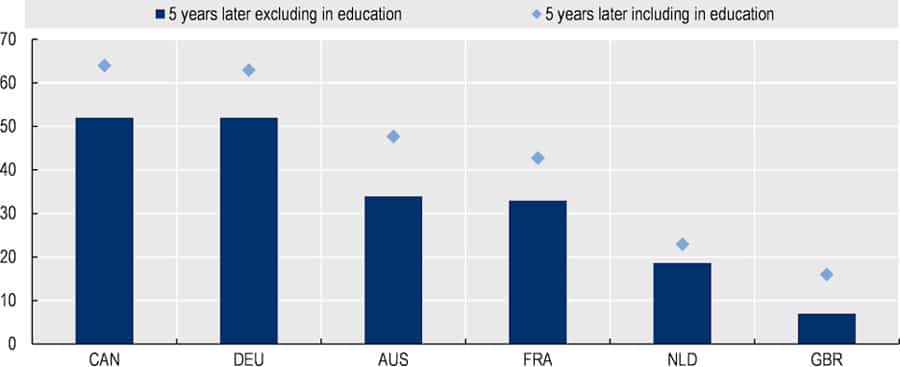
These low retention rates contrast with international students’ high hopes to remain in the country to work after completing their studies: over 70% in Canada, 73% in the Netherlands, 64% in Germany, and 83% in France want to stay on to work.
What barriers are international graduates facing?
The reality that many international graduates face is that employers in their host country find it too cumbersome or expensive to hire them. This leaves many students at a pronounced disadvantage compared with domestic peers.
For example, in Australia, a government-funded international student survey found that for about 20% of international graduates who reported taking a job which they were overqualified, the main reason was that they did not have permanent residency. Many Australian employers see temporary visas as unstable (in the sense that these visas have an expiry date) and administratively burdensome. It is not worth it for them to invest time and money in hiring a foreigner if they can find a domestic graduate with the right skills for the position.
As a result, many graduates go into “visa limbo” where they accept poorly paid jobs unrelated to their skill-set and education. They often apply for another work visa to remain in the country, but they end up becoming “permanently temporary” rather than permanent residents.
The report referenced surveys showing that in three of the six countries analysed, most international students say they feel inadequately prepared to secure a job after graduation and/or to find a job after their studies. For example:
- In the Netherlands, 59% faced difficulty in finding a job after graduation;
- In Germany, only 35% felt “rather” or “well” supported by their institution in planning their career;
- In the UK, 53% thought career support and placements at their institution should be improved, followed by internships and experiential learning.
The OECD notes:
“There seems to be a shared nervousness about the transition to employment among both international and domestic students. However, in the case of international graduates, the transition to employment is also tied with the possibility to remain in the country.”
The list of barriers can also include low language proficiency in destinations where English is not the dominant language:
“During their studies, international students are surrounded by English, in their institution and [because] they tend to socialise with other internationals. However, job opportunities for English speakers … tend to be very limited and concentrated in a few specific industries. Most companies in France, Germany, or the Netherlands will still expect at least working-level proficiency of the local language.”
This is particularly relevant given the high number of English-taught programmes (ETPs) in France, Germany, and the Netherlands – many of which do not require competency in these countries’ official languages. These are major attractions for non-EU students especially, and non-EU students are also the segment most interested in remaining in their host country after completing their studies. The issue here is that many of those ETP-enrolled students will not have gained sufficient proficiency in the official language (French, German, or Dutch) to compete successfully for jobs.
Recommendations
The OECD recommends that institutions adopt “a more realistic approach that clearly communicates that available opportunities, jobs and permanent residency permits, might be scarce. That stay after graduation is not guaranteed, and that there is a significant uncertainty about whether a particular international student will be able to settle in the country long term.”
Specific recommendations for policy makers and institutions include:
- Helping international students to understand the labour market, before and during their studies, to guide them in what topics to focus on and on choices regarding their education.
- Integrating labour-market literacy into programmes, supported by career centres.
- Allowing students to engage with employers and gain work experience during their studies. For example, “both professional networks and relevant work experience have been identified as among the most highly rated factors in finding employment by international graduates in the Netherlands.” This recommendation means “higher education institutions must establish and maintain strong relations with relevant employers.”
- Informing international students to start looking for possible employment early, to better inform them about various employment opportunities: “International students tend to be aware of the big and well-known companies but are not always aware of small- and medium-sized businesses and other employers.”
- Developing alumni networks that allow international graduates to turn to former students for career support and guidance.
For additional background, please see:
- “Germany’s foreign enrolment continued to grow in the 2025/25 academic year”
- “Many foreign students want to stay in Germany but need more help with the transition to life after study”
- “Netherlands reports first-ever decrease in foreign enrolment for 2025/26”
- “Canada struggling to attract and retain global talent”
- “UK to implement reduced Graduate Route from January 2027”







