
Survey highlights student views on returning to study abroad




- A majority of respondents to a new student survey are happy to have returned to study abroad this year, whether online or in-person.
- However, most are looking for further financial incentives from their institutions, especially in cases where COVID has forced programmes to go online
A newly released survey report gathers responses from nearly 15,000 prospective and current international students to explore students' perspective of returning to study abroad this year. Responses for Studying abroad again: How do current and prospective international students feel about the return of studying overseas? were collected between January and June 2021 from markets around the world.
Perhaps not surprisingly, the responding students expressed a strong preference for in-person teaching (61%), with only 17% indicating they preferred online study (another 23% did not express a preference). Of those who had already begun or resumed their studies this year, however, more than half (55%) said that their universities had been either "extremely effective" or "very effective" in their delivery of online programmes.
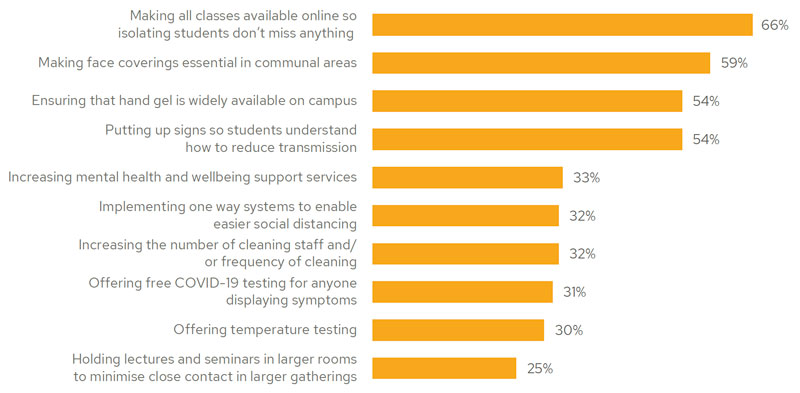
This is just as well as students also reported that the shift to online delivery is the most frequent tactic employed by institutions to limit the spread of COVID-19. As the following chart reflects, that pivot to online learning has been accompanied by a range of public health measures and students supports at many institutions.
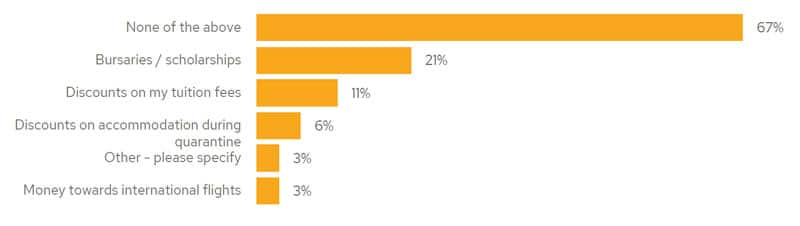
The survey also considered the extent to which students were offered any incentives by their institutions to return to study this year. The short answer in that respect is "no," with two-thirds of respondents saying they were not offered discounts or financial incentives of any kind. Much smaller numbers of students said that they received funding support, tuition discounts, or assistance with quarantine costs.
Interestingly, when asked what measures would make a different to them in terms of providing a further incentive to study overseas, students most often cited scholarships (49%) or tuition discounts (36%) as the most attractive options. In its analysis of the findings, QS makes the related point that, "While some financial incentives are seen as measures to encourage the return to international study, many students see it as a necessary reimbursement given the fact that their higher education experience is, or will be, far from the typical university experience had by so many before them." The students were similarly unequivocal in their view of discounts for online studies, with 81% saying that they believe fees should be adjusted where programmes are forced to shift online due to COVID.
The important question of vaccine equity
Finally, the survey measured student opinions on the impact of COVID vaccines. Roughly one in five (21%) said that the introduction of vaccines has encouraged them to start their studies earlier than they might have otherwise. But a surprising 42% said that vaccine availability has not factored in their study plans. "There may be several reasons for this," adds QS, "including the fact that, in some countries, young people may still have to wait a significant period until they are called for vaccination, or may not have access at all."
This finding points to a significant underlying issue for any international business this year: vaccine equity. Another recent report, this time from the UN World Tourism Organization, finds that "international tourism and its closely linked sectors" incurred an estimated loss of US$2.4 trillion in 2020. The report cautioned that a similar loss could be registered in 2021 as well, depending in large part on the availability, and uptake, of COVID vaccines.
"COVID-19 vaccination rates are uneven across countries, ranging from below 1% of the population in some countries to above 60% in others," adds the UNWTO. "The asymmetric roll-out of vaccines magnifies the economic blow tourism has suffered in developing countries, as they could account for up to 60% of the global GDP losses."
The other side of that coin is that international tourism is expected to recover more quickly in countries where there are higher vaccination rates, such as France, Germany, the UK, and the United States.
That global pattern of wide disparity in vaccine availability from country to country is an important cautionary note with respect to the timing and scale of recovery in international mobility. And it appears to be informing as well the mixed views and expectations that international students have about vaccines this year.
For additional background, please see: