
International students increasingly willing to switch destinations for in-person learning




- A new study tracking international students’ attitudes and behaviours through the pandemic finds that students are increasingly willing to begin studies online if they can eventually switch to face-to-face learning
- Demand for in-person learning is high, and more than half of international students said they would consider switching destinations for the chance to begin face-to-face learning as soon as possible
As COVID-19 wears on, tens of thousands of international students’ study abroad plans remain on hold, and those who are enrolled are having a very different experience than they might have imagined. Some are learning in-person on campuses, but many are learning online or through a combination of online and in-person instruction. A new study from IDP Connect – the third in their International Student Crossroads tracking series – provides insights on students' (1) intentions regarding study plans and (2) perceptions of five major destinations at this point in the pandemic.
The third installment of the study examined the attitudes and behaviours of 5,000 international students in October across Australia, Canada, New Zealand, the United Kingdom, and the United States. Students were either enrolled or had offers to enrol in higher education institutions in the five destinations.
Students are looking for in-person teaching
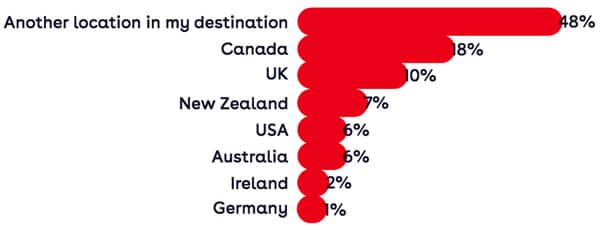
A key finding from the study is that international students are eager for in-person classes to resume, and many would be willing to switch destinations in order to receive face-to-face instruction. More than half (56%) said they were likely to switch destinations, and 32% of them said they were “highly likely” to do so.
Students are most likely to consider Canada as a compelling alternative destination (18%); the next most attractive to them is the UK (10%).
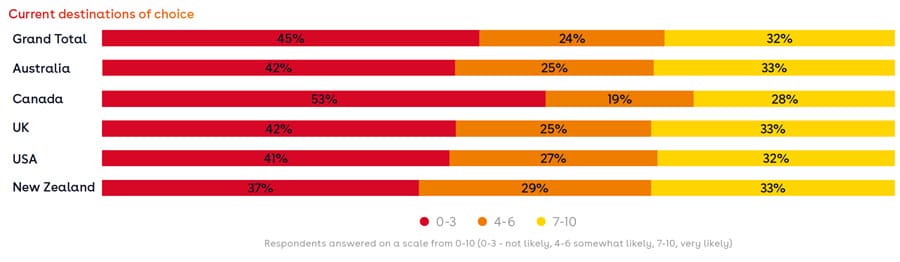
Canada also emerged as the destination commanding the highest level of brand loyalty, with 53% of students currently planning to study there saying they are not likely to switch to another destination. Even still, the 47% who show a willingness to consider an alternative to Canada is a large proportion.
More prefer to quarantine rather than defer
Students are increasingly accepting of safety measures aimed at minimising the further spread of COVID. Fully 9 in 10 (92%) said they are willing to quarantine upon arrival, with only 8% preferring to defer. In June, the proportions were 72% willing to quarantine and 23% preferring to defer.
That said, students from two important sending markets – China and Indonesia – are significantly less interested in quarantining and correspondingly more likely to defer. Three-quarters (75%) of Chinese and 80% of Indonesians would accept quarantine, while 25% and 20%, respectively, would defer.
Increasing acceptance of an online programme start
The findings also suggest that students are increasingly worried about pausing their studies in hopes of an imminent in-person start date. More students than in the previous two installments of the study are now willing to start their programmes through whatever means possible. In April, only 31% were willing to begin their studies online; in October, this proportion grew to 43%. The distinct preference is for face-to-face learning, and 44% of respondents said that they would wait for only three months before transitioning to face-to-face.
Good news for 2021
A sure sign of international students’ enduring drive to study abroad is that 80% of respondents now expect to begin their studies as planned in 2021, up from 69% in April and 74% in June.
New Zealand gets top marks
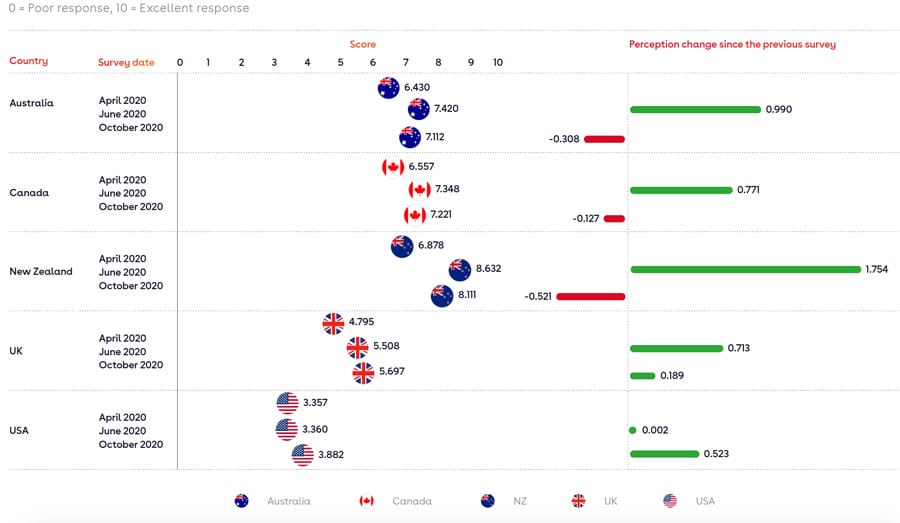
Students who had planned to study in New Zealand and Australia may feel frustrated at their inability to do so because of the countries’ tight border controls, but overall, New Zealand, Canada, and Australia continue to be perceived as the destinations that have responded the best to the pandemic.
The US and UK trail behind but have made some gains in terms of their perceived response over the past few months, possibly because international students have been pleased with these countries' borders remaining open to them. By contrast, New Zealand, Canada, and particularly Australia have dipped somewhat in students’ estimation of their pandemic response. New Zealand’s and Australia’s borders remain closed to international students while Canada’s just opened in late October. It will be interesting to see if students’ perceptions of Canada’s performance in the pandemic change as a result in coming months.
“Open for Business” signals are key
Simon Emmett, CEO of IDP Connect, said that the company’s latest Crossroads survey shows that there is “a real risk associated with being perceived as a country that is less ‘open for business.’” He noted that looking across destinations, those with closed borders have lost traction among students: “Countries that have communicated strongly that international students are welcome, such as the UK, have seen a rise in attractiveness compared to countries with stricter border controls, such as Australia.”
“As new study semesters commence, we encourage education institutions to understand the concerns of their student cohort and work with governments to find new ways to deliver blended models of delivery and enable students to study on campus sooner,” Emmett said.
For additional background, please see: