Canada: student group calls for improved supports for international students




The Canadian Alliance of Student Associations (CASA), a group representing 270,000 post-secondary students, has released a report calling for more support for international students studying in Canada: Value Beyond the Dollars and Cents: International Students’ Contributions to Canada and their Need for Supports. The report comes at a time when Canada’s international student numbers are growing exponentially, requiring many Canadian schools, colleges, and universities to adapt to rapidly changing campus dynamics. The CASA report notes that the Canadian government views talented international students as ideal candidates for immigration and vital for alleviating skills shortages in the Canadian workforce. CASA points out that while Canadian colleges and universities are actively recruiting and adding international students to their campuses, numbers alone do not tell the whole story. Ultimately, the report argues, Canada’s ability to build international student enrolments will depend on whether it can provide students with positive experiences of living, studying, and working in the country:
“Attracting more international students, it is clear, is directly tied to the ability of Canadian post-secondary institutions, as well as provincial and federal levels of government, to make the case for Canada as an appealing, respected and top-quality destination for academic pursuits and career development.”
The following video clip from CASA expands on this point.
Tuition fees and affordability
Recent research by the Canadian Bureau for International Education (CBIE) has shown that international students’ satisfaction with their studies in Canada is high (93% satisfied, 55% very satisfied), but that there are some areas where improvements are required. In particular, eight in ten students surveyed said that they were concerned about their ability to pay for accommodation, and a substantial proportion of students who had not yet found employment during their studies were having difficulty finding paid employment (43%).
At the same time as some international students are concerned about affordability, the tuition fees that international students pay to Canadian institutions have been rising. And, they have been increasing at a rate far greater than Canadian students’ fees, as illustrated in the chart below.
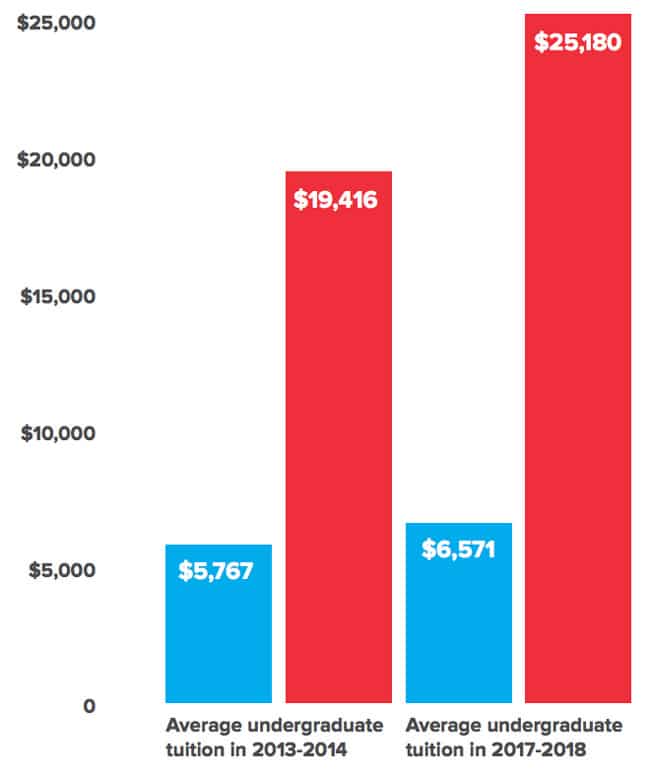
“Additionally, a lack of funding opportunities prevents the enrolment of international students who might have lots to offer the overall quality of post-secondary education in Canada, but who come from lower income backgrounds.”
Difficulties with social integration
The CASA report echoes CBIE research that found that along with affordability, social integration is emerging as a challenge for many international students. More than a quarter of students participating in the CBIE survey did not agree that they were encountering success in becoming involved in campus activities. CASA notes that when students aren’t happy socially at school, it can affect their determination to stay in Canada to work and/or immigrate:
“[International students’ difficulties with social integration are] especially concerning in light of the fact that many international students will make decisions about whether to stay and work in Canada following graduation based on their study experiences.”
They argue that this is especially true because “international students also encounter challenges when seeking to work while studying in Canada, and when aiming to stay and work in Canada following graduation.” Indeed, many of the CASA report’s key recommendations are ideas for making it easier for international students to work and immigrate to Canada.
Key recommendations
The CASA report makes several recommendations in the report, including:
- More supports on campus for international students (e.g., writing centres, counseling, advising) as well as a more meaningful approach to internationalisation so that Canadian students benefit more from the presence of international students on campus;
- More straightforward explanations of visa processes for spouses/partners of international students, and more understanding in general that many international students would prefer coming to Canada to study (and potentially stay on to work) with their partners as opposed to by themselves;
- “Greater accessibility for international students from all economic backgrounds” through new scholarships based on merit and need, as well as specific funding for refugee students;
- Faster immigration processes allowing international students to work while studying;
- The extension of off-campus work rights for part-time international students;
- The introduction of full-time elective internships or co-op internships of up to a year for international graduate students;
- An extension of the period of time in which international graduates can remain in the country to look for work from 90 days to 6 months, “to better reflect the average time it takes to get a job”;
- An adjustment of policy that would see the government apply international students’ time studying toward their citizenship eligibility (as well as several other recommendations around making it easier for international students to immigrate);
- More start-up and entrepreneurship programmes for international graduates to start businesses in Canada;
- Tighter regulation around international branch campuses set up by Canadian institutions in other countries.
For more, please see the full report online. For additional background, please see:
Most Recent
-
Breaking: US Department of Homeland Security publishes rule to end Duration of Status for international students Read More

-
Joint sector alert sends a clear compliance message to Australian higher education and VET providers Read More
-
Academic support and learning resources in TNE: Delivering student success across borders Read More