Market intelligence for international student recruitment from ICEF
27th Jun 2018

China’s rapid urbanisation becoming a global story


The economist and Nobel laureate Joseph Stiglitz has been widely quoted as predicting that urbanisation in China is one of two transformative forces that will most impact global prosperity in the 21st century (the other: technological innovation in the US). However you may feel about economists, the movement of greater numbers of Chinese to a growing number of large Chinese cities is an unmistakable trend, and notable in part for its sheer scale. Forecasters expect that roughly 70% of the country's population – or about a billion people – will be living in cities by 2030. And a new report from The Brookings Institution only underscores the importance of the continuing migration toward large cities throughout the country. Brookings actively tracks the performance of the world's 300 largest metropolitan economies, as measured by GDP and employment data. In 2014, less than 50 of the top 300 cities were found in China. In an updated tracking study released earlier this month, China was home to just over a third (103) of the total. The pace of this change is being driven by the still-hot economic performance of many of China's cities, which as a group continue to outpace the growth of large cities elsewhere in the world. In a recognition of the complexity and variety of cities within China, Brookings has classified this field of more than 100 large urban centres into five "city types" based on size, composition of the local economy, and growth patterns. They include:

  • "Giants": A category that belongs only to the two mega-cities of Beijing and Shanghai.
  • "Anchor Cities": A next tier of 14 large cities that together account for about a quarter of China's GDP: Tianjin, Chongqing, Zhengzhou, Nanjing, Hangzhou, Guangzhou, Wuhan, Changsha, Chengdu, Qingdao, Suzhou, Wuxi, Ningbo, and Shenzhen.
  • "Rust Belt": Six cities previously noted for their prominent role in China's declining steel and coal industries: Harbin, Daqing, Changchun, Jilin, Shenyang, and Dalian.
  • "Service Cities": Another 24 centres where the local economies are heavily weighted toward the service sector.
  • "Industry Cities": A final cohort of 57 metropolitan areas where industry (e.g., manufacturing or extractive industries) continues to drive the local economy.
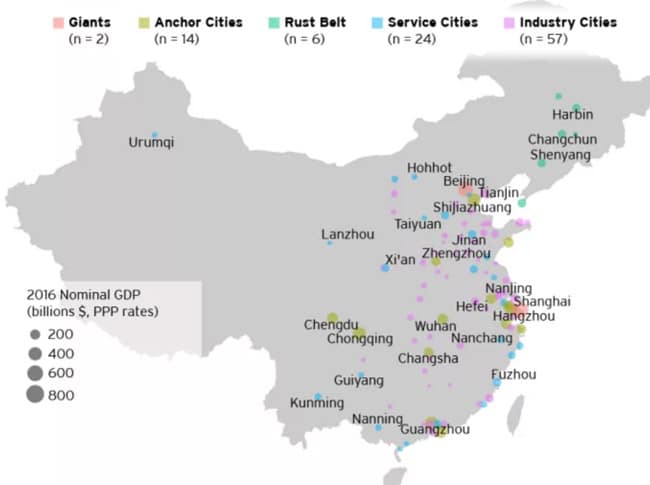
the-five-categories-of-chinese-cities-as-defined-by-the-brookings-institution The five categories of Chinese cities as defined by The Brookings Institution. Source: Brookings

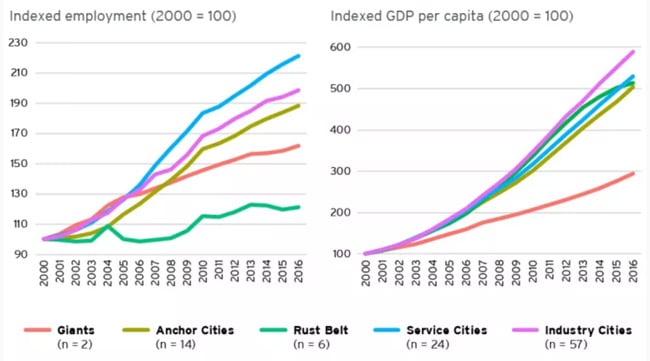
The report notes as well that each category of city demonstrates different employment and growth patterns. "While Beijing and Shanghai still get most of the headlines, they no longer serve as the main engines of national economic growth," says Brookings. "Domestic migration has been shifting from Beijing and Shanghai to smaller cities for a decade...The gap in average living standards (measured by GDP per capita) between the two Giants and other Chinese metro areas is also shrinking. Since 2000, GDP per capita in China’s 101 metro areas outside of Beijing and Shanghai rose twice as fast as in the two Giants." This relationship between Beijing and Shanghai and the other categories of urban centres in China is illustrated in the charts below. They reflect that growth in employment, and also in economic output, in Beijing in Shanghai has been eclipsed by that of other Chinese cities. growth-patterns-by-category-of-chinese-city-2000-2016 Growth patterns by category of Chinese city, 2000–2016. Source: Brookings The performance of both "Anchor" and "Service" cities are particularly notable in the charts above, in that they reflect the continuing transformation of the Chinese economy. As Brookings says of the "Anchor" category: "These metro areas are usually the regional hubs for transportation, with well-connected domestic high-speed rail and international airports or seaports. They also house many of the country’s tech unicorns, including Alibaba (Hangzhou), Tencent (Shenzhen), and Huawei (Shenzhen). As China’s Anchor Cities transition toward higher-value industries, skilled labor shortages are forcing them to aggressively compete for talented workers, including from Beijing and Shanghai." A similar pattern is playing out in "Service" cities, each of which has relied more heavily on industrial activity in the past and would have at one time been classed as "Industrial" cities. Strictly from a recruitment perspective, this analysis highlights a growing field of robust metropolitan areas throughout the country – second-tier cities and beyond – that will likely play a greater role in Chinese student mobility in the decade ahead. More broadly, economic growth and demographic social and trends in China are stories that will increasingly be told through the country's cities. And beyond its borders, the scale and reach of China's urban centres will play a greater role in shaping global patterns and performance as well. For additional background, please see:
Most Recent

  • A common challenge: Strengthening student confidence in the ROI of study abroad Read More
  • New international student permit approvals for Canada fell below COVID levels in 2025 Read More
  • UK Home Office publishes updated visa sponsor guidance for “agents and third parties” Read More

Most Popular

  • Which countries will contribute the most to global student mobility in 2030? Read More
  • Research shows link between study abroad and poverty alleviation  Read More
  • Beyond the Big Four: How demand for study abroad is shifting to destinations in Asia and Europe Read More

Because you found this article interesting

New international student permit approvals for Canada fell below COVID levels in 2025 Canada approved only 75,372 new study permits in 2025. This represents a -64% drop year-over-year, and an -18%...
Read more
UK Home Office publishes updated visa sponsor guidance for “agents and third parties” The UK government has expanded its regulatory oversight for British institutions’ engagement with education agents. The existing structure...
Read more
Visa rejections climb in the US for international students from key markets including India A new report from Shorelight called Beyond the Interview: A Decade of Student Visa Denials
and What Comes Next,...
Read more
Supply and demand for international higher education increasingly aligned in Asia A new report from Studyportals and the British Council, “Asia, Latin America, and MENA in global education,” demonstrates...
Read more
Canadian immigration officials move to ease rules around student work permits Immigration, Refugees and Citizenship Canada (IRCC) has introduced a package of amendments to the current rules around student...
Read more
Australia: Student visa refusal rates reach record high amid weakening demand from China Australian universities have so far faced fewer challenges than English-language training (ELICOS) and vocational education providers in the...
Read more
What international students need to know about study and work visas in the United States The current political climate in the United State has spurred a flurry of proposals and rules affecting the...
Read more
Study finds strong agent interest in partnering with Japanese universities For many years, institutions in the Big Four (Australia, Canada, UK, and US) have partnered with educational agents...
Read more
What are you looking for?
Quick Links