Increasing numbers of Chinese graduates returning home from overseas




For years, Chinese students have been flocking to foreign universities to study – often staying on to work after graduating. As recently as 2013, the US-based National Science Foundation found that more than 9 in 10 Chinese students graduating with American PhDs remained in the US five years after finishing their programmes. “These so-called ‘sea turtles’ have long been prized by Chinese companies, both for the quality of their education as well as their experience of living abroad,” says a recent report from Forbes.
There are signs, however, that the labour market for returning students is changing, even as graduates of overseas institutions are now returning to China in greater numbers.
Official government statistics show that 339,700 Chinese students went abroad during 2011, with 186,200 overseas graduates returning to China that same year. In 2016, 544,500 Chinese students went abroad while 432,500 returned from overseas study.
In other words, the number of returning students, as a proportion of outbound students in each year, increased from 55% in 2011 to nearly 80% in 2016. In absolute terms, this represents a 132% increase in the annual volume of returning students over this five-year period.
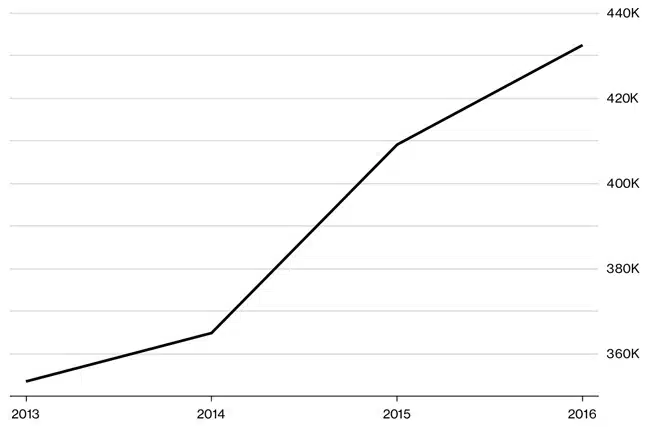
It’s the economy
The growing Chinese economy is not surprisingly one of the factors tempting Chinese students to return home after graduating – particularly if their skills are a match for China’s hot tech industry, which grew by about 10% between 2015 and 2016 alone. New opportunities in the tech sector in China contrast with an environment in which Chinese students with US degrees have faced limits to upward movement in careers in US tech companies. A recent study found that in five major US companies – Google HP, Intel, LinkedIn, and Yahoo – Asians and Asian-Americans represent 27% of employees overall but only 14% of those in executive positions. Redressing this imbalance may well be a top priority for such companies as they face the growing reality that Chinese companies seek out American-schooled Chinese graduates to fuel their growth. Bloomberg notes that,
“US-trained Chinese-born talent is becoming a key force in driving Chinese companies’ global expansion and the country’s efforts to dominate next-generation technologies like artificial intelligence and machine learning. Where college graduates once coveted a prestigious overseas job and foreign citizenship, many today gravitate toward career opportunities at home, where venture capital is now plentiful and the government dangles financial incentives for cutting-edge research.”
Bloombergnotes that the technology sector is now the “biggest draw for overseas Chinese returnees, accounting for 15.5% of all who go home, according to a 2017 survey of 1,821 people conducted by the think tank Center for China & Globalization and jobs site Zhaopin.com.” This is up from just 10% in 2015. Salaries in China’s tech sector are increasing in tandem with the sector’s expansion, with those for Artificial Intelligence professionals among the particularly impressive: team leaders in this sector with three to five years of experience can make more than 1.5 million Yuan (roughly US$237,000) annually.
Star power plays a part too
The increasing prestige of massive Chinese companies – such as Tencent Holdings, e-commerce giant Alibaba Group, media aggregator Toutiao, AI startup Cloudminds, and the search engine Baidu – is without doubt a major factor drawing Chinese talent home. What’s more, there are ever more cases of Chinese students taking their foreign degrees back to China and achieving tremendous success as entrepreneurs and innovators. For example:
- Forbes recently interviewed 29-year-old Kevin Diao, who left the US for Beijing to found Meixin Finance, a wealth management company which in 2017 raised “‘tens of millions of dollars’ in investment led by Korea Investment Partners. Mr Diao told Forbes, “If I’d stayed on Wall Street, I thought I might end up being a managing director at some bank. But China is different. The market is moving so fast, and there are so many opportunities. "
- Bloomberg further highlights the example of 37-year-old Wang Yi, a graduate of Princeton University, who left California and a position at Google to go to Shanghai and launch a popular English teaching app, LingoChamp, which raised $100 million in 2017.
Foreign degrees not always a ticket to success
Even as more Chinese students with foreign degrees are returning home, Chinese universities are climbing up world rankings, which may in turn be contributing to an apparent closing of the competitiveness gap between graduates of domestic and overseas institutions. The online newspaper Sixth Tone recently stated that “foreign degrees have become so common among Chinese job applicants that they are no longer the deciding factor for landing a position.” The trend is prevalent enough that in 2017, reports Sixth Tone,
“… state news agency Xinhua coined a new term for students who have spent only a short period of time abroad and are unsure of their career paths: 'bathing crabs,' a reference to hairy crabs dunked for a few hours in eastern China’s famous Yangcheng Lake and then sold alongside the genuine lake-raised crabs, which attract the highest prices.”
In a recent Center for China and Globalization poll of close to 2,000 returning Chinese students, roughly 45% reported their monthly salaries were below 6,000 Yuan (US$922) – compared to the average monthly salary in Beijing of 9,942 Yuan. The survey also found high levels of discontent among returning students: close to 7 in 10 said that their pay was below what they had expected it to be. Overall, the survey noted some consistent advantages and challenges for returning graduates:
- Nearly 86% of respondents felt more competitive because of the international perspectives obtained from studying abroad;
- 82% felt their language skills gave them an edge;
- 79% appreciated the cross-cultural communications capabilities they had developed while studying overseas;
- Nearly seven in ten felt hindered by a lack of understanding of domestic employment situation;
- 47% said they were concerned about missing the best timing for recruitment;
- 45% felt unable to accustom themselves to domestic working environment and the same percentage were concerned they were using the wrong strategies for job application
- 41% mentioned being unfamiliar with the domestic market.
Foreign enrolments surging in China
With China’s hot economy and rapidly improved and expanded university sector has come a greater ability to attract foreign students. China’s goal is to host 500,000 foreign students by 2020, and that target will almost certainly be met: Chinese universities and schools hosted just over 440,000 students in 2016, an increase of nearly 12% over the year before. China is now the fourth-ranked international study destination, by international student population – after only the US, UK, and Australia. In 2017, the Chinese government also introduced a new policy affecting foreign students’ ability to work after graduating. Previously, foreign students were required to obtain work experience before being offered a job in China, which effectively made it almost impossible for them to secure a job after graduating. Now, reports China Daily,
“According to a January circular issued by Ministry of Human Resources and Social Security, Ministry of Foreign Affairs, and Ministry of Education, foreign students with a postgraduate degree or higher from Chinese or ‘well-known’ foreign universities can be offered employment within a year after graduation.”
The new policy was also accompanied by eased residence and entry policies for foreigners. China Daily further reports, “Last year, 1,576 foreigners obtained permanent residence in China, rising 163% over the previous year. Foreigners with permanent residence will enjoy the same rights as Chinese citizens in areas such as investment, housing purchases and schooling, among other rights.” For additional background, please see:
Most Recent
-
Breaking: US Department of Homeland Security publishes rule to end Duration of Status for international students Read More

-
Joint sector alert sends a clear compliance message to Australian higher education and VET providers Read More
-
Academic support and learning resources in TNE: Delivering student success across borders Read More