Global demand for STEM training a growing factor in overall enrolment trends
In its 2013 Open Doors Report, the Institute of International Education (IIE) notes that more than 40% of the 819,644 international students in the US in 2012/13 were enrolled in STEM fields. World Education Services (WES), in its excellent summary of top-line STEM trends, points out that this represents a 27% increase in US STEM enrolments over the previous five years.
Similarly, WES notes that about a quarter of all international students in Canada are enrolled in STEM programmes, and that Canadian STEM enrolments grew by 60% from 2008 to 2012.
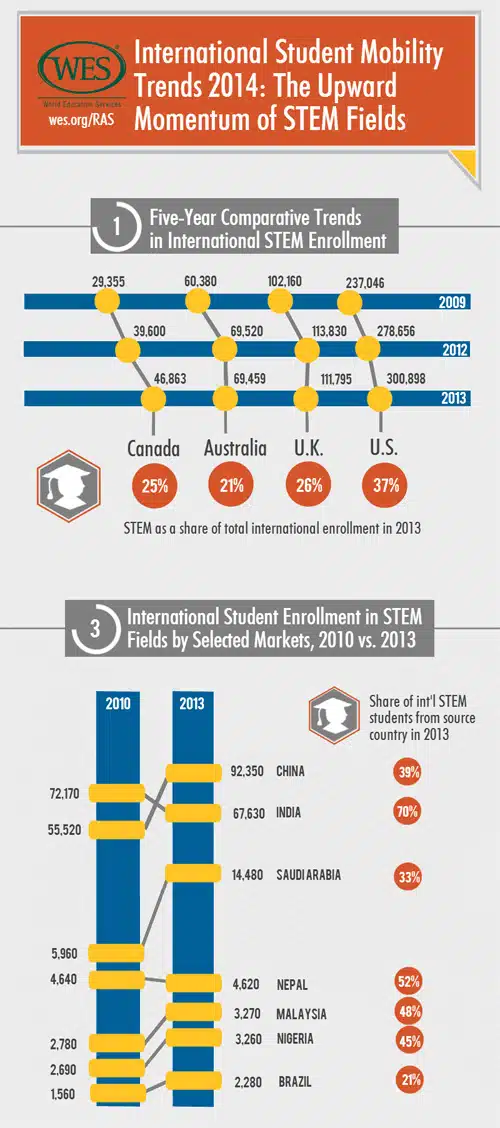
“Without doubt, the US leads in popularity of STEM programmes among globally mobile students,” says WES. “The sheer enrolment of international students in STEM fields in the US (300,898) in 2013 is more than the aggregate of that in the UK (111,795), Australia (69,459) and Canada (46,863). The share of STEM enrolments among all the international students in the US (37%) is the largest, followed by the UK (26%), Canada (25%) and Australia (21%).”
Excerpts from a WES infographic showing five-year STEM enrolment growth in leading destination markets and US STEM enrolment trends for 2010/13 for selected source countries.
As we noted in our earlier coverage of STEM trends, governments and employers around the world are well aware of the vital importance of the STEM fields for economic growth and innovation. By extension, students are ever more aware of the great job prospects and earning power they can command as a result of a STEM education.
The world’s leading source countries for international students - notably China and India - are, not surprisingly, also major markets for STEM training. As the infographic above illustrates, roughly 70% of Indian students enrolled in the US are studying in STEM fields. This enrolment is concentrated at the graduate level and there are indications of strengthening demand in India for US graduate programmes. The US Council of Graduate Schools (CGS) reported strong growth in admissions for Indian students through the second half of 2013, and WES notes that the number of Indian students taking the GRE (the most common entrance examination used by US graduate schools) spiked by 70% between 2012 and 2013.
In contrast, slower growth in Chinese enrolments was a major factor in a softening trend for applications to US graduate schools in 2013, and an ongoing concern for US STEM programmes in 2014 and beyond.
Needless to say, emerging markets also play an important role in shaping global trends in the STEM fields, whether fueled by population and economic growth, as in the case of Nigeria, or by major scholarship programmes, such as Brazil’s Ciências sem Fronteiras.
And the strong global demand for STEM is not just a function of burgeoning science and technology professions in emerging markets. Major destination countries are also facing significant labour market gaps in STEM fields within the next decade, partly due to increasing market demand and partly to projected large-scale retirements of current STEM professionals.
A recent report from Canada’s University Affairs, for example, reports that “engineering-intensive projects in mining, oil and gas, transportation and utilities will create 16,000 engineering jobs [in Canada] from 2011 to 2020, but at the same time, 95,000 Canadian engineers will retire by the decade’s end. As well, it says employers will have difficulties recruiting engineers with five to 10 years of experience or specialised skills.”
Similarly, The Telegraph recently reported on the situation in the UK: “Companies are facing a crippling ‘skills gap’ as tens of thousands of engineers retire without finding well-trained apprentices and graduates to replace them… Semta – the sector skills council for science, engineering and manufacturing technologies – warned that it was facing a shortfall of 80,000 workers within the next two years alone.”
And as we noted last year, Ireland is looking to the STEM fields to drive the country out of the crisis and help get its workforce in line with economic demand.
Such critical labour market needs at home may help to reinforce the need for immigration policies that encourage international students to pursue STEM fields and perhaps even stay on in their host countries after graduation. WES points out that the policy environment in major host countries has a significant bearing on enrolment trends and attributes the significant 2009/13 STEM growth in the US and Canada in part to such “immigration-friendly” policies.
Driven partly by such policy directions, by promising employment opportunities for STEM graduates, and - in the case of markets such as Brazil and Saudi Arabia - by the availability of large-scale scholarship programmes, observers expect continuing strong demand for STEM programmes going forward.
“The global competition for STEM talent has created a dynamic environment for international STEM recruitment,” says WES. “While the UK and Australia are still recovering from the negative effects of tightened immigration policies, Canada has continued to develop immigration and employment policies designed to attract international STEM talent, and has seen strong enrolment growth as a result. Although the US continues to enroll the most international STEM students of any country, the majority of students are enrolled at a limited number of [higher education institutions], indicating that other colleges and universities may face challenges but also opportunities in successfully recruiting these students.”