
New survey data says demand for MBA study abroad is shifting this year




- More restrictive policy settings in leading study destinations, along with a growing range of options for study at home (or in alternate destinations in Europe or Asia) are changing the pattern of demand for graduate business studies
- Surveys of prospective students over the last two years indicate a growing percentage are planning to study within their home countries, or in destinations outside of the Big Four
- Cost is a major factor, and, relatedly, so too is the anticipated return on investment from pursuing graduate studies in business abroad
It is getting harder for graduate business students to obtain a study visa for a number of leading study destinations. And, just as importantly, more challenging for them to secure a professional position and post-study work visa in the destination country after completing their studies.
That combination of factors is pressuring the return on investment (ROI) calculations of prospective students, and encouraging them to consider alternate destinations outside of the Big Four (US, UK, Canada, Australia), and/or to stay in their home countries to study.
Those are the key findings of two recent surveys of prospective graduate management education (GME) students.
The first is Tomorrow's MBA 2026 from CarringtonCrisp. The latest edition of this long-running survey (which has operated on an annual cycle since 2009) gathers responses from 1,646 prospective students from 35 countries.
The 2026 survey finds that 31% of prospective students now plan to pursue an MBA outside their home country. That compares to the 35% who intended to do so last year, and the 39% who indicated their interest in study abroad two years ago. The overall pattern, at least within the CarringtonCrisp sample, is one of weakening demand for MBA study abroad over time.
“Getting a visa for study has become more difficult in many of the previously leading study destinations, but it has also become more difficult to get a post-study work visa, impacting the potential ROI of an MBA,” says the report.
Aside from those ROI projections for study abroad, the survey found that half of the respondents who said they would not go abroad to study felt that there were good quality business schools in their home countries. This reflects in part the rapid and continuing expansion of transnational education programmes in a number of major sending markets over the last two years, including China and India.
Those findings are reflected as well in a second study released just this week: the 2026 GMAC Prospective Students Survey, which draws on a larger sample of 4,253 respondents from 145 countries.
"The direction of the future candidate pipeline is being reshaped by what, how, and increasingly where prospective students choose to study. When building new strategies, business schools should factor in the elasticity of evolving patterns in global student mobility as candidates explore a broader array of study destinations worldwide," says GMAC CEO Joy Jones. "At the same time, candidates are becoming ever more disciplined in how they assess return on investment, challenging programs to demonstrate clear relevance and concrete outcomes. Insights from the GMAC Prospective Students Survey suggest that success in this environment will hinge on how effectively schools communicate measurable value and build trust with prospective students navigating an increasingly complex global landscape."
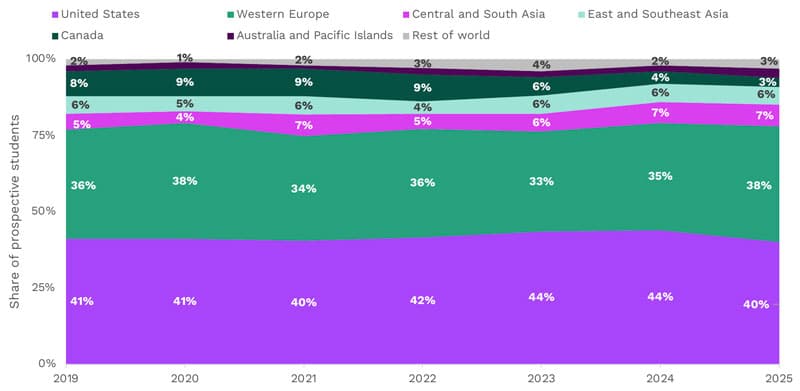
Both studies cite the cost of GME study abroad as a major factor in student decision making. The GMAC survey highlights a declining in interest in study in the United States between 2024 and 2025, in favour of destinations in Europe and Asia. The report adds that, "Where prospective students choose to study is shaped by far more than academic preference. It reflects perceptions of opportunity, risk, affordability, career access, and broader social and political contexts."
Of the declining interest in graduate business study in the United States in particular, GMAC says:
"Following the inauguration of President Donald Trump in January of 2025, non-US candidates have increasingly reported they are less likely to pursue GME in the United States under this government. Notably, a plurality of candidates are still neutral about the impact of this administration’s policies and practices on their study plans – though decidedly less than the months immediately following President Trump’s inauguration, and especially compared to the months after we first added the question prior to the election in May of 2024. Announcements related to global tariffs, potential changes to the H1-B visa program, and other economic and immigration policies – along with the informal chilling effects that accompany these formal policy positions – have had ripple effects on the global economy and migration to the United States, resulting in non-US GME candidates increasingly wanting to study elsewhere."
The GMAC report advises that recruitment teams adjust to this shifting student demand by:
- Creating region-specific messaging that "speaks directly to why studying in your country and institution delivers distinct academic, career, and lifestyle value."
- Addressing mobility concerns directly and early, especially as they relate to visas, work authorisations, and career transitions after study.
- Rebalancing recruitment targets and yield strategies toward markets where demand is rising "rather than relying on historical sending markets."
For additional background, please see: