Global agent survey highlights the most important factors influencing study abroad decisions




- The latest edition of ICEF’s long-running annual survey, Agent Voice, drew responses from more than 1,200 agents across 113 countries
- The findings signal that affordability, visa processes, and employment opportunities will continue to guide student decision-making in 2026
The latest ICEF Agent Voice survey shows that international student priorities remain centred on affordability and ease of getting a study visa. In 2025, cost of living edged out visa issues, reversing the 2024 trend, but both considerations are critical to the decisions students make about study abroad.
The survey, conducted between April and September 2025, collected responses from 1,225 agents across 113 countries.

Students continue to look into alternative destinations
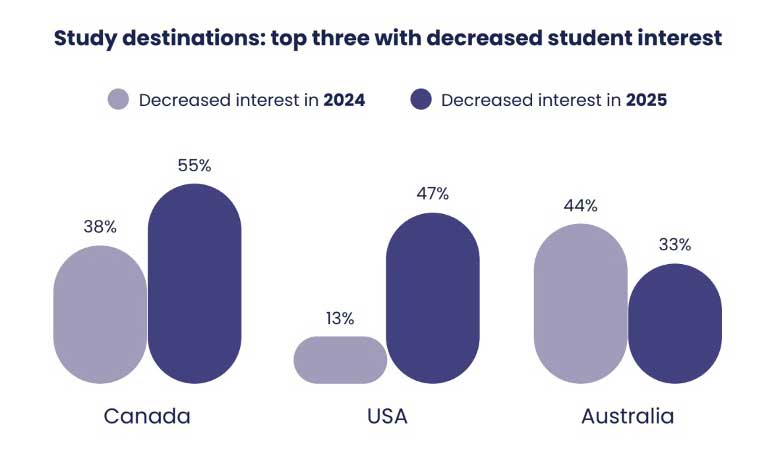
Students’ interest in destinations outside the “Big Four” continues to grow. Australia, Canada, the UK, and the US remain the most popular, but they are losing share of students’ interest. More than half of agents reported declining interest in Canada, and just under half said the same about the US. As you can see in the chart below, demand fell the most severely for the US between 2024 and 2025.
By contrast, agents reported increased interest for several other countries including Spain, Germany, Malaysia, China, and Japan.
Employment opportunities heighten interest
Study abroad is a major financial investment, and as such, families look carefully at the relative return on investment that different destinations, institutions, and programmes offer students as a result of:
- Prestigious degrees;
- In-demand skills;
- In-study work placements/co-op opportunities;
- Post-study work rights and pathways.
In essence, these are the benefits that can offset or surpass the cost of study in given destinations, highlighting the deep connection between a destination or institution’s attractiveness and its work opportunities.
The Agent Voice survey confirms that work rights are a major influence on decision-making about study abroad. On a scale of 0 to 10, where 0 signified “not important” and 10 signified “crucial,” the average across agent responses was 7.56.
This bodes well for those destinations that provide clear and generous pathways to employment. The survey report notes:
“Several destinations have moved aggressively to promote their own in-study and post-study work options. New Zealand and a number of European countries have expanded or more effectively highlighted the support they offer to international students seeking work experience. As confidence in the “Big Four” becomes more fragile, these clearer and more predictable employment pathways strengthen the competitive position of emerging destinations.”
On that point, policies on international students working during and after study have become more confusing and/or restrictive in the UK and US over the past year. For example:
- The UK government announced it will reduce the Graduate Route to 18 months at the undergraduate and master’s levels beginning in 2027, and it is also actively considering whether to include the increasingly popular research master’s category in its Dependants Ban.
- In the US, the Trump administration has been scrutinising the H-1B pathway to employment for international graduates and increasing its ability to deport international students and Green Card holders who protest the war in Gaza.
The role of agents
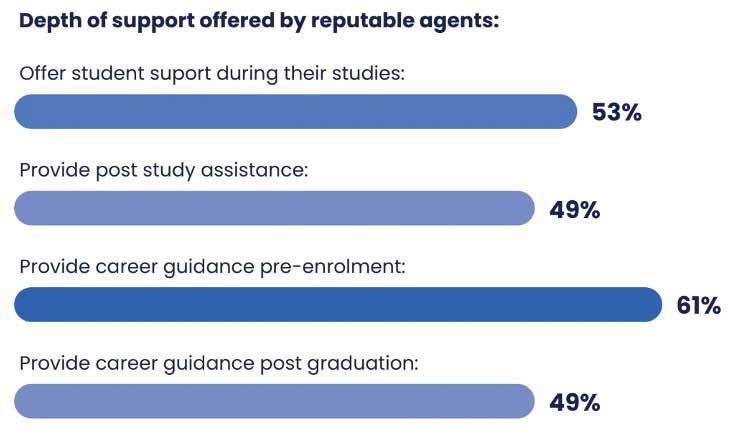
This year’s Agent Voice findings underline the depth of support provided by reputable agents. Fifty-three percent of respondents support students during their studies, and 49% provide post-study assistance. Agents also offer substantial career guidance, with 61% advising students before enrolment and 49% continuing this support after graduation.
For additional background, please see: