

Market intelligence for international student recruitment from ICEF

Japan and Europe increasingly important sending markets for Canada’s K-12 schools

Short on time? Here are the highlights:
  • In 2021/22, there were close to 30,000 long-term international students studying in Canadian public schools
  • Long-term enrolments are still down about 34% from their pre-pandemic peak, and short-term enrolments are recovering more slowly
  • China is sending significantly fewer students, which is a major reason for the decline
  • Japan, Hong Kong, and Europe are sending notably more students, and Japan is now the #1 sender of short-term students to Canadian public-schools

International student numbers in Canadian public schools are recovering from steep enrolment drops in the pandemic, according to new data from CAPS-I. Long-term enrolments (four months or longer) reached 24,915 in 2021/22, up from 19,100 the previous academic year. Short-term enrolments (less than four months) were up by 30% over the previous year but CAPS-I notes that these represent “a fraction of pre-pandemic numbers.” Students came to Canada from 131 countries in 2021/21.
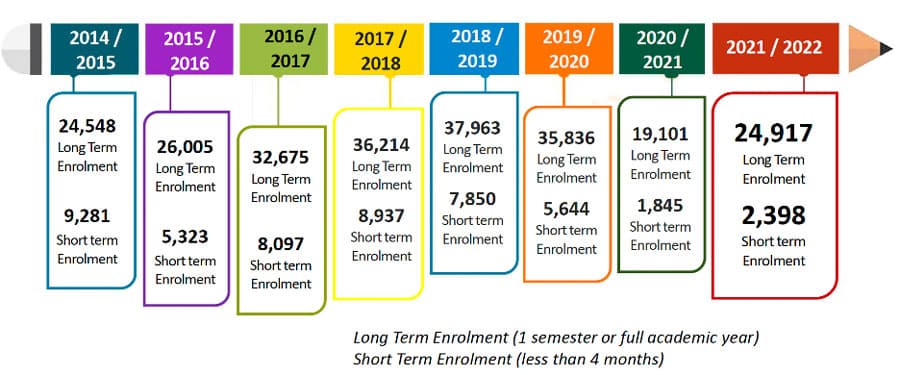
International student numbers in Canadian public schools over time. Source: CAPS-I.

Long-term enrolment trends

Peak numbers occurred in 2018/19 (37,970), so long-term international enrolments are still off by 34% from that record high. The relatively slow return to growth for the sector stems in large part from declines from China. China remains the top sender of long-term students to Canadian public schools, but the chart below shows that the flow of students from this market is decreasing – 2021/22 numbers are less than half what they were in 2018/19. Other top markets sending fewer students are South Korea and Vietnam.

Vietnam, like China, sent less than half the number of students in 2021/22 as in 2018/19. The decline here is troubling given that between 2016/17 and 2018/19, Vietnamese long-term enrolments had tripled.
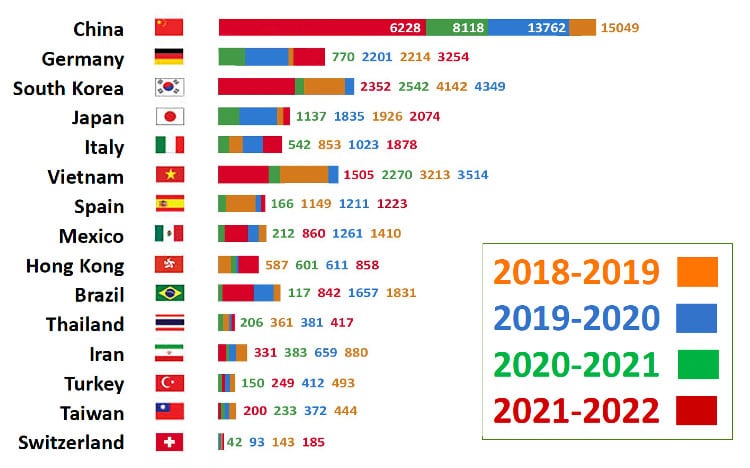
Top senders of long-term international students to Canadian public schools and trends over time. Source: CAPS-I.

The public-school sector was buoyed by significantly more students coming from Japan, Hong Kong, as well as European countries.

Japanese enrolments reached a new high in 2021/22, and there were 40% more students from Hong Kong. Japan is now the fifth most important sender of students.

Germany sent 2,500 more students in 2021/22 than the previous year (for a total 3,254 – a record high). Italy sent 1,300 more students – twice as many as the pre-pandemic record. Spain, Turkey, and Switzerland are also current growth markets for Canadian public schools.

Short-term enrolment trends

Japan sent more short-term students to Canadian public schools than China did in 2020/21, and so did Colombia. Germany and South Korea round out the top five sending markets for short-term students to Canada in 2021/22.
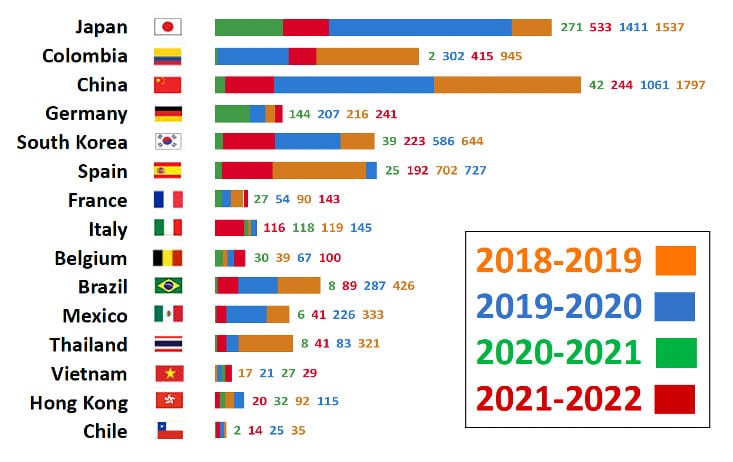
Top senders of short-term international students to Canadian public schools and trends over time. Source: CAPS-I.

For additional background, please see:

Most Recent

  • Decline in Indian demand a major factor in softer outlook for foreign enrolment in US higher education in 2026/27 Read More
  • Australia: As visa applications from foreign students fall, the government has set the national target for new international students in 2027 Read More
  • Independent K-12 schools in the UK hosting fewer international students this year Read More

Most Popular

  • Which countries will contribute the most to global student mobility in 2030? Read More
  • Research shows link between study abroad and poverty alleviation  Read More
  • Beyond the Big Four: How demand for study abroad is shifting to destinations in Asia and Europe Read More

Because you found this article interesting

Decline in Indian demand a major factor in softer outlook for foreign enrolment in US higher education in 2026/27 The Institute of International Education (IIE) does a twice-yearly snapshot survey of US institutions that required reading in...
Read more
Australia: As visa applications from foreign students fall, the government has set the national target for new international students in 2027 The Australian government has announced overall settings for “managing the growth” of the country’s international education sector for...
Read more
Independent K-12 schools in the UK hosting fewer international students this year Independent (private) K-12 schools belonging to the Independent Schools Council (ISC) are hosting 57,200 non-British students in the...
Read more
US regulatory agenda for 2026 aims to end “duration of status” and introduce Optional Practical Training and H-1B reforms On 6 July 2026, departments across the US federal government published a unified regulatory agenda for the year...
Read more
China in 2026: Slowing outbound student mobility, accelerating inbound momentum The number of international students studying in China is quickly catching up with the number of Chinese students...
Read more
Surprise hike in international student visa application fees “a direct hit to Australia’s competitiveness” Australia’s international education sector is reeling at new study, work, and working-holiday visa application fees for international students...
Read more
ICEF Podcast: “Good, steady, and disciplined”: New Zealand’s plan for sustainable international enrolment growth Listen in as ICEF’s Craig Riggs and Martijn van de Veen recap some of the latest developments in...
Read more
OECD: International students may be underinformed about job prospects in top destinations For many students from emerging markets in Asia, Africa, and Latin America, there is a dream pathway attached...
Read more
What are you looking for?
Quick Links