


Global student satisfaction survey highlights growing attention to career services




- More than 100,000 current students and recent graduates have contributed reviews for the 2025 Global Student Satisfaction Awards
- The programme recognises achievement for institutions and destinations across a number of key indicators of student satisfaction
- Overall, student satisfaction remains high in the 2025 ratings, but this year’s reviews reveal a softening in some key areas, including admissions and social integration
- Conversely, the ratings for career supports suggest a continuing strengthening of university services in this area
The 2025 Global Student Satisfaction Awards were announced this week, and they provide some important indicators of student experience and student preference for all international educators.
The programme – produced in partnership by Studyportals with Uni-Life and the British Council IELTS – relies entirely on student reviews, which this year amounted to 102,000 reviews from students across 3,059 universities and 124 countries. The reviews were submitted between January 2023 and July 2025, from current students or alumni who graduated after January 2022.
Overall student satisfaction remains high at 4.18/5.00, reflecting a marginal decrease from 2023's rating of 4.21. Comparable to the 2023 survey, just under 96% of responding students rated their overall study experience at either four or five stars.
At a national level, the top-performing destinations – based on that overall satisfaction score – were the United States (4.32), Belgium (4.29), and Austria (4.28). The following figure highlights a wider selection of country ratings (for overall satisfaction), comparing destination performance on two dimensions: (i) positive or negative change relative to the 2023 rating and (ii) relative ranking compared to the global average of 4.18.
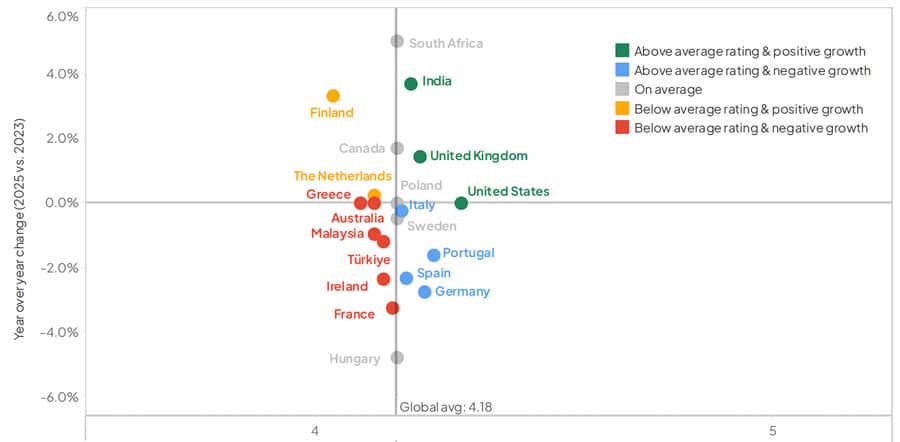
Aside from the US, Canada showed steady improvement over the last four years, climbing from a rating of 4.07 (2021) and 4.11 (2023) to reach the global average for first time. The United Kingdom has also shown steady, if more gradual improvement, rising from 4.1 (2021) and 4.18 (2023) to 4.23 this year. Australia, however, remains below the global benchmark, with ratings consistently around 4.13 over the past four years.
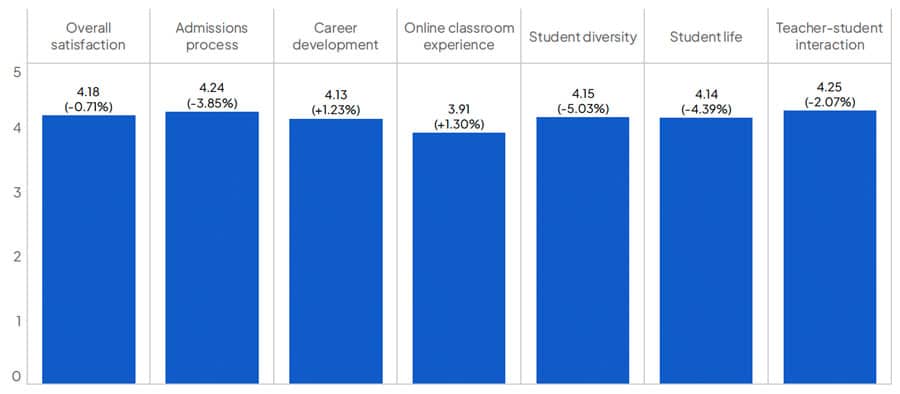
As we see in the following summary of other key indicators from the 2025 ratings, there is a little more variability sitting behind that overall score.
“These results show where universities are winning student trust, and where they risk losing it," said Studyportals CEO Edwin van Rest. "Students are more confident about career prospects, but increasingly concerned about diversity and their quality of life. In today’s competitive environment, these student voices are critical signals for universities. Understanding these perspectives is crucial for shaping policies and programmes that genuinely meet students’ needs.”
Signals for improvement
The student rating for "Admissions Process" declined from 4.41 in 2023 to 4.24 this year. This parameter reflects student feedback with respect to ease of application, clarity of website information, and quality of staff assistance during the admission process.
Part of the issue here may lie in the premium that students place on ease of use and streamlined experience in other parts of their lives. "Students specifically appreciate when online applications are 'easy and simple to operate' and websites are user-friendly," adds Studyportals. "Modern students expect admission processes to match the usability standards of consumer applications, with intuitive interfaces and straightforward procedures."
Another notable change this year was in the area of "Student Diversity," which reflects "how effectively universities foster welcoming environments for students from different countries, cultures, religions, age groups, gender identities, backgrounds, and those with special needs."
Student satisfaction with respect to "Student Diversity" dropped from 4.37 (2023) to 4.15 this year, a change that the report summarises as, "Universities that intentionally create welcoming spaces for students from different backgrounds see higher satisfaction. Conversely, some students faced problems integrating into the campus community or feeling at home in a new country."
The meaningful thing about both parameters is that they are largely within the control of each university, which highlights that they remain areas of opportunity and potential competitive advantage for most institutions.
The steady rise of career services
Students rated their satisfaction with "Career Development" at 4.13 this year, a small increase over the 4.08 rating from 2023 but an impressive gain over four years from the 3.86 rating from 2021. As the term suggests, this aspect of student experience is concerned with, "How well universities support students' career development through extracurricular courses, workshops, conferences, internship assistance, and other employability-enhancing activities."
Overall, "Career Development" is the most-improved category tracked in the programme, indicating the greater attention to student support and student outcomes in this respect. Given everything we are learning in recent years about the greater emphasis students now place on those outcomes, this is a particularly relevant finding in the 2025 ratings.
This year's report also includes a series of related recommendations for institutions planning to further strengthen their career services for students.
- "Facilitate industry professional connections. Organise regular interactions with working professionals through guest lectures, networking events, and mentorship programmes. These direct industry connections often prove more valuable than theoretical career guidance, providing students with realistic insights and professional networks.
- Expand hands-on learning opportunities. Bridge the gap between academic learning and professional application through well-supported internships and real-world projects. Students need practical experience with current industry tools and challenges to feel prepared for their careers.
- Leverage faculty research connections. Ensure professors actively engaged in current research translate contemporary industry challenges into classroom content. This makes education feel immediately relevant and prepares students for the evolving problems they'll encounter in their professional lives".
For additional background, please see:
- "How likely are students to recommend your institution?"
- "Global survey says graduate outcomes the most important factor in students’ choice of institution abroad"
- "Better living and social environments for students linked to better mental health"
- "Is employability still the holy grail for the new generation of international students?"
Most Recent
-
Decline in Indian demand a major factor in softer outlook for foreign enrolment in US higher education in 2026/27 Read More

-
Australia: As visa applications from foreign students fall, the government has set the national target for new international students in 2027 Read More
-
Independent K-12 schools in the UK hosting fewer international students this year Read More







