Global survey says graduate outcomes the most important factor in students’ choice of institution abroad




- Access to career opportunities remains a key priority for international students
- A new survey indicates that students may be giving greater weight to graduate outcomes than ever before, with most rating graduate employment outcomes as the top indicator of institutional quality
- Costs of study and return on investment from study abroad are also among students’ most pressing concerns
The latest edition of IDP's Emerging Futures student survey has just been released. Based on responses from more than 6,000 students, it concludes that students are placing an ever-sharper emphasis on career development when planning for study abroad. The survey also finds that students essentially equate "high-quality education" with "graduate employment rate." This factor now outweighs institutional ranking for many prospective students.
"We know that international students choose their study destination based on factors that help them become job ready, with access to post-study employment being the key influence,” said Simon Emmett, chief partner officer at IDP Education. "The research serves as a timely reminder for governments and policymakers to embrace international students, who go on to fill vital skill gaps and foster long-lasting diplomatic ties between their home and host countries."
Roughly a third of respondents were prospective international students (29%), another 43% had applied to study abroad, and 21% were already enrolled overseas. Consistent with earlier cycles of Emerging Futures findings, just over two-thirds of respondents (67%) cited "career development" as their main motivation for study abroad. Only "education quality" received a comparable rating (also 67%), with other factors such as "acquiring global knowledge" and "reputable qualifications" coming in slightly lower.
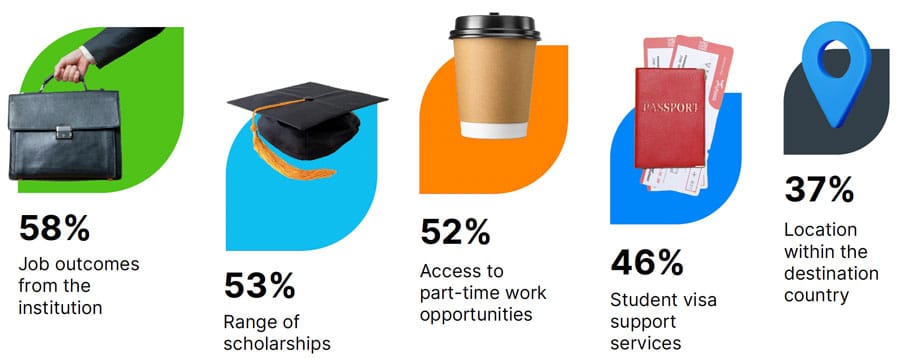
Respondents are also keenly looking at graduate outcomes. "Graduate employment rate" ranked as the top indicator of "high-quality education" abroad, ahead of "institution ranking" or "quality of academic staff." In a similar vein, "job outcomes from the institution" represent the top non-academic factor for students, ahead of "range of scholarships" or "access to part-time work opportunities."
Affordability continues to be a major concern
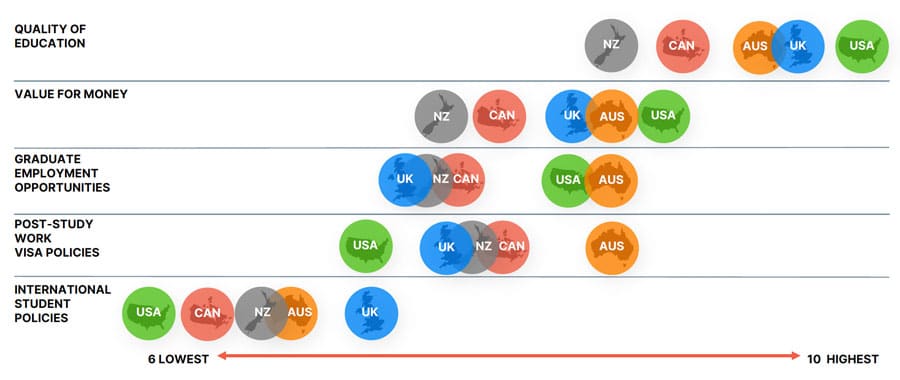
When asked about their main concerns about studying abroad, most students (66%) cited "cost and finances." That concern placed well ahead of the next-most pressing item: "visa challenges" (47%). Those factors, along with a growing student interest in post-study outcomes, are reflected in the following chart, which measures the relative attractiveness of leading study destinations across a range of criteria.
In fact, concerns around affordability are so high that one in two students told IDP they would consider switching to another destination if it had lower savings requirements.
The bottom line, says IDP, is that, "Students are driven by career development, job outcomes, and return on their investment when choosing where to study internationally. Employability is a critical priority, underscoring the need for institutions to strengthen career support and industry connections to enhance students’ international study experience."
For additional background, please see:
Most Recent
-
Breaking: US Department of Homeland Security publishes rule to end Duration of Status for international students Read More

-
Joint sector alert sends a clear compliance message to Australian higher education and VET providers Read More
-
Academic support and learning resources in TNE: Delivering student success across borders Read More