


Foreign enrolment in Japan reached record levels in 2024




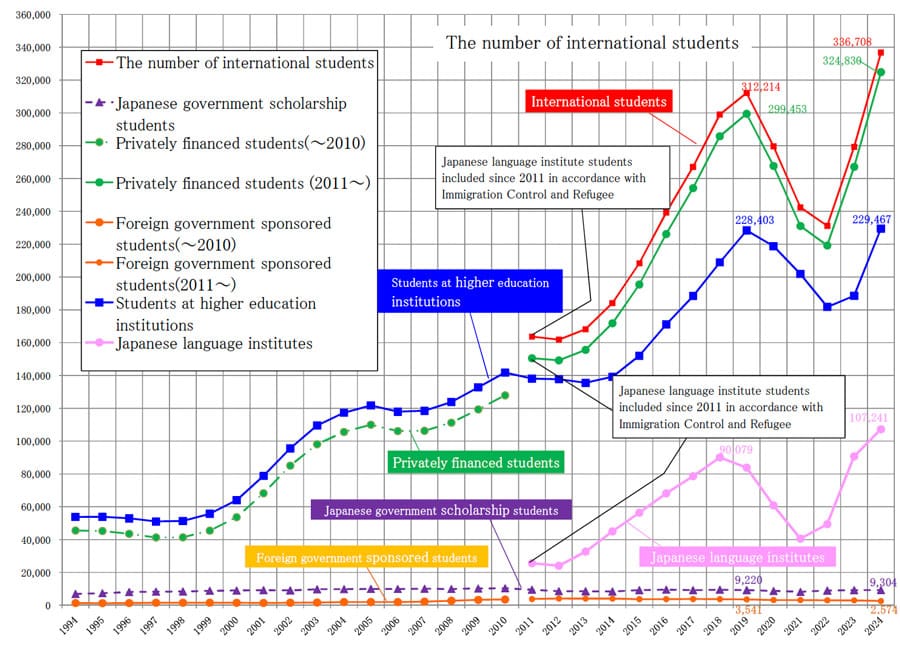
- Japan hosted more than 336,000 students in 2024, exceeding pre-pandemic numbers, representing a historic high, and reflecting year-over-year growth of 21%
- Most students came from elsewhere in Asia, were self-funded, and chose to study at a higher education institution
- China remains the top sending market but a number other important source markets across Asia, notably Nepal, showed real growth last year
Japan has an ambitious plan to expand its international student enrolment. In 2022, the government said it was intent on bringing student numbers back to pre-pandemic levels – or an enrolment base of 312,000 – by 2027. That more immediate target sits within a longer-term goal to attract 400,000 students by 2033.
The latest data from the Japan Student Services Organization (JASSO) indicates that Japan has already met its first goal and is well on its way to reaching the 400,000-student target as well.
JASSO reports that there were 336,708 international students in Japan as of 1 May 2024, representing a 21% increase year-over-year and moving Japan comfortably its that pre-COVID benchmark.
Nearly all students (96%) were self-funded, with the balance a mix of scholarships from either the Japanese government or foreign governments. More than two-thirds (68%) were enrolled in higher education, with the remaining 32% studying in Japanese language schools.
Of the students in higher education institutions in 2024 (229,467), 25% were pursuing graduate studies, 40% were in undergraduate or junior college programmes, 33% were enrolled in professional training colleges, and the remaining 2% were following university preparatory courses.
Where do students come from?
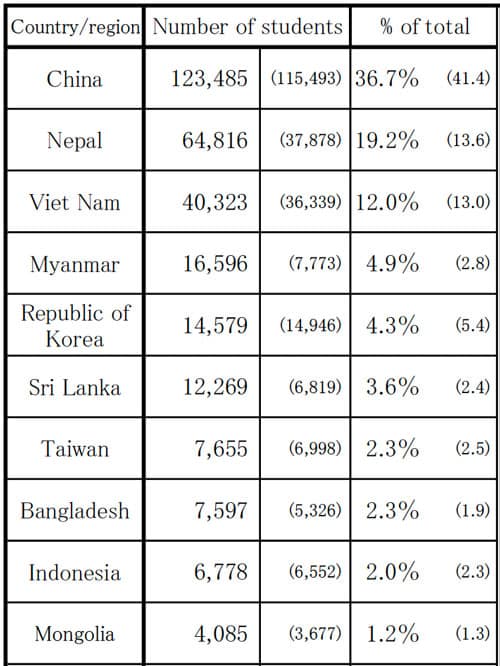
More than nine in ten (92.5%) of international students in Japan come from elsewhere in Asia. As the table below reflects, China is the number one sending market by a considerable margin, followed by Nepal, Vietnam, Myanmar, and South Korea. Those five markets accounted for nearly 80% of Japan's foreign enrolment in 2024, whereas the top ten sending markets provided 90% of the enrolment base last year.
Nepal was an important driver of overall growth, with the number of Nepalese students in the country growing by more than 70% year-over-year. (Government officials in Nepal have previously confirmed that Japan was the most popular destination for Nepalese students last year.)
The Kanto and Kinki prefectures – which are, respectively, home to the major centres of Tokyo and Osaka – hosted just over three out of every four international students Japan last year.
The vast majority of students (70%) were studying humanities or the social sciences, with another 14% enrolled in science or engineering programmes.
For additional background, please see:
Most Recent
-
Offering reassurance to international students after they apply is increasingly key to securing enrolments Read More

-
Ireland’s ELT sector reports modest growth in student numbers but weeks are down amid “real and consequential” challenges Read More
-
Japan: Japanese proficiency essential for foreign graduates staying on to work Read More







