International students contributed $31 billion to Canadian economy in 2022




- A new economic impact analysis estimates total international student spending in Canada for 2022 at CDN$37.3 billion for “tuition, accommodation, and discretionary items”
- This results in estimated direct and indirect impacts on Canada’s GDP of CDN$30.9 billion
- That amounts to nearly a quarter of Canada’s service exports for the year, placing education among Canada’s top export sectors
An updated analysis from Global Affairs Canada (GAC) estimates that the combined direct and indirect GDP contribution of all students expenditures in the country amounted to CDN$30.9 billion (US$23 billion) in 2022.
Education exports, as measured by the total value of international students in Canada (CDN$37.3 billion in 2022), accounted for just over 23% of Canada's total service exports in that year, and 1.2% of Canada's GDP overall. The report adds that, "In 2022, the total amount of international student spending (CDN$37.3 billion) surpassed the value of Canada’s exports in many product categories, for example, wood and wood products (CDN$25.7 billion), fertilizers (CDN$17.9 billion), or electrical or electronic machinery and equipment (CDN$19.2 billion). Total international student spending in 2022 was equivalent to about 4.8% of the total value of Canada’s merchandise exports."
Also for 2022, international student spending is estimated to support 361,230 jobs in Canada, or 246,310 FTE positions.
"Over the past two decades, the number of study permit holders in Canada increased more than sixfold, with every province and territory recording positive gains," notes the report. "Although Ontario attracted the greatest number of international students, it is worth noting that Prince Edward Island recorded the highest percentage increase in the number of study permit holders – from 2000 to 2022, the percentage increase has been over 1,800%." Ontario hosted just over half of all international students in the country (51%) in 2022. British Columbia accounted for nearly a quarter (22%), and Quebec another 12%.
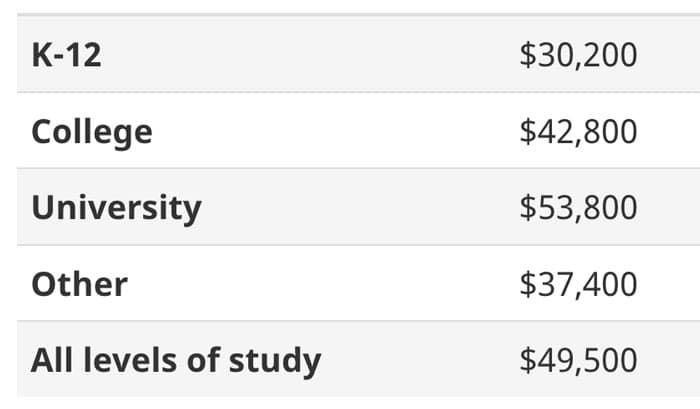
The GAC analysis attributes roughly 97% of that economic impact to long-term students – that is, students enrolled in programmes of six months or more. The following table breaks that long-term-student spending down into per-student averages for various levels of study.
Not surprisingly, GAC finds that India has been the big driver of that recent-year growth: "Detailed data indicates that of the top source countries for long-term students, the biggest increase was from India (+47%, with 319,130 study permit holders in 2022)…Other top source countries for long-term international students that experienced strong increase between 2021 and 2022 include:
- Philippines (+112% to 32,455)
- Hong Kong (+73% to 13,100)
- Nigeria (+60% to 21,660)
- Colombia (+54% to 12,440)"
The other significant feature that comes through in the GAC estimates is just how quickly the economic impact of international students has expanded over the past decade. Overall student spending more than doubled between 2016 and 2022 alone, from CDN$15.5 billion to CDN$37.3 billion, for an average annual increase of nearly 16% per year.
That pattern would have certainly continued in 2023, a year after the period of the current GAC analysis, when foreign enrolment in Canada climbed by 29% year-over-year. Even a crude extrapolation of the GAC figures from the year before would suggest that international students' contribution to Canadian GDP would have approached CDN$40 billion (US$30 billion) in 2023.
For additional background, please see:
- "Canada hosted more than 1 million international students in 2023"
- "Study estimates economic impact of foreign students in France at €5 billion"
- "Measuring the economic impact of foreign students in the UK and the country’s competitive position in international recruitment"
- "International students generate global economic impact of US$300 billion"
Most Recent
-
Breaking: US Department of Homeland Security publishes rule to end Duration of Status for international students Read More

-
Joint sector alert sends a clear compliance message to Australian higher education and VET providers Read More
-
Academic support and learning resources in TNE: Delivering student success across borders Read More