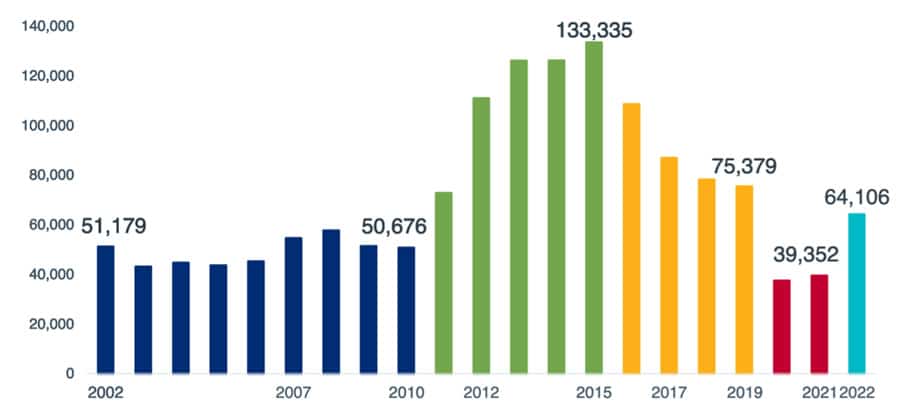
US English-language training providers reach 65% of pre-pandemic volumes




- Enrolments were up by 63% in 2022 over the previous year, and weeks were up by 43%
- Japan, China, and France made up 3 in 10 students in US IEPs
- Europe and Latin America are becoming more important recruiting grounds
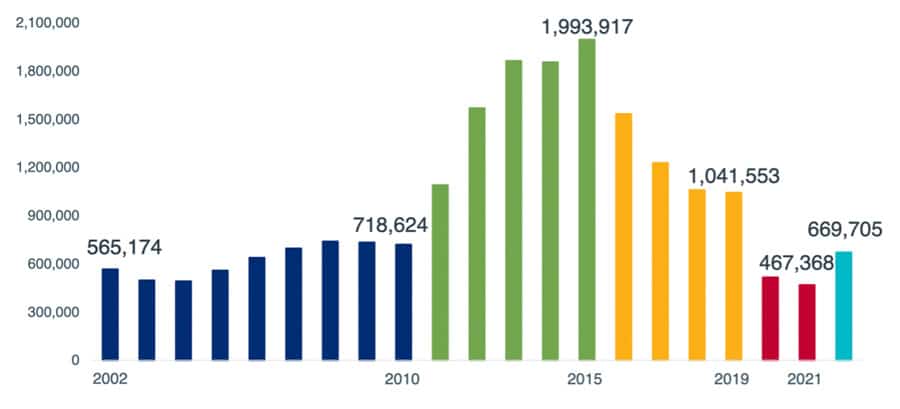
There were 63% more international students enrolled in US intensive English programmes (IEPs) in 2022 than in 2021, for a total of 64,105 enrolments (92% of which were in-person enrolments). Those students spent a total of 669,705 weeks studying with their providers, a 43% increase over 2021.
The data, based on information from over 700 IEP providers, was released by the Open Doors team at the NAFSA Conference last week. Open Doors is produced by the Institute of International Education (IIE) with the support of the US Department of State’s Bureau of Educational and Cultural Affairs.
The IEPs were delivered by three types of provider: colleges and universities, independent providers affiliated with higher education institutions, and providers not affiliated with a higher education institution. The first two types accounted for 89% of the total market.
In 2022, IEP enrolments recovered to about 85% of pre-pandemic levels but were less than half of what they were at the peak for the industry in 2015.
Student weeks are following a slower recovery trajectory. In 2022, they were only 35% lower than in 2019 but 66% lower than at the peak in 2015. Students spent on average 10 weeks in IEPs in 2022, down from 12 weeks in 2021 and 14 weeks in 2019.
Top markets
The top three sources of students for American English-language training providers in 2022 were Japan (16%), France (8%), and China (7%), which together made up about 3 in 10 international students enrolled in an IEP programme in the US. Otherwise, the top 10 included Brazil, South Korea, Colombia, Italy, Saudi Arabia, Germany, and Switzerland.
Japanese enrolments jumped by 105% year-over-year, France by 82%, and China by 22%. Other fast-growing markets are Brazil (+149%) and Italy (+122%).
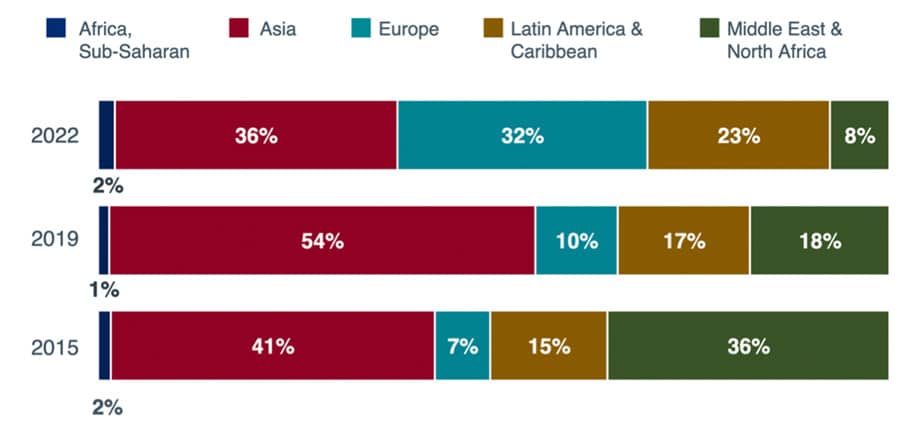
Europe and Latin America are becoming much more important recruiting zones for US English-language training providers, while Asia and the Middle East are becoming less so. Latin America is also a major part of the recovery story for the English-language training sectors in Australia, Ireland, and Malta.
Differences by type of provider
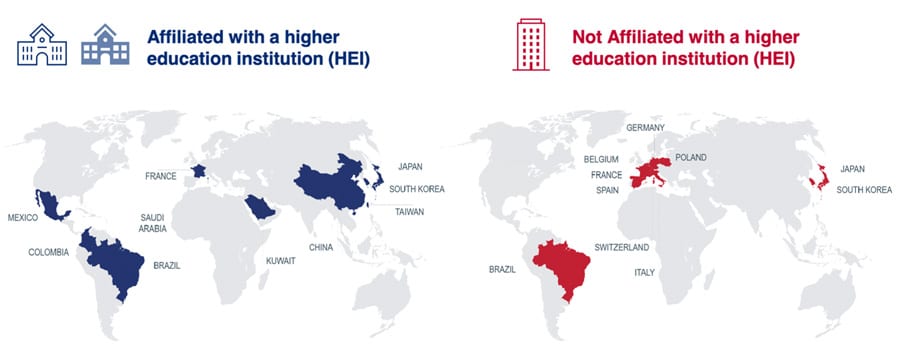
More than half of international students were studying in IEPs affiliated with a higher education provider. As you can see, different markets are more or less important to providers depending on whether they are affiliated with a higher education institution.
A pipeline into other levels of study
More than a quarter of IEP students intend to pursue further study, such as degree programmes, with US institutions. The proportion they make up in the overall international student population is 1%, down from 4% in 2015.
For additional background, please see:
Most Recent
-
Japan: Greater availability of in-country English programmes is exerting some downward pressure on outbound mobility Read More

-
UK: Sponsored study visa issuances down, rejection rates up, and more Read More
-
Beyond borders: Why student support matters more than ever in transnational education Read More