


Chinese agent survey highlights important trends for student recruitment this year




- A recent agent survey reveals that Chinese students are showing greater interest in studying in the UK, Canada, and Singapore this year
- Working while studying, post-study work rights, and immigration opportunities matter more to Chinese students than in the past
Growth in Chinese outbound may be slowing, but China still represents the largest or second largest nationality within the international student populations of Australia, Canada, the UK, and the US. Even so, the UK was the only country of the four major English-speaking study destinations to avoid a decline in Chinese numbers last year. Chinese enrolment in UK universities rose by 1.4% year-over-year (141,870 in 2019/20 to 143,820 in 2020/21), though commencements were down by 5%.
As such, many educators are trying out new recruitment strategies in the market to keep as many Chinese students in their classrooms as possible. These include lowering entrance requirements, offering scholarships, providing greater agent incentives, and more.
At the 2022 edition of the Australian International Education Conference, held on the Gold Coast in October 2022, Navitas Insights executives Jonathan Chew, Kim Ecklund, Neil Fitzroy, and Simon Jacobs presented results from a May 2022 survey the firm conducted among more than 700 agents. Some of these results illuminate how Chinese students are now making decisions about study abroad.
Where are Chinese students most interested in studying?
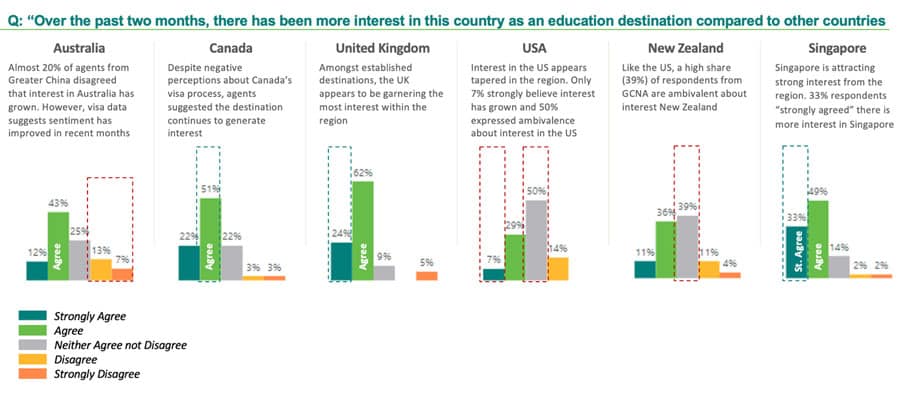
Overall, agents said that in the first half of 2022, of six possible destinations, Chinese students were most interested in going to Canada and the UK, as shown in the chart below. However, Singapore is very popular, garnering the highest proportion of agents saying they “strongly agree” that there was more student interest in Singapore than in other destinations in the past two months.
Canada may soon lose market share of Chinese students if it can’t remedy its serious visa processing issues and high study permit refusal rates. As the following chart indicates, Chinese agents rank Canada last of the destinations in terms of visa processing times and last in terms of the acceptance rate of visas submitted by students.
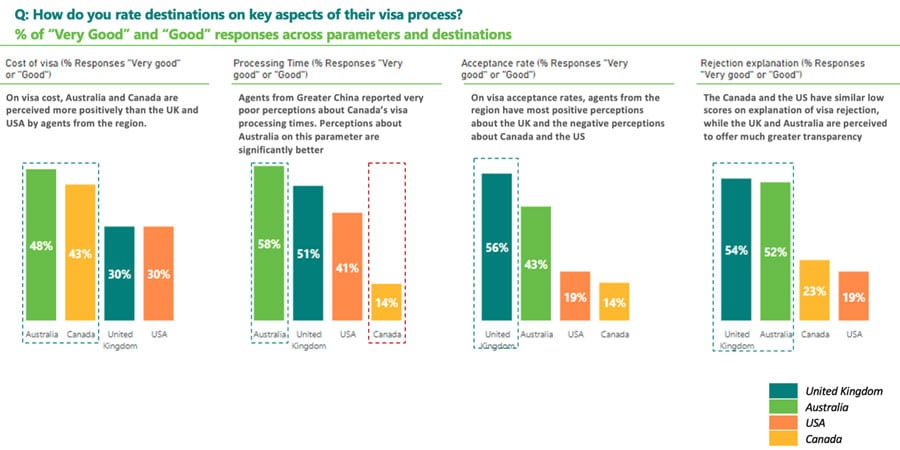
Incidentally, recent IDP research confirms that Canada’s visa problem is impacting its competitiveness. IDP asked 11,000 students in August 2022 what they considered a “reasonable” time frame for visa processing; over two-thirds (67%) said it should be no more than four weeks. IDP then asked how long it actually took students to get their visa processed. Fully 36% of current students said that it took more than 10 weeks to receive their visa for Canada, compared to only 4% who said this about the UK or the US. Only 15% of students said they received a visa for Canada in under four weeks, compared with 66% in the UK.
Overall, 58% of students said that if a visa decision took longer than four weeks, they would consider switching destinations.
Top priorities for Chinese students
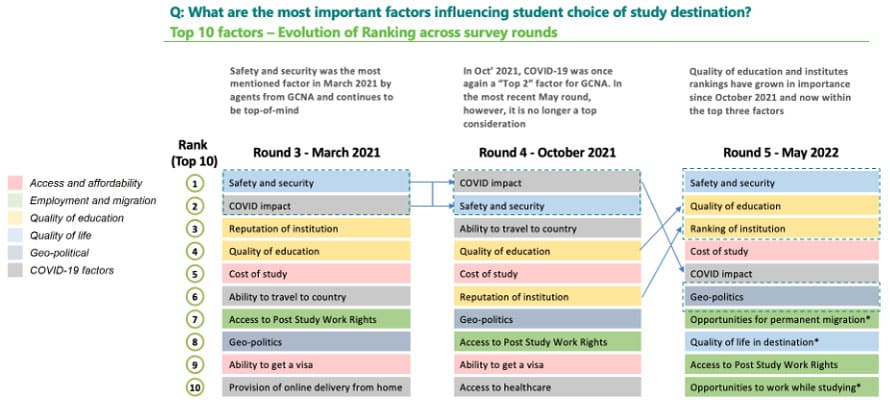
Chinese students and parents carefully assess where their children will be safest while studying. Safety comes in as their top priority, followed by quality of education, ranking of institution, cost of study, and “COVID impact.” However, Neil Fitzroy, Nativas’ regional director for Oceania, said that educators should be aware that some factors that don’t usually matter much to Chinese families have become more important this year as a result of the economic recession in their country. As you can see from the chart below, opportunities for permanent migration, access to post-study work rights, and opportunities to work while studying made the top 10 list in May 2022. In March and October of 2021, only post-study work rights made that list.
Ms Ecklund notes that for some Chinese students, there has never been a better time to study in the West, explaining:
“With the significant decline in student numbers since 2020, it has also become a serendipitous opportunity for those willing and able to go, since higher-ranking universities are now being much more accommodating to the reduced candidate pool. This is evident in the extended deadlines and reduced entry requirements being often observed.”
For additional background, please see:
Most Recent
-
China in 2026: Slowing outbound student mobility, accelerating inbound momentum Read More

-
Surprise hike in international student visa application fees “a direct hit to Australia’s competitiveness” Read More
-
ICEF Podcast: “Good, steady, and disciplined”: New Zealand’s plan for sustainable international enrolment growth Read More







