
Market intelligence for international student recruitment from ICEF
29th Jun 2022

Japanese outbound numbers still down in 2021 with a distinct shift to online study

Short on time? Here are the highlights:
  • The number of outbound Japanese students continued to fall last year, although marginally so compared to 2020
  • There has been a distinct shift to online study over the last two years, with a significant number of Japanese students enrolled online with language schools in the Philippines

The latest mobility data from JAOS (Japan Association of Overseas Studies) highlights that 2021 was another challenging year for Japanese outbound. The annual report relies on a survey of 40+ education agents that are also JAOS members. That cohort of agents reported total outbound numbers of just under 78,000 students in 2019, the last survey year before the pandemic, but those volumes plunged in 2020 as COVID took hold.

The association reported total student numbers of 18,374 for 2020, but the latest report explains that only 7,442 of those were students that actually went abroad -- with the balance studying online. Those numbers eroded further still in 2021 with a total of 15,083 enrolments reported by JAOS agent-members. Just over 6,100 of those went abroad, while nearly 9,000 stayed in Japan to study online. In other words, over the last two years the number of Japanese students enrolled in online study abroad programmes exceeded the number that travelled for study.

The following chart breaks that total enrolment base -- including online and offline enrolments -- down in more detail.

Type and purposes of study abroad programme for Japanese students, 2021. Source: JAOS

"The results indicate there were many students still wished to study abroad despite COVID-19 in 2021," says a media release from JAOS. "[However,] they took online programmes."

Another interesting finding in this year's survey results is that Japanese students were heavily reliant on language schools in the Philippines for their online studies. As we see in the additional chart below, roughly half of all students enrolled in online studies were following programmes offered by a school in the Philippines. Enrolments with language training centres in China, Australia, Canada, and South Korea collectively accounted for another third of online enrolments in 2021.

JAOS adds that, "Before COVID-19, study abroad programmes in the Philippines had become common in Japan, and we consider these programmes had advantages over other online study abroad programmes in other countries in terms of the time difference and programme fees."
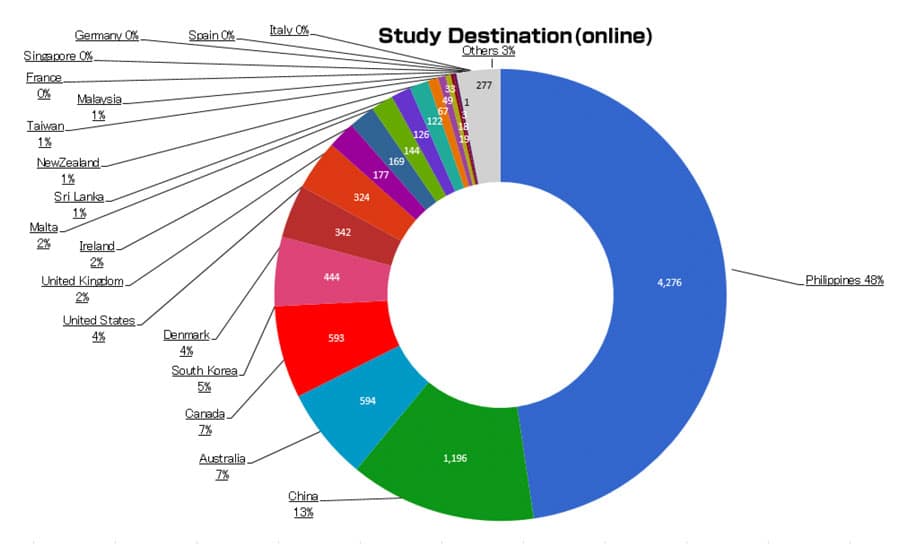
Online enrolments of Japanese students by country of provider, 2021. Source: JAOS

In contrast, the United States (with a 36% share) and Canada (30%) were the leading destinations for outbound students. "The US continued to be the most popular destination for Japanese students studying abroad for degree studies," notes JAOS. "The second most common destination was Canada which started to accept international students in the early stages of the COVID-19 pandemic."
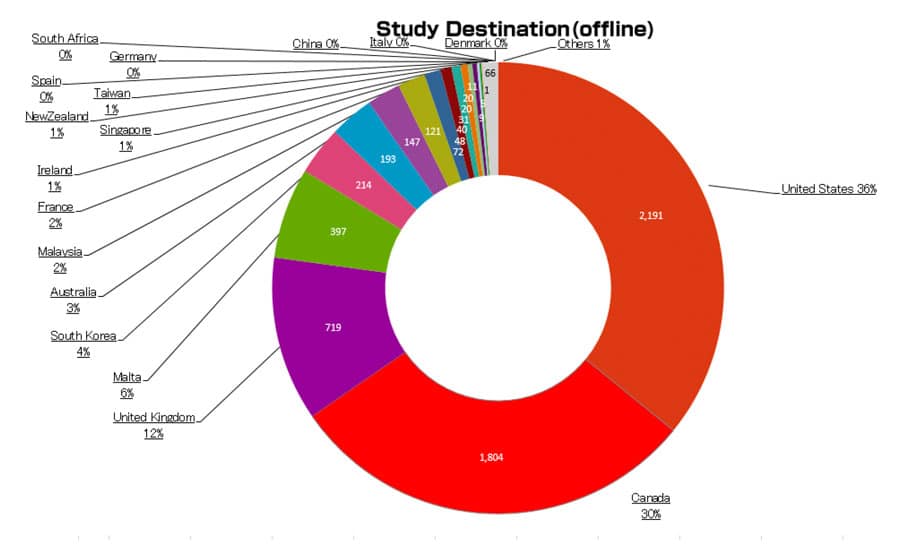
Outbound enrolments of Japanese students by study destination, 2021. Source: JAOS

For additional background, please see:

Most Recent

  • British Council says student recruitment to UK higher education will get a boost this year from South Asia and the “Trump effect” Read More
  • New Zealand expands post-study work opportunities for international students Read More
  • As Iran retaliates across the Middle East, schools close, students worry, and institutions reassess transnational education Read More

Most Popular

  • Which countries will contribute the most to global student mobility in 2030? Read More
  • Research shows link between study abroad and poverty alleviation  Read More
  • Beyond the Big Four: How demand for study abroad is shifting to destinations in Asia and Europe Read More

Because you found this article interesting

British Council says student recruitment to UK higher education will get a boost this year from South Asia and the “Trump effect” “Demand for UK education will remain resilient over the coming year despite increased competition from intra-regional mobility in...
Read more
New Zealand expands post-study work opportunities for international students In late 2026, New Zealand is rolling out a new Short Term Graduate Work Visa and extending eligibility...
Read more
As Iran retaliates across the Middle East, schools close, students worry, and institutions reassess transnational education The US/Israel-Iran war has touched down in several countries in the Middle East, and international educators and students...
Read more
US: Student visa issuances fell by -36% in summer 2025; OPT uncertainty among factors affecting international student demand The US government has renewed its focus on the Optional Practical Training (OPT) programme that allows international students...
Read more
Canada and India deepen educational ties; India repositions as an equal player in international education As with China in the 2010s, the West is waking up to the reality that India’s “emerging economy”...
Read more
Inbound, outbound, and transnational: the landscape for international education in China continues to evolve China is broadening its approach to international education and talent attraction. The Chinese government continues to support the...
Read more
Australia doubles post-study work visa application fee The Temporary Graduate Visa (Subclass 485) visa allows eligible foreign graduates to work in Australia from 18 months...
Read more
Australia moving to wider sharing of education agent data On 28 November 2025, the Australian House of Representatives passed the Education Legislation Amendment (Integrity and Other Measures)...
Read more
What are you looking for?
Quick Links