
UK ELT sector endured another tough year in 2021 but vows “fightback” to recovery




- Travel restrictions in the UK in 2021 exacted a profound toll on the country’s ELT sector – only a tenth as many international students were enrolled with English UK member schools last year as before the pandemic
- The majority of students enrolled in UK ELT were adults, a significant reversal of the pre-pandemic trend of junior students making up more than half the student population
- Almost one in three students last year transitioned to blended course delivery rather than face-to-face learning
- Despite the difficult year, English UK says, “we continue our fightback – [to recovery] – with new weapons in our armoury.”
New data shows that Covid-related travel restrictions enforced at various points in 2021 – especially during the Delta wave – meant that recovery for the UK’s English-language school sector did not materialise. Student numbers did improve over the course of the year, but looking at the whole period, UK ELT schools hosted 35.7% fewer students than in 2020, following the devastating drop of 83.6% in 2020. Only a tenth as many international students travelled to the UK in 2021 as in 2019, before the pandemic. The total number of students enrolled in English UK members’ courses in 2021 was just over 53,600.
Student weeks were also down significantly (-12.9%) to just over 462,000 after declining by 71.1% in 2020.
But the introduction to English UK’s Student Statistics Report 2022 attests to the resilience and determination of the sector:
“This new market information and lobbying ammunition is invaluable as we – with few reserves - battle residual Covid issues, capacity challenges and EU junior groups preferring to travel on ID cards. Together, we continue our fightback - with new weapons in our armoury.”
The report is based on more than 330 English UK members reporting their enrolments for 2021 and on past years’ statistics for comparison purposes. Because of the pandemic, members reported information on both face-to-face courses as well as courses that were forced to switch to a different mode of delivery. English UK notes that “While 41% of students studied face-to-face in 2021, almost one in three saw tuition delivery changed to a blended model.”
Most students enrolled in UK ELT in 2021 were from outside the EU (71%) and these students were also responsible for the lion’s share of weeks (76%).
The junior segment suffered the most
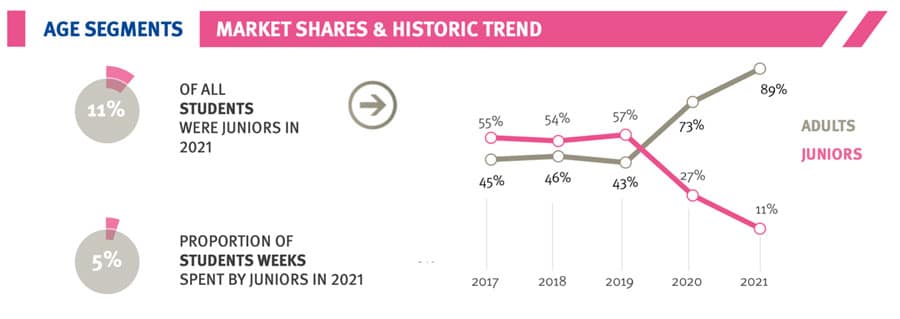
In pre-pandemic times, students under the age of 18 (Juniors) made up just over half of the overall ELT market for the UK. But the COVID crisis and related travel restrictions reversed this trend both in 2020 and 2021. Juniors composed only 9% of the student population in English UK schools last year – even less than the 23% proportion they represented in 2020.
Most juniors are enrolled in private ELT centres. The following graphic representing trends in the 298 private schools submitting data show the impact of the pandemic on this important market segment.
Ivana Slobodnikova, head of international education for industry research specialist BONARD, explained that UK ELT was especially hard hit because of its large proportion of junior students.
"If we compare the share of English language students aged under 18 in the UK (54% in 2019) to the levels recorded in the USA, Australia, or Canada, it is understandable that the overall y-o-y declines in the UK were considerably greater. The junior segment has strong fundamentals to bounce back and continue growing the way it did in the years prior to the pandemic, yet recovery pace in key markets such as China will continue to be more volatile to external factors than the adult segment."
Public versus private
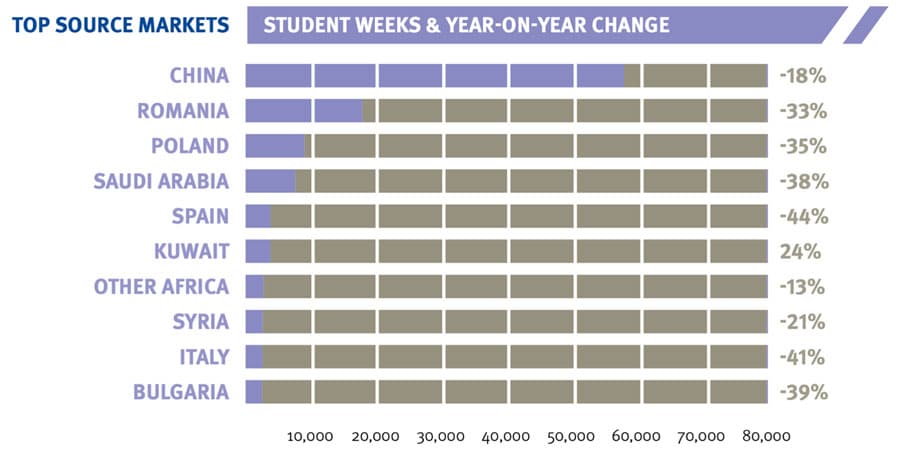
English UK’s membership predominantly consists of private schools, but there are 43 “state” language centres as well that overwhelmingly enrol adult students. That latter group hosted just over 13,000 international students in 2021, a drop of 5.7%. Student weeks were down by 9.2% to 141,000. Most students enrolled with state sector centres were either studying online in the UK (9%) or outside the UK (62%), attesting to a profound disruption of normal business. Another 18% attended a mix of online and in-person classes (i.e., blended learning).
Chinese students still represent the largest proportion of international students in state centres and accounted for 41.2% of student weeks in 2021. The next major markets for this sector are Romania (12.7% of student weeks), Poland (6.4%), Saudi Arabia (5.4%), and Spain (2.7%). Student weeks in those markets fell by between 18% and 44% in 2021.
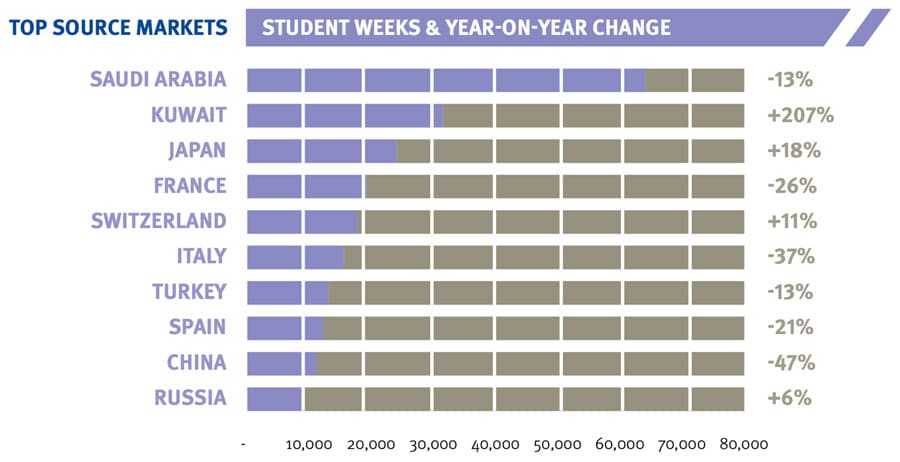
It was in the private sector (298 schools) that declines were most pronounced. Student numbers fell by -42% to approximately 40,600 students and weeks fell by -15% to 320,960. Juniors made up 11% of students and only 5% of weeks. Student stays were longer, moving from 5.4 weeks in 2020 to 7.9 weeks in 2021. Top markets were more balanced than in the public sector: Saudi Arabia (20% of student weeks), Kuwait (9.8%), Japan (7.5%), France (6%), and Switzerland (5.5%). Kuwaiti weeks grew by an impressive 207% in 2021.
For additional background, please see:
Most Recent
-
Japan: Greater availability of in-country English programmes is exerting some downward pressure on outbound mobility Read More

-
UK: Sponsored study visa issuances down, rejection rates up, and more Read More
-
Beyond borders: Why student support matters more than ever in transnational education Read More