
Germany’s foreign enrolment grew again in 2019/20




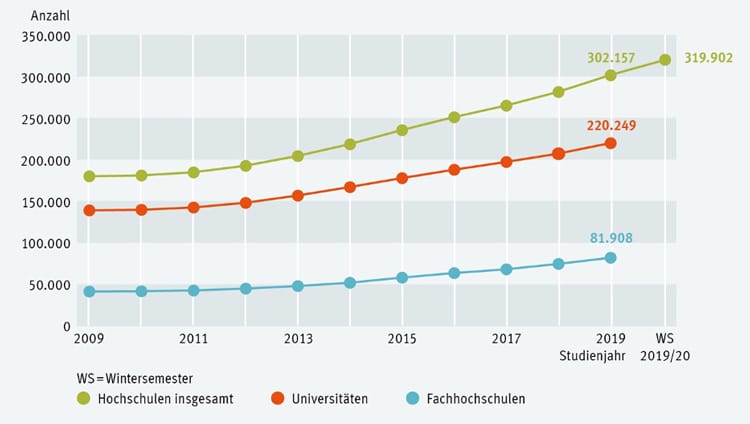
- There were roughly 320,000 international students in Germany’s higher education institutions in the 2019/20 academic year, representing growth of 6% and following growth of 7% the previous year
- While China and India still send the most students, Syria has become an increasingly important source market
- Germany’s education brand held strong in 2020 and there is hope for a strong 2021 as well
Germany saw its international student population grow by 6% in 2019/20, following an increase of 7% in 2018/19. Over the past decade, international student numbers in Germany have risen by 76% overall. The data comes from the Wissenschaft Weltoffen 2020 report released by the German Academic Exchange Service (DAAD) and the German Centre for Higher Education Research and Science Studies (DZHW).
In the past, DAAD reported on both international students coming to Germany for the first time from other countries as well as foreign students entering German higher education from within the country; the two segments of students were both included in DAAD’s total count. This year DAAD is basing its reporting on the former group, “Bildungsausländer,” to better conform with global conventions for how international students are counted. Bildungsausländer account for more than three-quarters of all non-German students in the country’s higher education system.
The Bildungsausländer cohort numbered 319,900 in 2019/20, an increase of around 18,000 students over the previous year.
Growth despite the pandemic
DAAD notes that even during the pandemic, international student numbers increased and it suggests that global market share of foreign students is changing as a result of the upheaval this year. Students are considering destinations according to unprecedented factors including whether a country’s borders are open to them and whether they will be able learn face-to-face and not just online.
DAAD President Professor Joybrato Mukherjee said,
“The corona pandemic has altered international students' mobility patterns on a global basis. Survey data show that Germany has apparently been able to further improve its good reputation among international students thanks to good pandemic management during the first corona wave in spring and summer. This is a good starting point from which we can in future convince even more talented young people of the benefits of our education system and thus connect them to our country. All those involved should collectively grasp this opportunity.”
Research this year has shown that Germany’s brand has remained strong in the face of an overall trend where many students have been willing to switch destinations. A Fintiba study from earlier this year of prospective students in 70 countries found that 74% said they would “very likely” still go to Germany for study. Only 2% said that it was “very unlikely” they would cancel their study plans in Germany.
Professor Monika Jungbauer-Gans, DZHW’s academic manager, predicts a strong year in 2021 in part because German higher education institutions are innovating in response to the challenges of the pandemic:
“Innovative teaching formats and concepts, which many higher education institutions are certainly developing, will more than ever be an important prerequisite for positive development in international mobility. They can add to Germany's attractiveness as a study location.”
Top sending markets
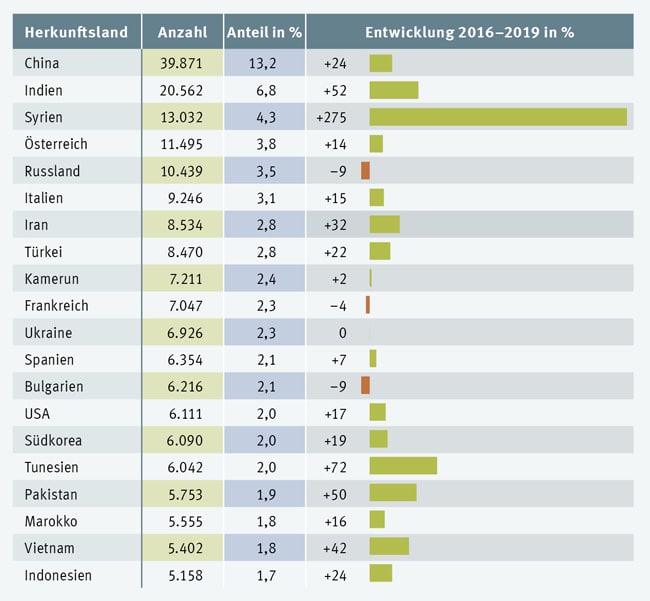
As is common in the other major destination countries, China and India are the major contributors of students to Germany. The top countries are (with numbers rounded):
- China (40,000)
- India (20,600)
- Syria (13,000)
- Austria (11,500)
- Russia (10,500)
Certain countries have become much more important as source markets; the chart below illustrates trends between 2019 and 2019. The number of Syrian students in particular is growing fast: a 275% increase since 2016.
Most study at universities
Nearly three-quarters of international students were enrolled at a university and 27% were studying at a higher education institution for applied sciences (Hochschule für Angewandte Wissenschaften – HAW).
DAAD notes that though the proportion of international students at HAWs is smaller than at universities, it has been growing significantly and in 2019/20 there was a 10% increase over the previous year. DAAD has had a specific programme for the past two years that has been encouraging this growth, the “DAAD HAW.International programme.”
Another area of growth is in the number of international students pursuing doctoral studies. The 27,100 international students doing so in 2019/20 represents growth of 3% over the previous year and 52% over the past 10 years. International students now make up a quarter of the entire doctoral student population in Germany.
Are Germany’s borders open or closed?
The answer is not entirely clear, and it also depends where a student is coming from.
Germany’s borders were closed for months but they are currently open to international students to some degree and at the discretion of immigration officials. International students are included in the German government’s list of people who can enter “because of an imperative need.” But this isn’t a blanket allowance, as the government’s wording is that foreign students are allowed in “if their course of study is not fully possible from abroad as well as trainees and third-country nationals who are entering Germany to obtain qualifications if their training or qualification programme is not fully possible from abroad.” This prevents students whose programmes have transitioned online from entering, but because many German universities are using a hybrid learning model (i.e., with some instruction in-person and some online) this, in principle, should not prevent most international students from entering. For more information and detailed notes about scholarship students, you can visit this page from DAAD.
The German government currently (subject to change given COVID unpredictability) allows in EU and Schengen students and also (according to a 27 October directive) citizens from:
- Australia
- New Zealand
- Singapore
- Thailand
- Uruguay
That directive also noted that the list would be expanded to Japan, South Korea, China, and Hong Kong “as soon as the possibility of mutual entry is confirmed.”
Editor’s note: Entry guidelines can change at a moment’s notice due to COVID rules, so students and agents should check the government website regularly for current information.
For additional background, please see:
Most Recent
-
Japan: Greater availability of in-country English programmes is exerting some downward pressure on outbound mobility Read More

-
UK: Sponsored study visa issuances down, rejection rates up, and more Read More
-
Beyond borders: Why student support matters more than ever in transnational education Read More