
Ireland: Number of non-EEA students in higher education jumps by 45% over five years




The number of new international students from outside the European Economic Area (EEA) pursuing higher education in Ireland jumped by 45% between 2013 and 2017 according to a recently released study from the European Migration Network, which is part of the Economic and Social Research Institute (ESRI) think tank. The study is entitled Attracting and Retaining International Students, and it bases its growth figures on the number of first residence permits issued to non-EEA students arriving in Ireland to undertake higher education. (Residence permits are required for all non-EEA nationals planning to study in Ireland.) In 2013, 9,325 first residence permits were issued to non-EEA students. In 2017, the number had grown to 13,520. According to the Irish Times, the total number of full-time, non-EEA international students reached nearly 18,500 in 2018. Roughly another 5,000 full-time foreign students from within the EU were also enrolled in Irish higher education as of 2017/18.
Need for international students grows
Overall, non-EEA students make up more than half of all international students in Ireland, and they are increasingly vital to the financial health of universities and Institutes of Technology (IoTs) given the higher fees they pay relative to Irish and students from EEA countries in Europe. The tuition charged to international students ranges between €9,000 and €25,000, with fees in some fields much higher (e.g., up to €54,000 a year for medicine). By contrast, Irish students pay €3,000 a year, an amount commonly known as a “contribution charge.” Irish universities and IoTs have been investing more in international outreach over the past few years, in part because they need international students’ tuition to help offset declining government funding in the sector. This spring, executives from the Irish Universities Association warned that universities may end up having to reduce the number of places available to Irish students in order to free up more space for international students as a result of underfunding. This is despite the fact that Irish demand for higher education is expected to rise by 25% in the next ten years due to demographics. Jim Miley, director general of the IUA, warned, “As numbers grow, universities are fearful that they will be put in a position where places for Irish students would have to be curtailed or replaced by higher fee-paying international students.” At the same time, Ireland is poised to become even more popular among international students after Brexit, when it will become the only remaining English-speaking country in the EU, apart from Malta.
Top source countries
According to the Irish Higher Education Authority (HEA), the main non-EEA sending countries for Ireland are:
- United States
- China
- Saudi Arabia
- Malaysia
- Canada
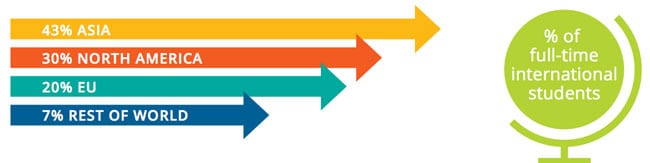
As the following chart reflects, Asia sends the largest share of students (43% as of 2017/18), followed by North America (30%), and the EU (20%).
Work rights a major draw
Ireland has generous post-study work right policies in place for non-EEA students completing higher-level studies in the country. International graduates of recognised degree programmes at Level 8 (undergraduate) or higher may apply for the Third Level Graduate Scheme which allows them to stay in Ireland for 12–24 months after they have completed their degree. Master’s degree, postgraduate diploma, and doctoral degree holders may remain in Ireland to two years. There are also opportunities for non-EU students to immigrate to Ireland once they are in the Third Level Graduate Employment Scheme as long as they receive a job offer that meets certain conditions. ESRI notes that “2,090 non-EEA students were granted permission to stay under the Third Level Graduate Programme in 2017, up from around 650 in 2012.” A 2018 HEA study, The Internationalisation of Higher Education, which combined survey data and interviews with directors of international offices, faculty and both international and Irish students to arrive at a multi-perspective exploration of internationalisation in Irish higher education, found that in addition to work rights, the main draws for international students choosing Ireland were:
“Ireland’s location in Europe, tuition fees which are cheaper than in other English-speaking countries, and the ease of application through institutional websites” as factors that “gave Ireland advantages over other countries.”
Potential barriers to growth
Sarah Groarke, lead author of ESRI’s Attracting and Retaining International Students report, notes that, “Ireland is successfully attracting and retaining increased numbers of higher-level non-EEA students. However, our report highlights obstacles persist for some students including delays in immigration registration, securing affordable student accommodation and transition to employment after graduation.” The issues regarding employment, the ESRI study found, include:
- Employers not always being aware that non-EEA students are entitled to work under the Third Level Graduate Programme;
- A minimum wage threshold set for non-EEA students in order for them to obtain work permits.
Non-EEA students also reported some anxiety regarding delays and difficulties associated with renewing their resident permits at Irish immigration offices.
Students are happy
On the whole, international students in Ireland are happy to have chosen the country for their education. i-graduate International Student Barometer has found that Ireland is performing better than the global average in terms of student satisfaction in a number of areas, including the welcoming and supportive environment that visiting students find in the country: “The majority of students were very happy with the social aspects of their experience which included the availability of facilities, friendships and contacts. They were also very satisfied with their day to day experiences of living in Ireland.” For additional background, please see:
Most Recent
-
Breaking: US Department of Homeland Security publishes rule to end Duration of Status for international students Read More

-
Joint sector alert sends a clear compliance message to Australian higher education and VET providers Read More
-
Academic support and learning resources in TNE: Delivering student success across borders Read More