Canada announces international student enrolment cap levels for 2025




- The Canadian government is reducing the number of study permits it will issue in 2025 by 10% compared with 2024
- It has just announced the maximum number of permits it will process from each Canadian province this year
The Canadian government has just released information about its target caps for study permit issuance for 2025 and a breakdown of how those targets will be distributed across the country according to the Provincial Attestation Letter (PAL) formula introduced in 2024. Since the introduction of caps on new international students last year, students (with some exceptions) have had to include a PAL with their study permit application, and each province receives an allocation of PALs they can distribute among their Designated Learning Institutions (DLIs).
Study permit targets for 2025
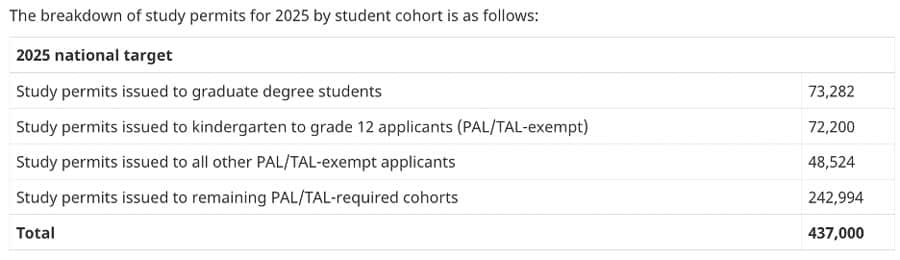
For 2025, the government plans to issue a total of 437,000 new study permits, a 10% reduction compared to the overall cap level of 485,000 permits for 2024. Some of those study permits will go to students exempt from the cap (K-12 students, exchange students, students with study permits applying for extensions at the same institution) and some will be specifically reserved for graduate students, which are now factored in the cap as well.
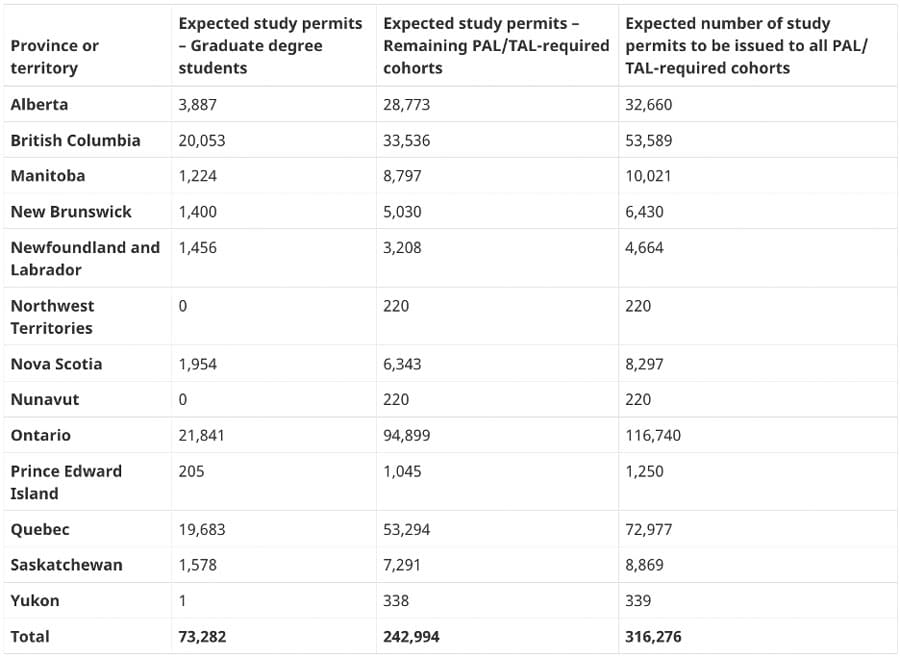
Overall, 316,276 of the 437,000 study permits will go to students who must apply with a PAL. That includes college students, undergraduate students, language students, students in graduate diploma programmes, and master’s and doctoral programmes. Those segments make up most of the applications submitted every year to study in Canada.
These are the broad cap allocations for study permit issuance by type of student for 2025:
And these are the targets broken down by province:
Breakdown of PAL allocations
So far, we have covered the target for approved study permits in 2025. Now we’ll move on to the allocation of PALs. The table below essentially shows the maximum number of PAL-required student applications allowed per province, i.e., the number of applications that Immigration, Refugees, and Citizenship Canada (IRCC) will process per province. As you can see, some of the PALs (about 17%) are reserved for master’s and doctoral students.
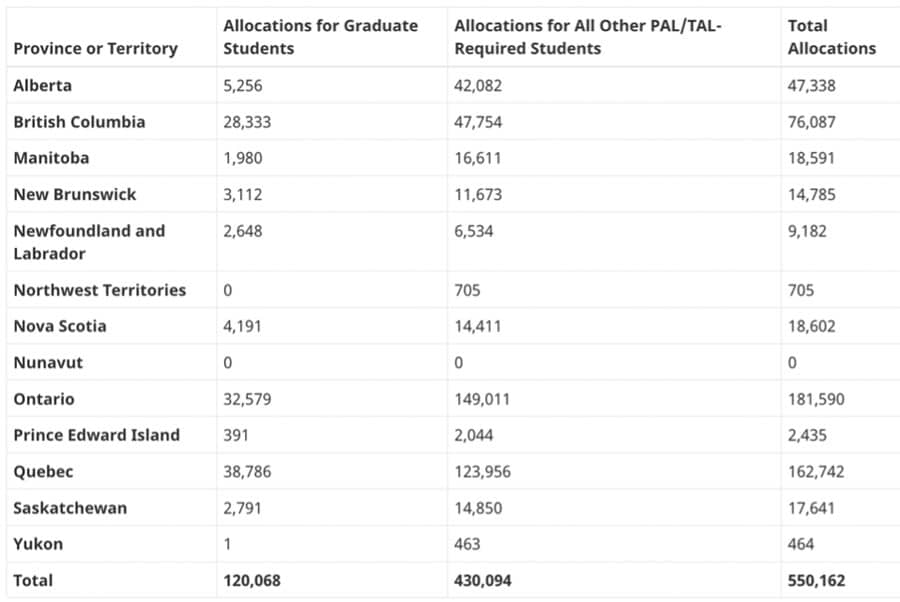
Most will go to postsecondary students
In Ontario, the Canadian province with the most international students, the provincial government intends to allocate 96% of its PALs to public postsecondary institutions, with only 4% going to language schools and zero going to private colleges. The Ministry of Colleges and Universities stated: “All public institutions will receive at least the same number of applications as they used in 2024.”
Nolan Quinn, Ontario minister of colleges and universities, said: “As we have been from the beginning, our government is laser focused on ensuring students in Ontario receive the skills they need to succeed in industries that address our province’s labour market needs.”
Of Ontario’s 181,000 allocations, 32,000 will be reserved for master’s and doctoral students.
Last year’s cap led to roughly half as many applications approved as in 2023
In 2024, the number of approved study permits fell by about 45%, according to a recent analysis from ApplyBoard, and based on a 50% average approval rate for submitted study permit applications up to October 2024.
As the enrolment cap – and related policies around post-study work eligibility and more – were being introduced throughout 2024, many observers suggested that the government response was an overcorrection. These latest estimates for 2024 study permit issuances appear to bear that out. Indeed, the new policy environment has introduced sufficient confusion into the marketplace and otherwise dampened student interest that actual study permit volumes for 2024 appear likely to fall below the cap level for the year.
For insights about how the Canadian international education sector has responded to the new policy settings, please see IDP’s recently released Canada Sector Survey whitepaper.
For additional background, please see:
Most Recent
-
Breaking: US Department of Homeland Security publishes rule to end Duration of Status for international students Read More

-
Joint sector alert sends a clear compliance message to Australian higher education and VET providers Read More
-
Academic support and learning resources in TNE: Delivering student success across borders Read More